
We read your photo as:
Explain the properties of subatomic particles and their interactions.
Chemistry
ScanSolve AI Answer
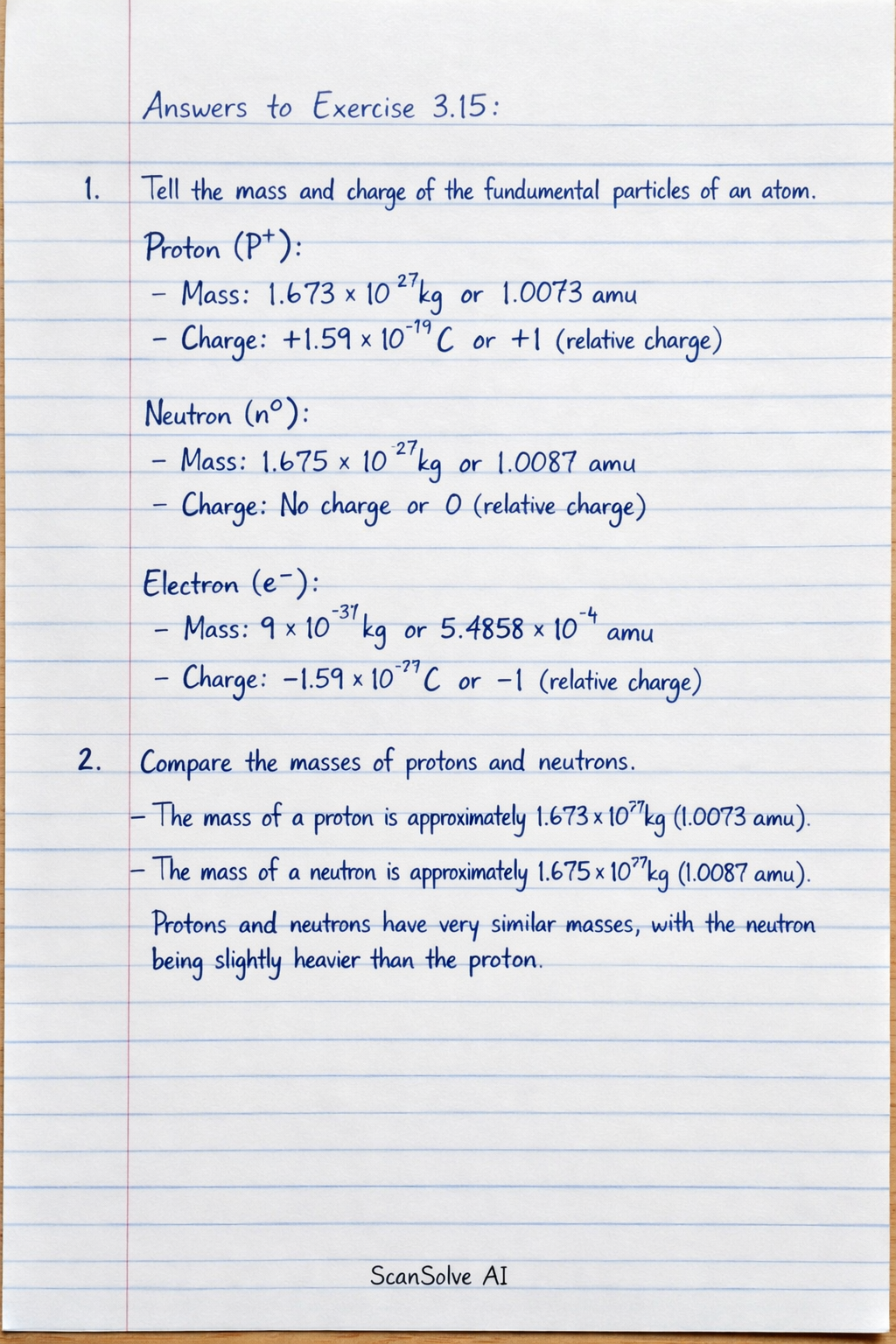
here are the answers to .15:
-
Tell the mass and charge of the fundamental particles of an atom.
- Proton (P):
- Mass: kg or 1.0073 amu
- Charge: C or (relative charge)
- Neutron (n):
- Mass: kg or 1.0087 amu
- Charge: No charge or 0 (relative charge)
- Electron (e):
- Mass: kg or amu
- Charge: C or (relative charge)
- Proton (P):
-
Compare the masses of protons and neutrons.
- The mass of a proton is approximately kg (1.0073 amu).
- The mass of a neutron is approximately kg (1.0087 amu).
- Protons and neutrons have very similar masses, with the neutron being slightly heavier than the proton.
-
Compare the charges of electrons and protons.
- The charge of a proton is C (relative charge ).
- The charge of an electron is C (relative charge ).
- Protons and electrons have charges of equal magnitude but opposite signs.
-
Neutrons are neither attracted to nor repelled from the objects; they don't interact with protons or electrons. Explain?
- Neutrons have no electric charge (relative charge 0). Electrostatic forces of attraction or repulsion only occur between charged particles. Since neutrons are electrically neutral, they do not experience these forces and therefore do not interact electromagnetically with charged particles like protons and electrons.
-
Why is the mass of an atom depends only on the mass of protons and neutrons?
- The mass of an electron ( kg) is significantly smaller than the mass of a proton ( kg) or a neutron ( kg). Specifically, an electron's mass is about of a proton's mass. Due to this negligible mass contribution, the total mass of an atom is primarily determined by the sum of the masses of its protons and neutrons, which are located in the nucleus.
Was this helpful?
Still stuck on this one?
Ask a follow-up, and the answer starts from this question.
Got a different question?Ask your own question
More Chemistry Questions
QProvide definitions for atoms, elements, periodic table, and sub-atomic particles, and describe the…QExplain the structure of an atom, including its subatomic particles, their locations, and the…QWhat are the subatomic particles of an atom? Define key atomic terms and fill in a table about…QWhich of the following statements correctly describes the behavior of subatomic particles in an…QTwo subatomic particles and their respective electric charges are:
Handwritten Step-by-Step Solution
Get this as a handwritten image on WhatsApp — like a tutor wrote it for you.
Try on WhatsApp