
We read your photo as:
Which of the following statements correctly describes the behavior of subatomic particles in an electric field?
Physics
ScanSolve AI Answer
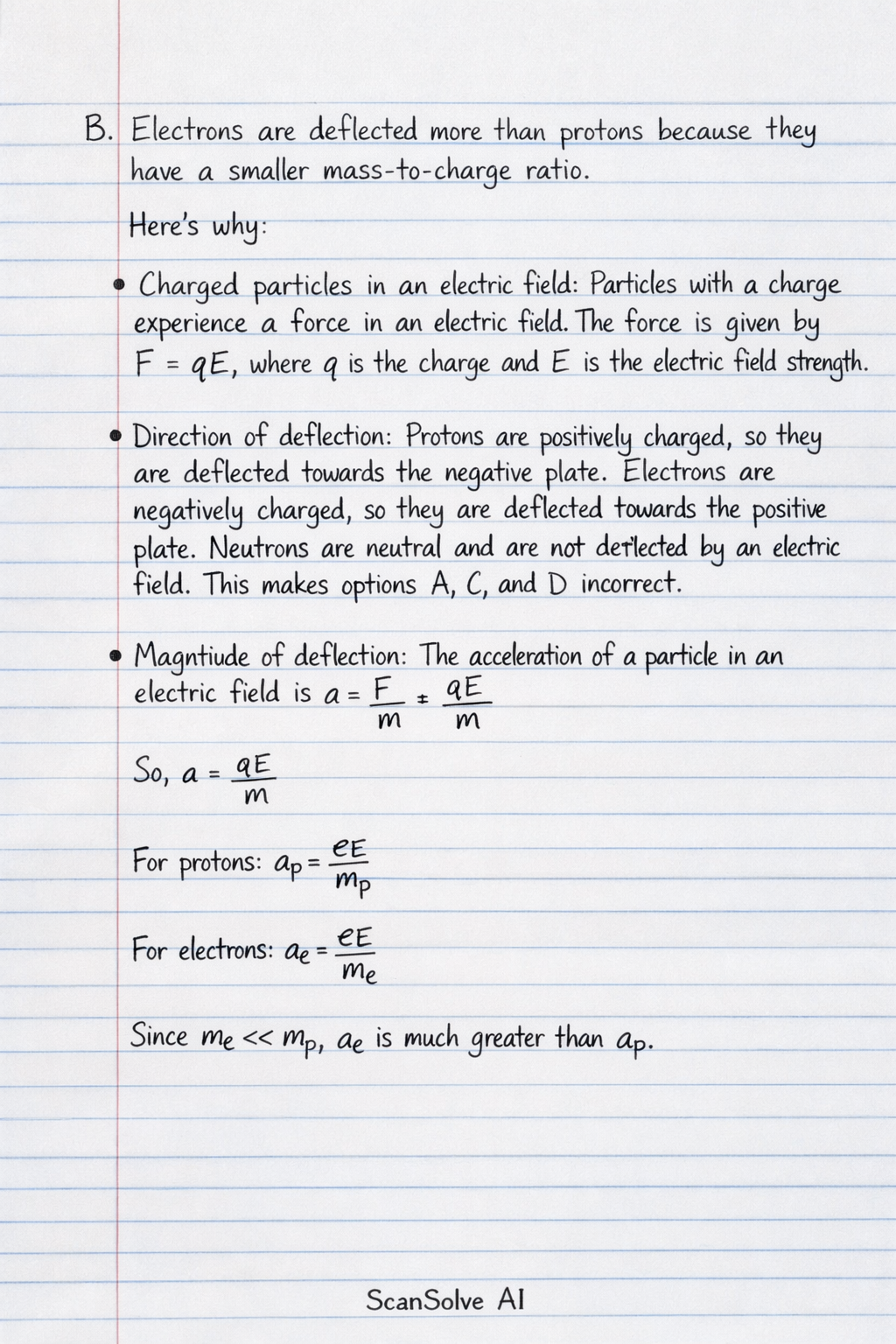
B. Electrons are deflected more than protons because they have a smaller mass-to-charge ratio.
Here's why:
- Charged particles in an electric field: Particles with a charge experience a force in an electric field. The force is given by , where is the charge and is the electric field strength.
- Direction of deflection: Protons are positively charged, so they are deflected towards the negative plate. Electrons are negatively charged, so they are deflected towards the positive plate. Neutrons are neutral and are not deflected by an electric field. This makes options A, C, and D incorrect regarding the direction or magnitude of deflection.
- Magnitude of deflection: The acceleration of a particle in an electric field is . The deflection is proportional to this acceleration. Both protons and electrons have charges of equal magnitude (), but the mass of an electron () is significantly smaller than the mass of a proton ().
- Mass-to-charge ratio: The mass-to-charge ratio for an electron () is much smaller than for a proton (). A smaller mass-to-charge ratio means a larger charge-to-mass ratio (). A larger charge-to-mass ratio results in a greater acceleration and thus a greater deflection for the same electric field strength. Therefore, electrons are deflected more than protons.
Was this helpful?
Still stuck on this one?
Ask a follow-up, and the answer starts from this question.
Got a different question?Ask your own question
More Physics Questions
QWhich of the following statements about electric charge is true?QExplain the properties of subatomic particles and their interactions.QTwo subatomic particles and their respective electric charges are:QWork done on a charge particle moving in a uniform magnetic field isQIs electric field a scalar quantity
Browse by topic:Electromagnetism
Handwritten Step-by-Step Solution
Get this as a handwritten image on WhatsApp — like a tutor wrote it for you.
Try on WhatsApp