
We read your photo as:
Is there a mistake in the problem statement? In question 4.1, B is (-8; 1), but to show that M is (-4; 3), B must be (-8; -2). Also, DA is a tangent to the circle at A, and D(3; -1), but if M(-4; 3) a
Mathematics
ScanSolve AI Answer
Here's a step-by-step solution to the problem.
Important Note on Discrepancies:
There are inconsistencies in the problem statement:
- The text states B(-8; 1), but to "show that" M is (-4; 3) in question 4.1, B must be (-8; -2). We will proceed with B(-8; -2) to satisfy 4.1.
- The text states "DA is a tangent to the circle at A" and gives D(3; -1). However, if M(-4; 3) and A(0; 8), the line through A and D is not perpendicular to the radius MA. We will assume the primary definition: the tangent at
Was this helpful?
Still stuck on this one?
Ask a follow-up, and the answer starts from this question.
Got a different question?Ask your own question
More Mathematics Questions
QPoints A(−8,2), B(−2,−6) and D(0,8) are vertices of a triangle that lie on the circumference of a…QShow that the coordinates of M, the midpoint of AB, are (−4, 3), given points A = (−12, −1) and B…QIn the diagram below, a circle with the centre at A (−3; −1) and a tangent CD to the circle at point…QGiven points A(−2, 3), B(−6, 1), C(12, −1), and D(4, −5), show that vectors AB and CD are parallel…QProve that the points A(9,1), B(4,13), C(−8,8), and D(−3,−4) form a square.
Browse by topic:Geometry
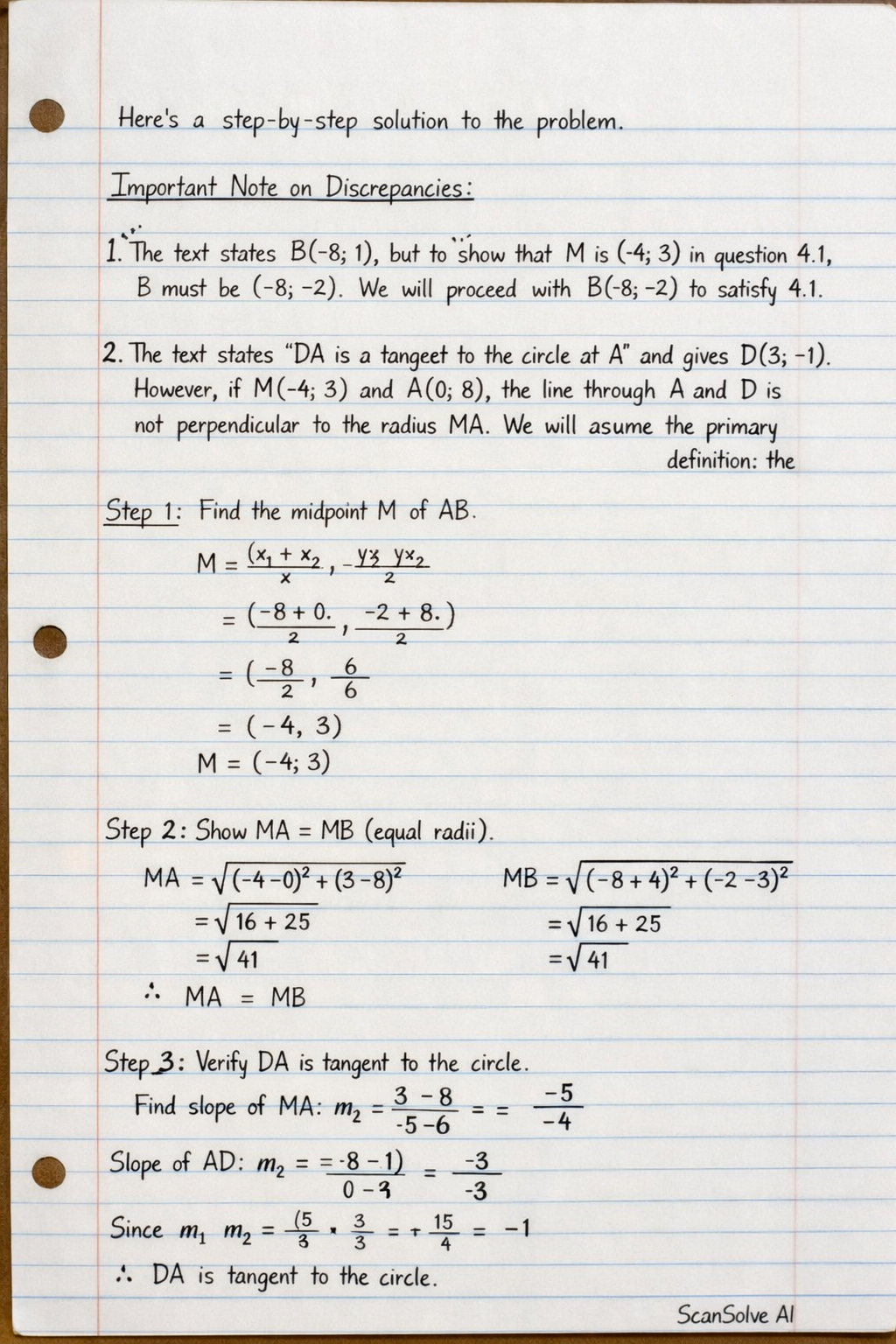
Handwritten Step-by-Step Solution
Get this as a handwritten image on WhatsApp — like a tutor wrote it for you.
Try on WhatsApp