
We read your photo as:
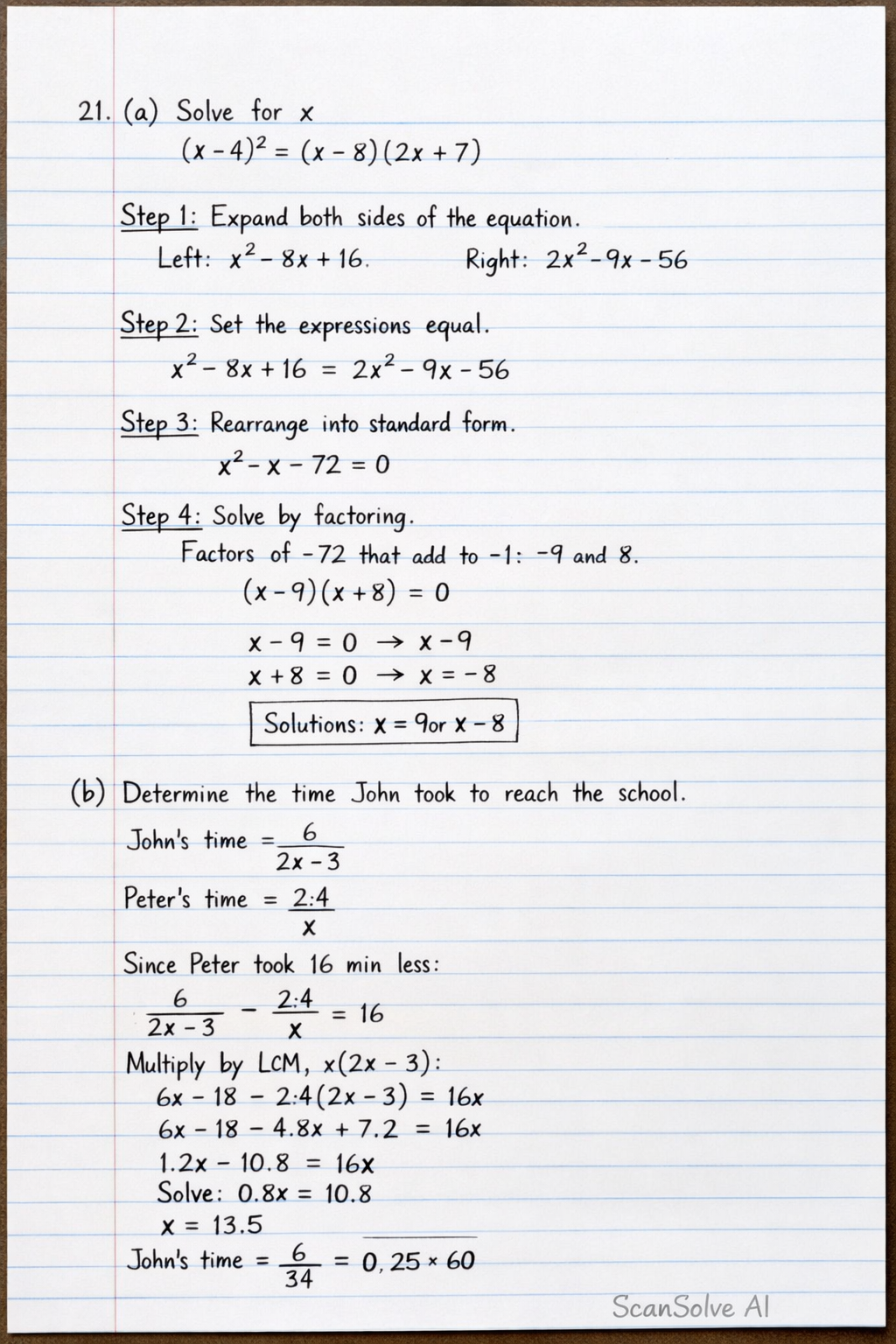
John cycled 6 km from his home to school at an average speed of (2x-3) km/h. Peter walked 2.4 km from his home to the school at an average speed of x km/h. Peter took 16 minutes less than John. Determine the time, in minutes, that John took to reach the school.
ScanSolve AI Answer
Answers
2 partsStep-by-step solution
9 stepsPart a· 4 steps
Solve for .
We are given the equation:
Expand both sides of the equation.
The left side is .
The right side is .Set the expanded expressions equal to each other.
Rearrange the equation to the standard quadratic form .
Solve the quadratic equation by factoring.
We need two numbers that multiply to -72 and add to -1. These numbers are -9 and 8.
Therefore, the possible values for are:
The solutions are .
Part b
Determine the time, in minutes, that John took to reach the school.
Write expressions for the time taken by John and Peter.
Time is calculated as .
For John:
Distance km
Speed km/h
Time hoursFor Peter:
Distance km
Speed km/h
Time hoursFormulate an equation based on the given time difference.
Peter took 16 minutes less than John. Convert 16 minutes to hours: hours.
So, .Solve the equation for .
Multiply the entire equation by the common denominator to eliminate fractions.
Rearrange into a standard quadratic equation :
Divide by 2 to simplify:
Use the quadratic formula :
Two possible values for :
Since speed cannot be negative, km/h is the valid speed for Peter. Also, John's speed km/h, which is positive.
Calculate the time John took () using .
Convert John's time from hours to minutes.
John took to reach the school.
Try one yourself
A new problem that tests the same skill.
Still stuck on this one?
Ask a follow-up, and the answer starts from this question.
More Mathematics Questions
Handwritten Step-by-Step Solution
Get this as a handwritten image on WhatsApp — like a tutor wrote it for you.
Try on WhatsApp