
We read your photo as:
Jose had 200 buckets, and each bucket had a mass of 20 kg. The mass decreased in the ratio 29:32. What was the total mass lost?
Mathematics
ScanSolve AI Answer
Answer
Step-by-step solution
3 stepsCalculate the total initial mass of water.
Jose had 200 buckets, and each bucket had a mass of 20 kg.
Determine the fraction of mass lost due to evaporation.
The mass decreased in the ratio 29:32. This means that the new mass is of the original mass.
The fraction of mass lost is the difference between the original fraction (1) and the remaining fraction:Calculate the total mass lost.
Multiply the total initial mass by the fraction of mass lost.
The final answer is .
Was this helpful?
Try one yourself
A new problem that tests the same skill.
Still stuck on this one?
Ask a follow-up, and the answer starts from this question.
Got a different question?Ask your own question
More Mathematics Questions
Q800 jerrycans fill a tank. One jerrycan weighs 20 kg. How many litres does the tank hold? A bucket…QA person carries a bucket of water of mass 20 kg for a distance of 10 m. Calculate the work done.QConvert 36000 seconds to hours and solve a ratio problem with total mass 8 kg.QSolve the following multiplication problems: 27. 15.78 kg x 25, 28. 3.58 × 2.9, 29. ksh. 25.25 × 8.6…QThe figure M shows a cylindrical bucket of diameter 28cm and height 100cm while figure N shows a jug…
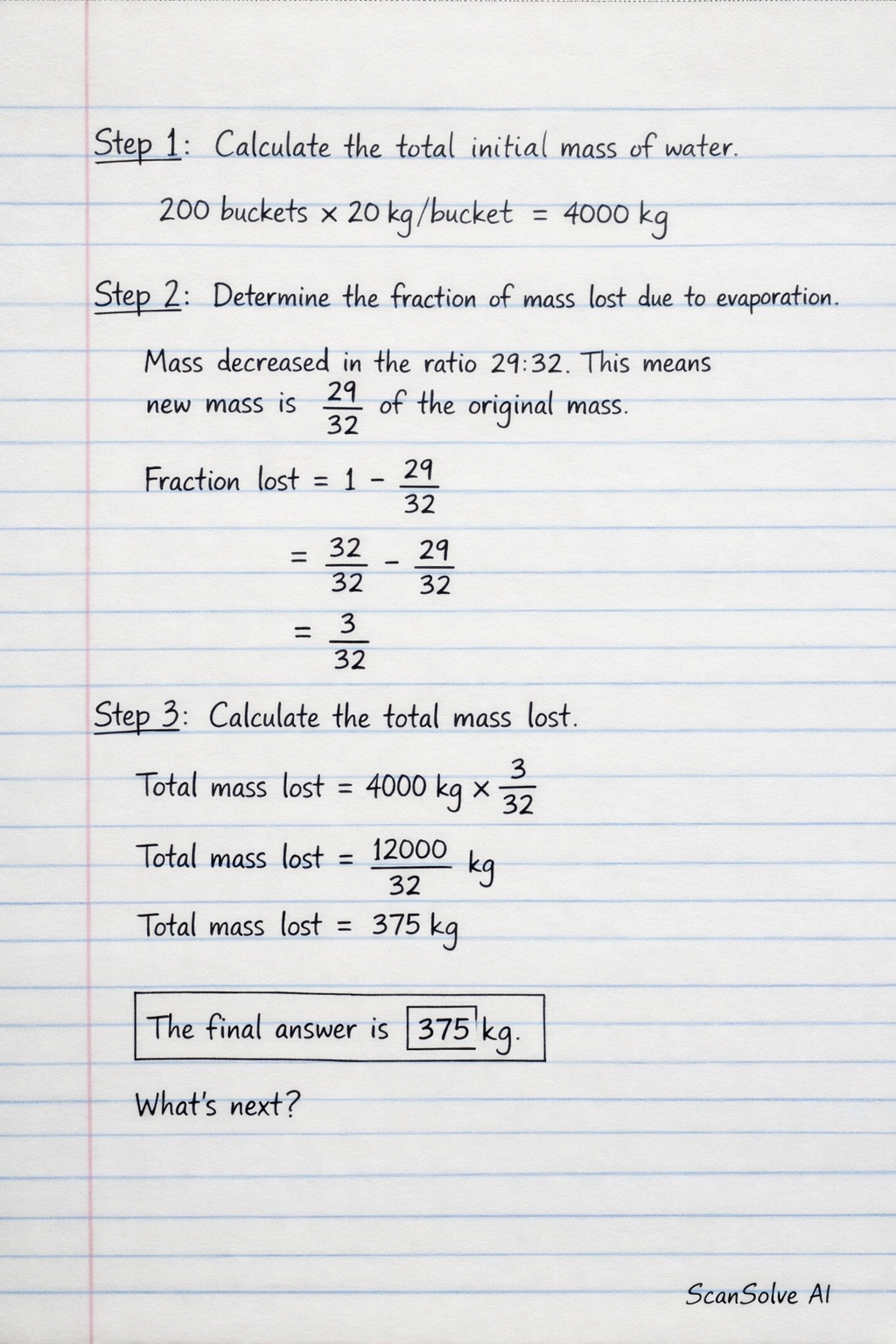
Handwritten Step-by-Step Solution
Get this as a handwritten image on WhatsApp — like a tutor wrote it for you.
Try on WhatsApp