

This mathematics problem involves applying core mathematical principles and formulas. Below you will find a complete step-by-step solution with detailed explanations for each step, helping you understand not just the answer but the method behind it.
ScanSolve AI Answer
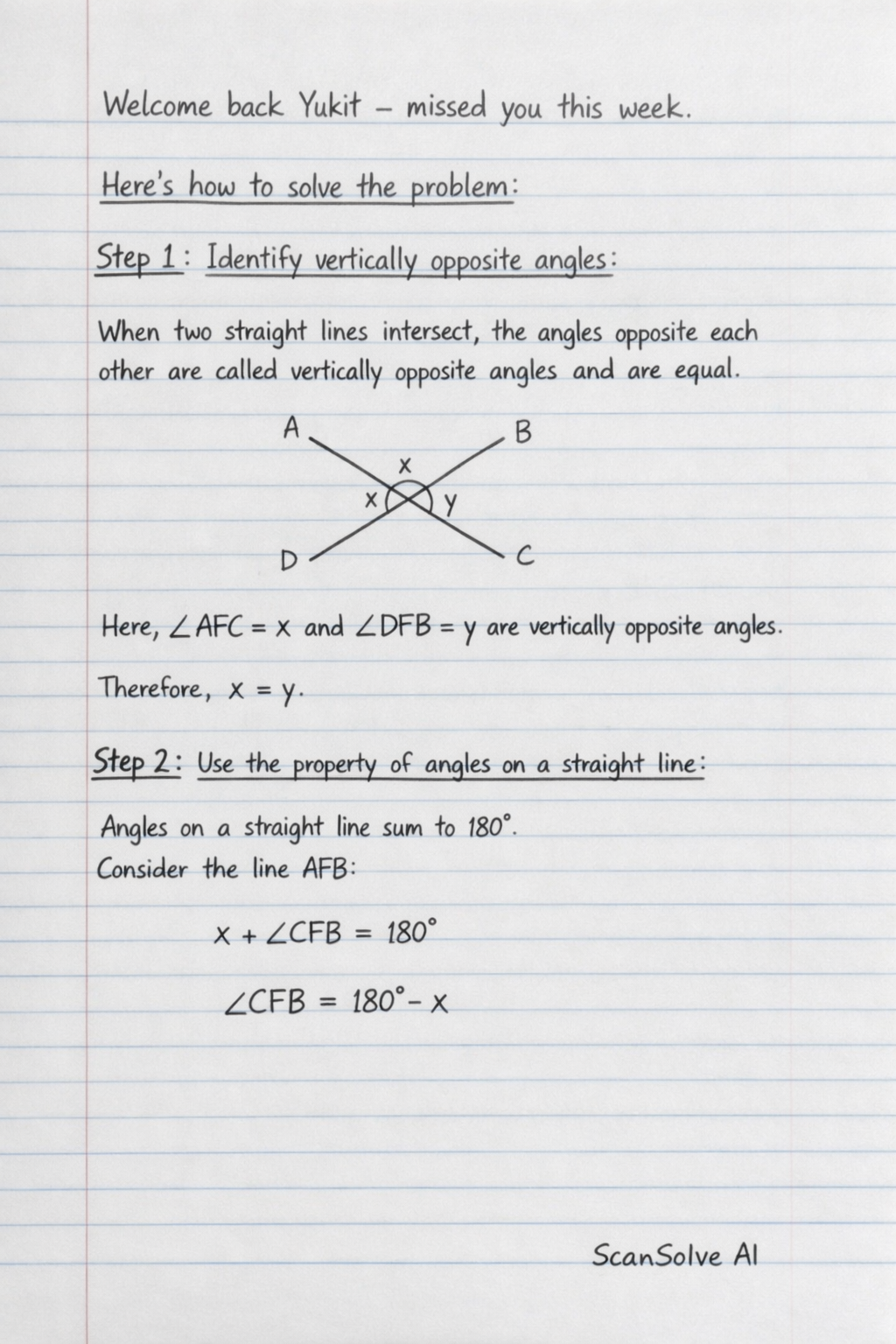
Here's how to solve the problem: Step 1: Identify vertically opposite angles. When two straight lines intersect, the angles opposite each other are called vertically opposite angles and are equal. In this diagram, lines AFB and CFD intersect at F. Angle AFC (x) and Angle DFB (y) are vertically opposite angles. Therefore, x = y Step 2: Use the property of angles on a straight line. Angles on a straight line sum to 180^. Consider the straight line AFB. Angle AFC (x) and Angle CFB are adjacent angles on this line. So, x + Angle CFB = 180^ This means Angle CFB = 180^ - x Step 3: Relate the given angle to the angles found. We are given that Angle EFB is 54^. From the diagram, Angle CFB is composed of Angle CFE and Angle EFB. However, a more direct relationship can be observed: Angle CFB and Angle EFB are adjacent angles, and Angle DFB (y) is composed of Angle DFE and Angle EFB. Looking at the diagram, Angle EFB (54^) and Angle AFD are vertically opposite angles. This is a common interpretation in such diagrams where a ray intersects two straight lines. If Angle EFB and Angle AFD are vertically opposite, then: Angle AFD = 54^ Step 4: Calculate x and y. Angle AFC (x) and Angle AFD are adjacent angles on the straight line CFD. So, x + Angle AFD = 180^ Substitute the value of Angle AFD: x + 54^ = 180^ x = 180^ - 54^ x = 126^ Since x = y (from Step 1), y = 126^ The values are: x = 126^ y = 126^ Send me the next one 📸