
We read your photo as:
Find L[3 t] and L[3 t]
ScanSolve AI Answer
Step-by-step solution
22 stepsHere are the solutions to problems 11, 12, 13, 14, and 15:
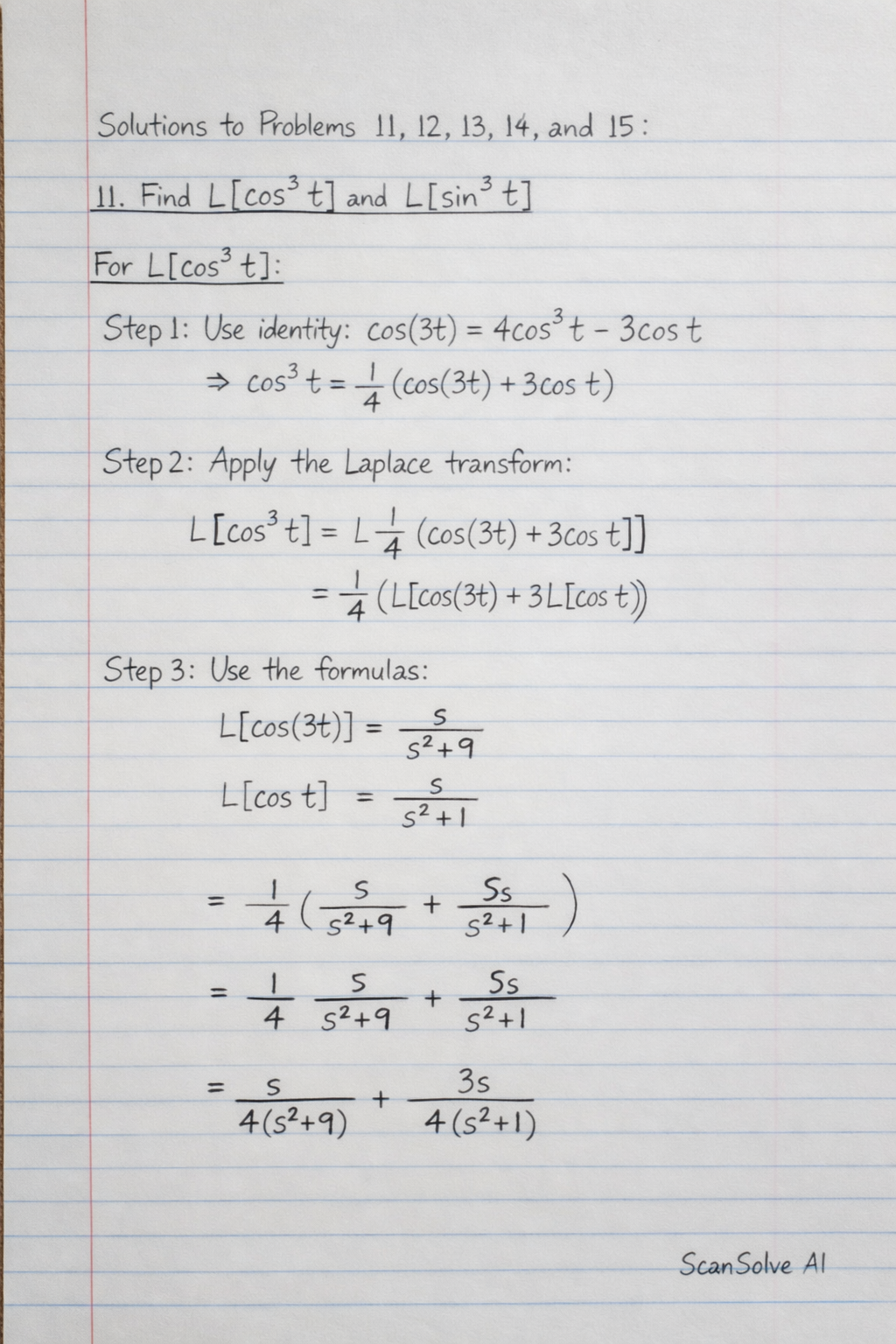
11. Find and
- For :
Use the trigonometric identity .
Rearrange to express $\cos^3 t$: $$ \cos^3 t = \frac{1}{4}(\cos(3t) + 3\cos t) $$Apply the Laplace transform using linearity.
$$ L[\cos^3 t] = L\left[\frac{1}{4}(\cos(3t) + 3\cos t)\right] $$ $$ L[\cos^3 t] = \frac{1}{4}(L[\cos(3t)] + 3L[\cos t]) $$Use the standard Laplace transform formula .
$$ L[\cos(3t)] = \frac{s}{s^2+3^2} = \frac{s}{s^2+9} $$ $$ L[\cos t] = \frac{s}{s^2+1^2} = \frac{s}{s^2+1} $$Substitute and simplify.
$$ L[\cos^3 t] = \frac{1}{4}\left(\frac{s}{s^2+9} + 3\frac{s}{s^2+1}\right) $$ $$ L[\cos^3 t] = \frac{s}{4}\left(\frac{1}{s^2+9} + \frac{3}{s^2+1}\right) $$ $$ L[\cos^3 t] = \frac{s}{4}\left(\frac{s^2+1 + 3(s^2+9)}{(s^2+9)(s^2+1)}\right) $$ $$ L[\cos^3 t] = \frac{s}{4}\left(\frac{s^2+1 + 3s^2+27}{(s^2+9)(s^2+1)}\right) $$ $$ L[\cos^3 t] = \frac{s}{4}\left(\frac{4s^2+28}{(s^2+9)(s^2+1)}\right) $$ $$ L[\cos^3 t] = \frac{s(s^2+7)}{(s^2+9)(s^2+1)} $$ $$ L[\cos^3 t] = \boxed{\frac{s(s^2+7)}{(s^2+1)(s^2+9)}} $$- For :
Use the trigonometric identity .
Rearrange to express $\sin^3 t$: $$ \sin^3 t = \frac{1}{4}(3\sin t - \sin(3t)) $$Apply the Laplace transform using linearity.
$$ L[\sin^3 t] = L\left[\frac{1}{4}(3\sin t - \sin(3t))\right] $$ $$ L[\sin^3 t] = \frac{1}{4}(3L[\sin t] - L[\sin(3t)]) $$Use the standard Laplace transform formula .
$$ L[\sin t] = \frac{1}{s^2+1^2} = \frac{1}{s^2+1} $$ $$ L[\sin(3t)] = \frac{3}{s^2+3^2} = \frac{3}{s^2+9} $$Substitute and simplify.
$$
L[\sin^3 t] = \frac{1}{4}\left(3\frac{1}{s^2+1} - \frac{3}{s^2+9}\right)
$$
$$
L[\sin^3 t] = \frac{3}{4}\left(\frac{1}{s^2+1} - \frac{1}{s^2+9}\right)
$$
$$
L[\sin^3 t] = \frac{3}{4}\left(\frac{(s^2+9) - (s^2+1)}{(s^2+1)(s^2+9)}\right)
$$
$$
L[\sin^3 t] = \frac{3}{4}\left(\frac{s^2+9 - s^2-1}{(s^2+1)(s^2+9)}\right)
$$
$$
L[\sin^3 t] = \frac{3}{4}\left(\frac{8}{(s^2+1)(s^2+9)}\right)
$$
$$
L[\sin^3 t] = \frac{6}{(s^2+1)(s^2+9)}
$$
$$
L[\sin^3 t] = \boxed{\frac{6}{(s^2+1)(s^2+9)}}
$$
12. Find
This is a direct application of a standard inverse Laplace transform formula.
Recall the Laplace transform of the hyperbolic sine function:
Therefore, the inverse Laplace transform is
13. Find
Identify the form of the expression.
It resembles .
Here, and , so .Adjust the numerator to match the required form for .
Apply the inverse Laplace transform using the shifting property .
We know .
So, .Combine the results.
14. Find
Use the product-to-sum trigonometric identity
.
Let and .Apply the Laplace transform using linearity.
Use the standard Laplace transform formula .
Substitute and simplify.
15. Find
Complete the square in the denominator.
Rewrite the expression using the completed square.
This expression is of the form where .
Let .
Then the given expression is .
We need to find .
From , we know that .
For :Apply the shifting property .
Here, and .
Still stuck on this one?
Ask a follow-up, and the answer starts from this question.
More Mathematics Questions
Handwritten Step-by-Step Solution
Get this as a handwritten image on WhatsApp — like a tutor wrote it for you.
Try on WhatsApp