
We read your photo as:
Find the least number which must be added to 525 and 1750 to make them a perfect square. Also, find the square root of the perfect squares so obtained.
ScanSolve AI Answer
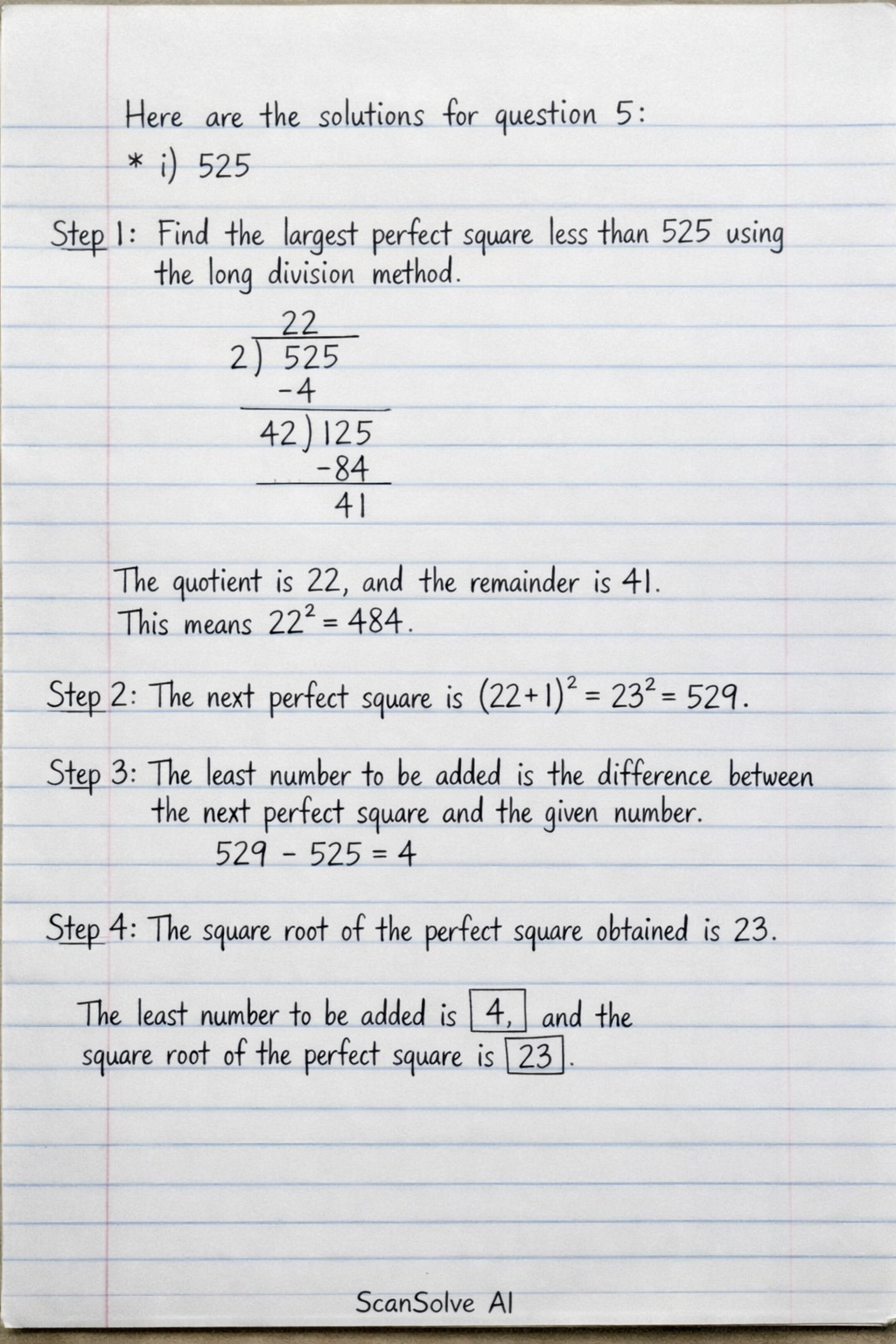
i) 525
Step 1: Find the largest perfect square less than 525 using the long division method.
The quotient is 22, and the remainder is 41. This means .
Step 2: The next perfect square is .
Step 3: The least number to be added is the difference between the next perfect square and the given number.
Step 4: The square root of the perfect square obtained is 23.
The least number to be added is , and the square root of the perfect square is .
ii) 1750
Step 1: Find the largest perfect square less than 1750 using the long division method.
The quotient is 41, and the remainder is 69. This means .
Step 2: The next perfect square is .
Step 3: The least number to be added is the difference between the next perfect square and the given number.
Step 4: The square root of the perfect square obtained is 42.
The least number to be added is , and the square root of the perfect square is .
iii) 252
Step 1: Find the largest perfect square less than 252 using the long division method.
The quotient is 15, and the remainder is 27. This means .
Step 2: The next perfect square is .
Step 3: The least number to be added is the difference between the next perfect square and the given number.
Step 4: The square root of the perfect square obtained is 16.
The least number to be added is , and the square root of the perfect square is .
iv) 1825
Step 1: Find the largest perfect square less than 1825 using the long division method.
The quotient is 42, and the remainder is 61. This means .
Step 2: The next perfect square is .
Step 3: The least number to be added is the difference between the next perfect square and the given number.
Step 4: The square root of the perfect square obtained is 43.
The least number to be added is , and the square root of the perfect square is .
v) 6412
Step 1: Find the largest perfect square less than 6412 using the long division method.
The quotient is 80, and the remainder is 12. This means .
Step 2: The next perfect square is .
Step 3: The least number to be added is the difference between the next perfect square and the given number.
Step 4: The square root of the perfect square obtained is 81.
The least number to be added is , and the square root of the perfect square is .
Still stuck on this one?
Ask a follow-up, and the answer starts from this question.
More Mathematics Questions
Handwritten Step-by-Step Solution
Get this as a handwritten image on WhatsApp — like a tutor wrote it for you.
Try on WhatsApp