
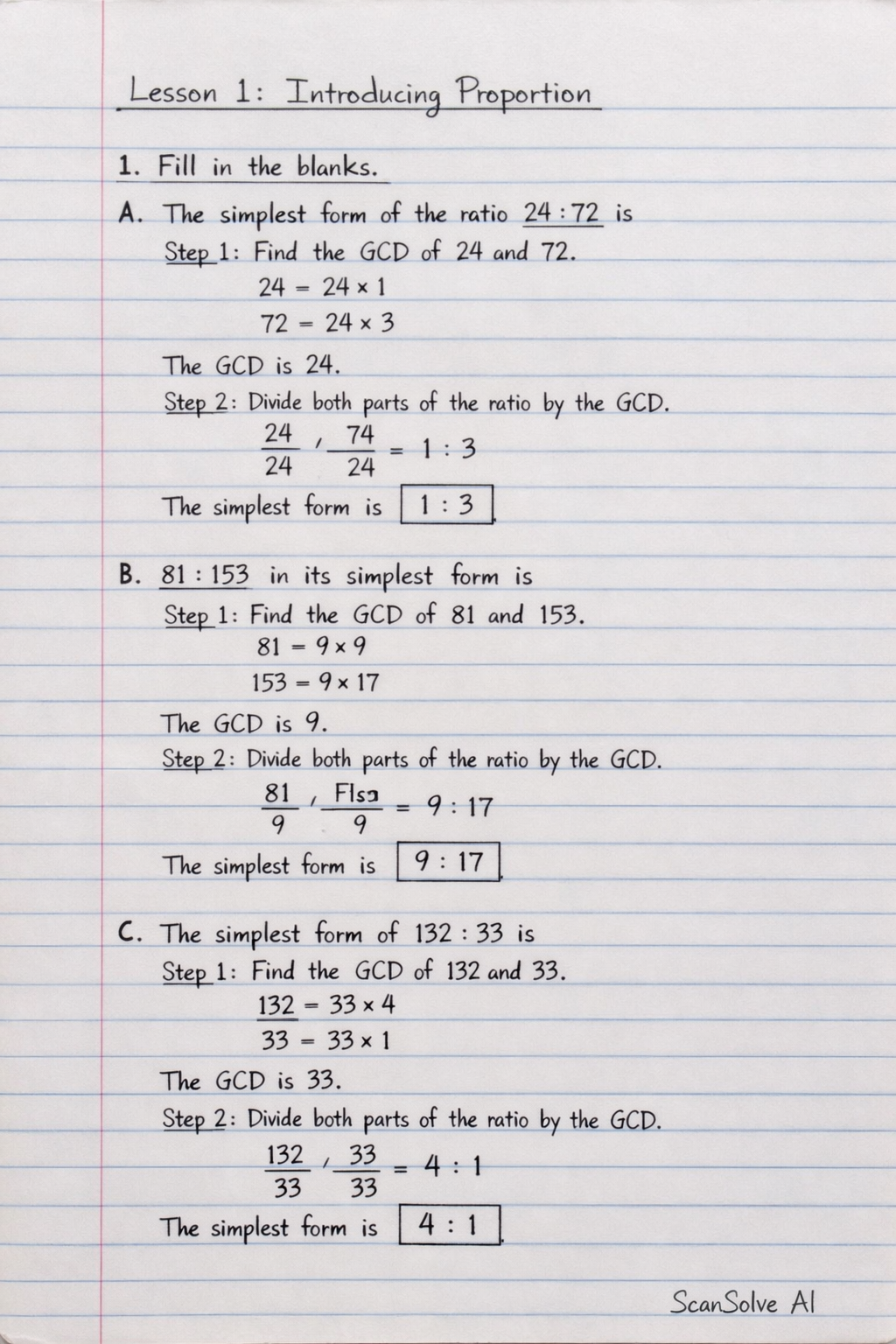
We read your photo as:
Write if true or false. A. The cost of 16 pineapples is ₹432. So, the cost of 1 pineapple is ₹26. B. 15 bottles of juice cost ₹225. The cost of 1 bottle of juice is ₹15.
ScanSolve AI Answer
Step-by-step solution
29 stepsLesson 1: Introducing Proportion
1. Fill in the blanks.
- A. The simplest form of the ratio 24:72 is
Find the greatest common divisor (GCD) of 24 and 72.
$$ 24 = 24 \times 1 $$ $$ 72 = 24 \times 3 $$ The GCD is 24.Divide both parts of the ratio by the GCD.
$$ \frac{24}{24} : \frac{72}{24} = 1:3 $$ The simplest form is $\boxed{\text{1:3}}$.- B. 81:153 in its simplest form is
Find the GCD of 81 and 153.
$$ 81 = 9 \times 9 $$ $$ 153 = 9 \times 17 $$ The GCD is 9.Divide both parts of the ratio by the GCD.
$$ \frac{81}{9} : \frac{153}{9} = 9:17 $$ The simplest form is $\boxed{\text{9:17}}$.- C. The simplest form of 132:33 is
Find the GCD of 132 and 33.
$$ 132 = 33 \times 4 $$ $$ 33 = 33 \times 1 $$ The GCD is 33.Divide both parts of the ratio by the GCD.
$$ \frac{132}{33} : \frac{33}{33} = 4:1 $$ The simplest form is $\boxed{\text{4:1}}$.2. Write if the ratios are in proportion or not.
To check for proportion, we compare the simplified forms of the ratios or cross-multiply.- A. 15:45 and 21:63
Simplify the first ratio.
$$ \frac{15}{45} = \frac{1}{3} $$Simplify the second ratio.
$$ \frac{21}{63} = \frac{1}{3} $$ Since $\frac{1}{3} = \frac{1}{3}$, the ratios are in proportion. The ratios are $\boxed{\text{in proportion}}$.- B. 14:15 and 56:60
Simplify the first ratio.
$$ \frac{14}{15} $$ This ratio is already in simplest form.Simplify the second ratio.
$$ \frac{56}{60} = \frac{56 \div 4}{60 \div 4} = \frac{14}{15} $$ Since $\frac{14}{15} = \frac{14}{15}$, the ratios are in proportion. The ratios are $\boxed{\text{in proportion}}$.- C. 20 L:100 mL and 50 L:250 L
Convert units for the first ratio to be consistent.
. Simplify the first ratio.
Simplify the second ratio.
$$ \frac{50 \text{ L}}{250 \text{ L}} = \frac{50 \div 50}{250 \div 50} = \frac{1}{5} $$ Since $\frac{200}{1} \neq \frac{1}{5}$, the ratios are not in proportion. The ratios are $\boxed{\text{not in proportion}}$.- D. 65 people:35 people and ₹600:₹300
Simplify the first ratio.
$$ \frac{65}{35} = \frac{65 \div 5}{35 \div 5} = \frac{13}{7} $$Simplify the second ratio.
$$ \frac{600}{300} = \frac{2}{1} $$ Since $\frac{13}{7} \neq \frac{2}{1}$, the ratios are not in proportion. The ratios are $\boxed{\text{not in proportion}}$.3. Ryan bought 16 bananas for ₹120 and Kate bought 18 bananas for ₹144. Did they buy the bananas at the same price? Write yes or no.
Calculate the price per banana for Ryan.
Calculate the price per banana for Kate.
Compare the prices.
Since ₹7.50 ₹8.00, they did not buy the bananas at the same price.
The answer is .Lesson 2: Proportional Terms
1. Write 3 equivalent ratios for 7:12.
To find equivalent ratios, multiply both terms by the same non-zero number.Multiply by 2.
Multiply by 3.
Multiply by 4.
Three equivalent ratios are .
2. Find out if the ratios are in proportion by comparing the product of the means and the product of the extremes. If they are, write them in proportion.
For , they are in proportion if .- A. 7:14 and 6:12
Identify extremes and means.
Extremes are 7 and 12. Means are 14 and 6.
Calculate the product of the extremes.
$$ 7 \times 12 = 84 $$Calculate the product of the means.
$$ 14 \times 6 = 84 $$ Since $84 = 84$, the ratios are in proportion. In proportion: $\boxed{7:14::6:12}$.- B. 5:8 and 25:40
Identify extremes and means.
Extremes are 5 and 40. Means are 8 and 25.
Calculate the product of the extremes.
$$ 5 \times 40 = 200 $$Calculate the product of the means.
$$ 8 \times 25 = 200 $$ Since $200 = 200$, the ratios are in proportion. In proportion: $\boxed{5:8::25:40}$.- C. 9:12 and 99:112
Identify extremes and means.
Extremes are 9 and 112. Means are 12 and 99.
Calculate the product of the extremes.
$$ 9 \times 112 = 1008 $$Calculate the product of the means.
$$
12 \times 99 = 1188
$$
Since $1008 \neq 1188$, the ratios are not in proportion.
The ratios are
Still stuck on this one?
Ask a follow-up, and the answer starts from this question.
More Mathematics Questions
Handwritten Step-by-Step Solution
Get this as a handwritten image on WhatsApp — like a tutor wrote it for you.
Try on WhatsApp