
We read your photo as:
Lesson 1: Round off to the nearest thousandth. Do these: (1) 13.48, (2) 7.123, (3) 14.46, (4) 9.369, (5) 0.887, (6) 0.946, (7) 0.8122, (8) 7.687, (9) 0.9122, (10) 8.466
ScanSolve AI Answer
Step-by-step solution
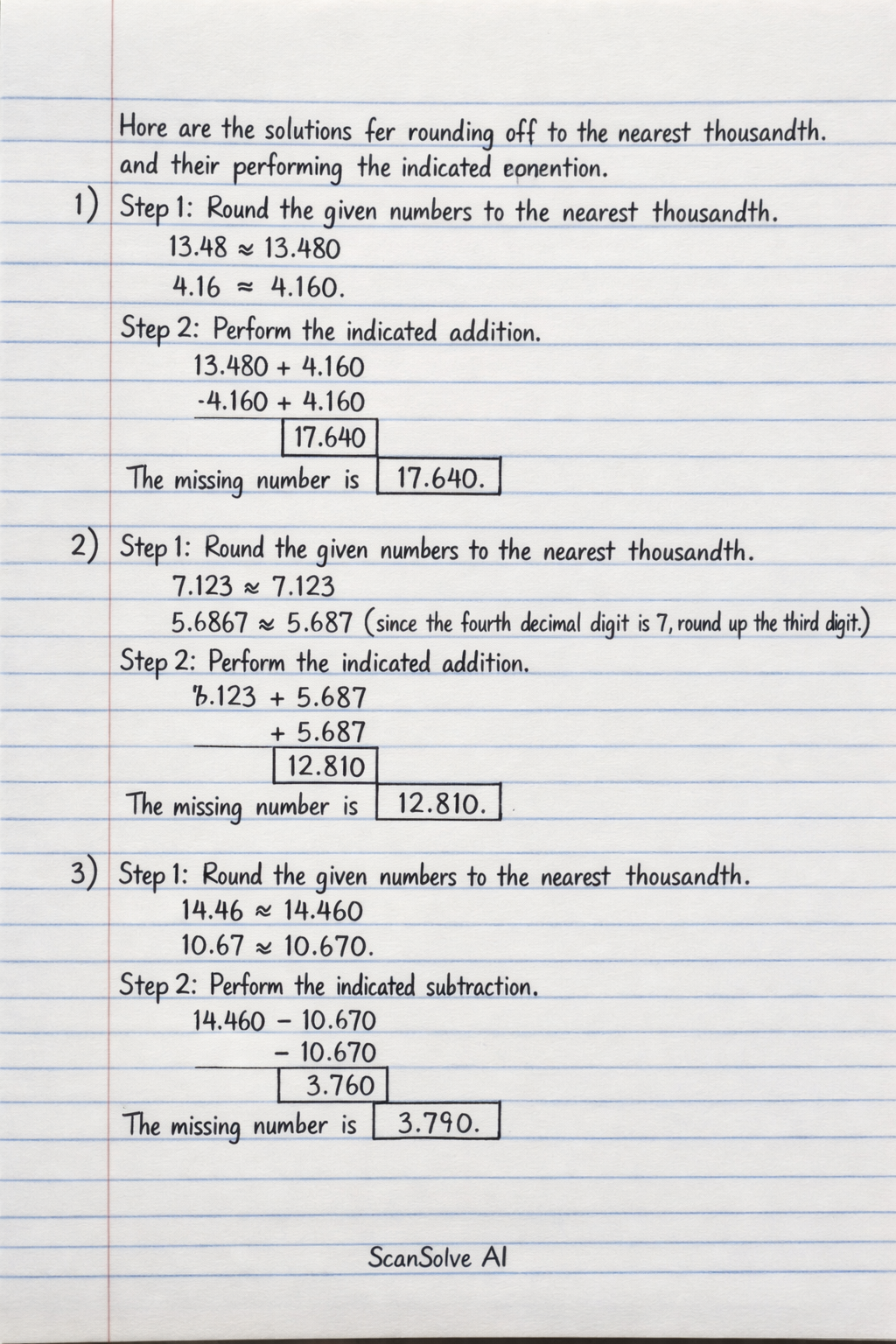
20 stepsHere are the solutions for rounding off to the nearest thousandth and then performing the indicated operation.
1)
Round the given numbers to the nearest thousandth.
Perform the indicated addition.
The missing number is .2)
Round the given numbers to the nearest thousandth.
(since the fourth decimal digit is 7, round up the third digit)Perform the indicated addition.
The missing number is .3)
Round the given numbers to the nearest thousandth.
Perform the indicated subtraction.
The missing number is .4)
Round the given numbers to the nearest thousandth.
(since the fourth decimal digit is 1, keep the third digit as is)Perform the indicated addition.
The missing number is .5)
Round the given numbers to the nearest thousandth.
(since the fourth decimal digit is 5, round up the third digit)Perform the indicated addition.
The missing number is .6)
Round the given numbers to the nearest thousandth.
Perform the indicated subtraction.
The missing number is .7)
Round the given numbers to the nearest thousandth.
(since the fourth decimal digit is 2, keep the third digit as is)
Perform the indicated addition.
The missing number is .8)
Round the given numbers to the nearest thousandth.
Perform the indicated subtraction.
The missing number is .9)
Round the given numbers to the nearest thousandth.
(since the fourth decimal digit is 2, keep the third digit as is)
Perform the indicated addition.
The missing number is .10)
Round the given numbers to the nearest thousandth.
Perform the indicated subtraction.
The missing number is .
Still stuck on this one?
Ask a follow-up, and the answer starts from this question.
More Mathematics Questions
Handwritten Step-by-Step Solution
Get this as a handwritten image on WhatsApp — like a tutor wrote it for you.
Try on WhatsApp