
We read your photo as:
Let the given matrix be C. We are given that A is a symmetric matrix (A^T = A) and B is a skew-symmetric matrix (B^T = -B). The sum of these matrices is A+B = C.
Mathematics
ScanSolve AI Answer
This answer stops before the end.
It was cut off when it was first written. Ask ScanSolve this question again for the full working.
Step 1: Let the given matrix be . We are given that is a symmetric matrix () and is a skew-symmetric matrix (). The sum of these matrices is .
The given matrix is:
The transpose of is :
Step 2: We know that .
First, calculate :
Now, calculate :
Step 3: We know that .
First, calculate :
Now, calculate :
Step 4: Evaluate the product .
Was this helpful?
Still stuck on this one?
Ask a follow-up, and the answer starts from this question.
Got a different question?Ask your own question
More Mathematics Questions
QGiven matrices A, B, and C, verify the associative property of matrix addition: (A+B)+C = A+(B+C).QGiven matrices A, B, and C, calculate C = A2 - 6B.QGiven matrices A and B, find A+B and A-B.QGiven A, B, and C matrices, evaluate A-B+C.QGiven matrices A = [[3, 1], [6, 2]] and B = [[−1, 3], [3, 9]], calculate (A+B)A. Also, given 2M…
Browse by topic:Linear Algebra
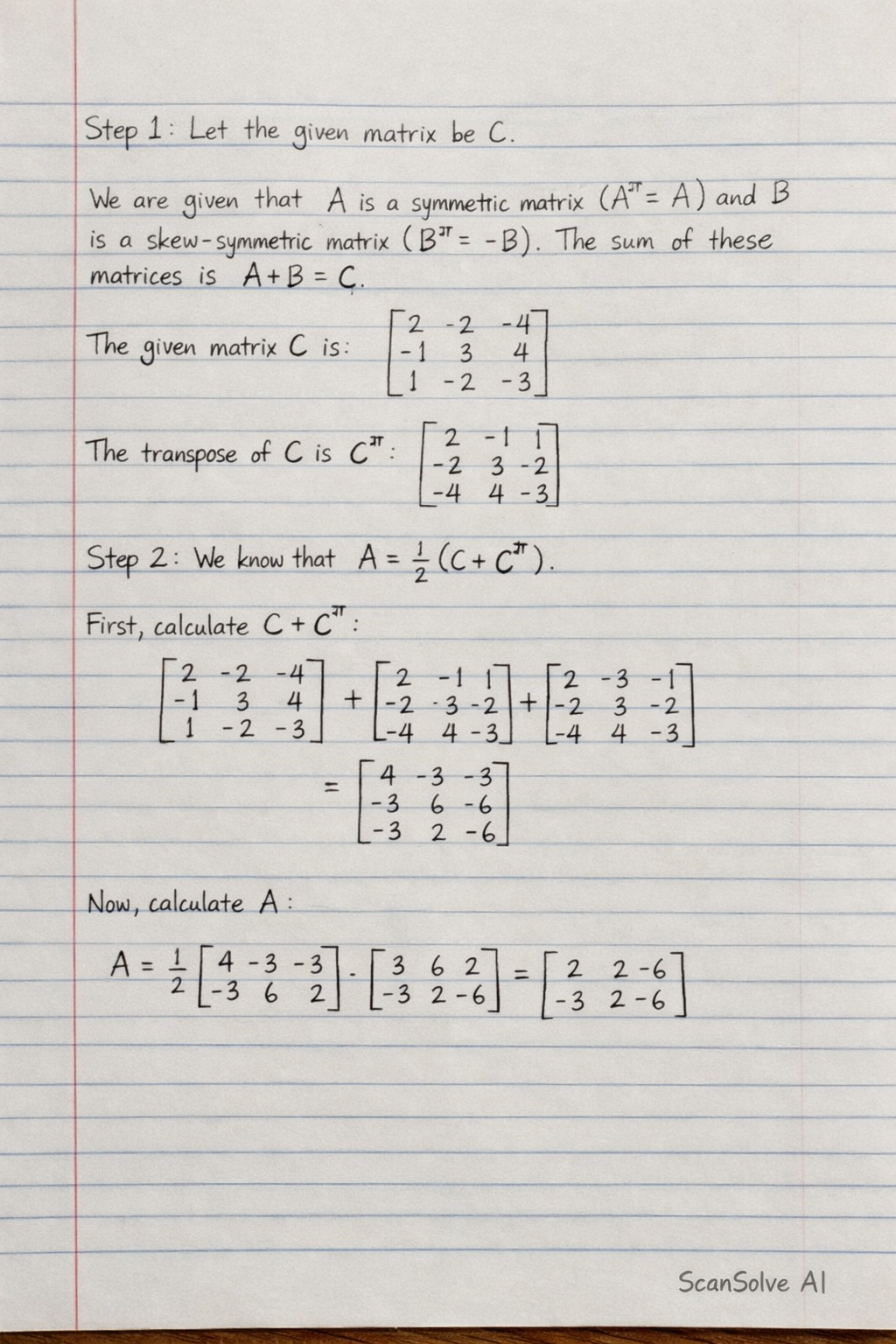
Handwritten Step-by-Step Solution
Get this as a handwritten image on WhatsApp — like a tutor wrote it for you.
Try on WhatsApp