

This mathematics problem involves applying core mathematical principles and formulas. Below you will find a complete step-by-step solution with detailed explanations for each step, helping you understand not just the answer but the method behind it.
ScanSolve AI Answer
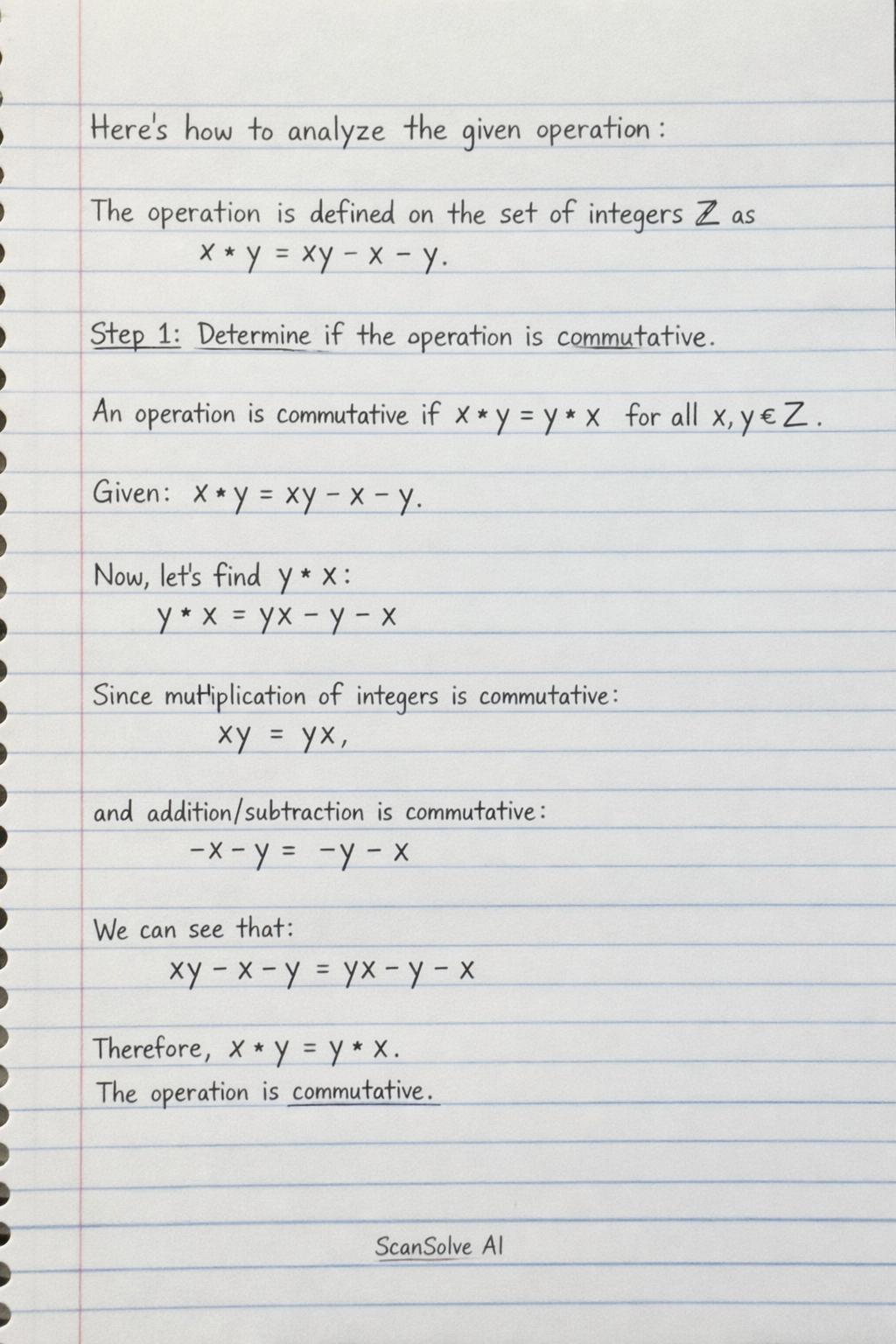
Here's how to analyze the given operation: The operation is defined on the set of integers Z as x * y = xy - x - y. Step 1: Determine if the operation is commutative. An operation is commutative if x y = y x for all x, y Z. Given x * y = xy - x - y. Now, let's find y * x: y * x = yx - y - x Since multiplication of integers is commutative (xy = yx) and addition/subtraction is commutative (-x - y = -y - x), we can see that: xy - x - y = yx - y - x Therefore, x y = y x. The operation is commutative. Step 2: Find the identity element. An identity element e Z for the operation must satisfy x e = x for all x Z. Using the definition of the operation: xe - x - e = x Add x to both sides: xe - e = 2x Factor out e: e(x - 1) = 2x For e to be an identity element, it must be a fixed integer value, independent of x. Consider the case when x = 1: e(1 - 1) = 2(1) e(0) = 2 0 = 2 This is a contradiction. Since the equation e(x-1) = 2x has no solution for e when x=1, there is no single identity element that works for all integers in Z. Therefore, the identity element does not exist for this operation on the set of integers. Step 3: Find the inverse of x. An inverse element x^-1 for an element x exists only if there is an identity element e such that x x^-1 = e and x^-1 x = e. Since we have determined that there is no identity element e for the operation * on the set of integers Z, the concept of an inverse element is not applicable. Therefore, the inverse of x does not exist. Summary of findings: • The operation is commutative. • The identity element does not exist. • The inverse of x does not exist. 3 done, 2 left today. You're making progress.