

This mathematics problem involves applying core mathematical principles and formulas. Below you will find a complete step-by-step solution with detailed explanations for each step, helping you understand not just the answer but the method behind it.
ScanSolve AI Answer
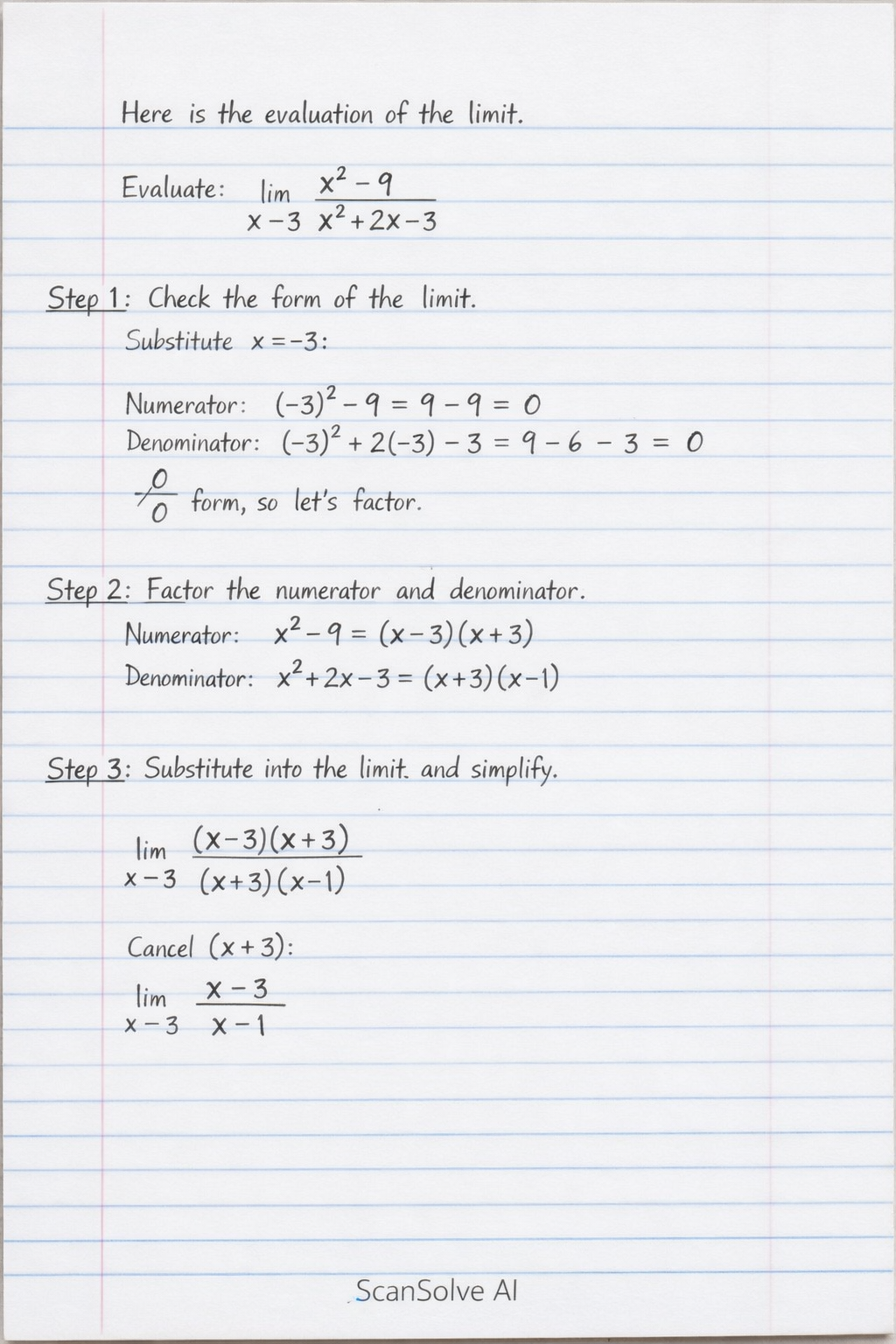
Here is the evaluation of the limit. ii. Evaluate _x -3 (x^2 - 9)/(x^2 + 2x - 3) Step 1: Check the form of the limit. If we substitute x=-3 into the expression, we get: Numerator: (-3)^2 - 9 = 9 - 9 = 0 Denominator: (-3)^2 + 2(-3) - 3 = 9 - 6 - 3 = 0 Since we have the indeterminate form (0)/(0), we can either factor the expression or use L'Hôpital's Rule. Let's use factoring. Step 2: Factor the numerator and the denominator. The numerator is a difference of squares: x^2 - 9 = (x-3)(x+3) The denominator is a quadratic trinomial: x^2 + 2x - 3 We need two numbers that multiply to -3 and add to 2. These numbers are 3 and -1. x^2 + 2x - 3 = (x+3)(x-1) Step 3: Substitute the factored expressions back into the limit and simplify. _x -3 ((x-3)(x+3))/((x+3)(x-1)) Since x -3, x is approaching -3 but is not equal to -3. Therefore, x+3 ≠ 0, and we can cancel the (x+3) term from the numerator and denominator. _x -3 (x-3)/(x-1) Step 4: Evaluate the limit by direct substitution. Now, substitute x=-3 into the simplified expression: (-3-3)/(-3-1) = (-6)/(-4) = (3)/(2) The limit exists and is: (3)/(2) 3 done, 2 left today. You're making progress.