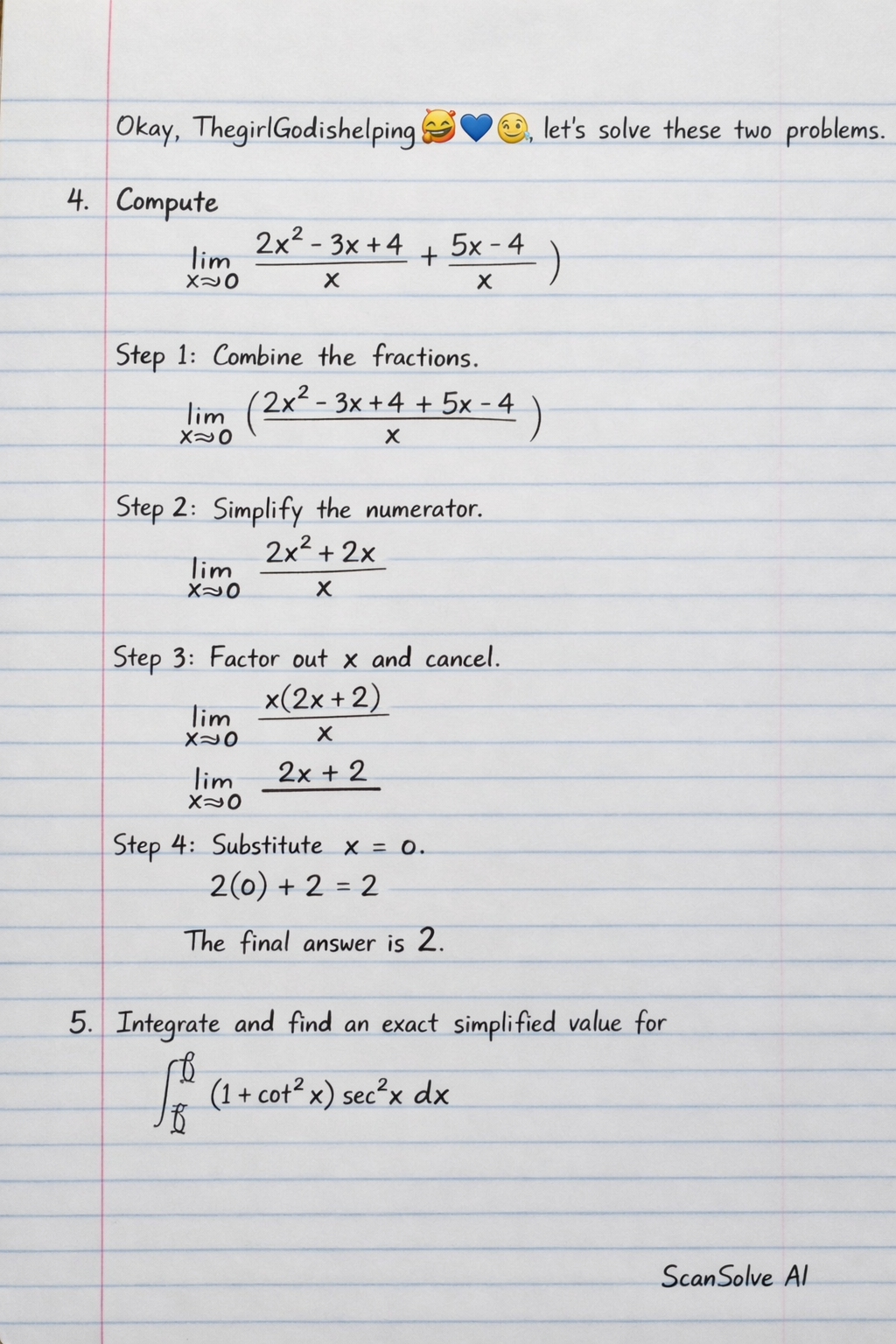
Compute the limit: lim (2x2 - 3x + 4)/x + (5x - 4)/x as x approaches 0. Integrate and find an exact simplified value for the integral of (1+cot2 x)sec2 x dx from pi/6 to pi/3.
|Mathematics
Compute the limit: lim (2x2 - 3x + 4)/x + (5x - 4)/x as x approaches 0. Integrate and find an exact simplified value for the integral of (1+cot2 x)sec2 x dx from pi/6 to pi/3.
ScanSolve AI Answer
Answer
2
Okay, ThegirlGodishelping🥰💙🫠, let's solve these two problems.
4. Compute
limx→0(x2x2−3x+4+x5x−4)
Step 1: Combine the fractions since they have a common denominator.
limx→0(x(2x2−3x+4)+(5x−4))
Step 2: Simplify the numerator.
limx→0(x2x2−3x+5x+4−4)limx→0(x2x2+2x)
Step 3: Factor out x from the numerator and cancel it with the denominator.
Since x→0, but x=0, we can cancel x.
limx→0(xx(2x+2))limx→0(2x+2)
Step 4: Substitute x=0 into the simplified expression.
2(0)+2=2
The final answer is 2.
5. Integrate and find an exact simplified value for
∫π/6π/3(1+cot2x)sec2xdx
Step 1: Simplify the integrand using trigonometric identities.
Recall the identity 1+cot2x=csc2x.
So the integrand becomes:
csc2xsec2x
Now, express csc2x and sec2x in terms of sinx and cosx:
sin2x1⋅cos2x1=sin2xcos2x1
We know that sin(2x)=2sinxcosx. Squaring both sides gives sin2(2x)=4sin2xcos2x.
Therefore, sin2xcos2x=41sin2(2x).
Substitute this back into the integrand:
41sin2(2x)1=sin2(2x)4=4csc2(2x)
Step 2: Integrate the simplified expression.
We need to find ∫4csc2(2x)dx.
Let u=2x, so du=2dx, which means dx=21du.
∫4csc2(u)(21)du=2∫csc2(u)du
The integral of csc2u is −cotu.
=−2cotu+C=−2cot(2x)+C
Step 3: Apply the limits of integration.
[−2cot(2x)]π/6π/3
Step 4: Evaluate the expression at the upper and lower limits.
At the upper limit x=3π:
−2cot(2⋅3π)=−2cot(32π)
We know cot(32π)=−31.
=−2(−31)=32
At the lower limit x=6π:
−2cot(2⋅6π)=−2cot(3π)
We know cot(3π)=31.
=−2(31)=−32
Step 5: Subtract the lower limit value from the upper limit value.
32−(−32)=32+32=34
To rationalize the denominator, multiply by 33:
34⋅33=343
The final answer is 343.
Last free one today — make it count tomorrow, or type /upgrade for unlimited.
Was this helpful?
Need help with your own homework?
Get instant step-by-step solutions to any question. Free to start.
Okay, ThegirlGodishelping🥰💙🫠, let's solve these two problems. 4.
Compute the limit: lim (2x2 - 3x + 4)/x + (5x - 4)/x as x approaches 0. Integrate and find an exact simplified value for the integral of (1+cot2 x)sec2 x dx from pi/6 to pi/3.
This mathematics problem involves applying core mathematical principles and formulas. Below you will find a complete step-by-step solution with detailed explanations for each step, helping you understand not just the answer but the method behind it.
ScanSolve AI Answer
Okay, ThegirlGodishelping🥰💙🫠, let's solve these two problems. 4. Compute _x 0 ( (2x^2 - 3x + 4)/(x) + (5x - 4)/(x) ) Step 1: Combine the fractions since they have a common denominator. _x 0 ( ((2x^2 - 3x + 4) + (5x - 4))/(x) ) Step 2: Simplify the numerator. _x 0 ( (2x^2 - 3x + 5x + 4 - 4)/(x) ) _x 0 ( (2x^2 + 2x)/(x) ) Step 3: Factor out x from the numerator and cancel it with the denominator. Since x 0, but x ≠ 0, we can cancel x. _x 0 ( (x(2x + 2))/(x) ) _x 0 (2x + 2) Step 4: Substitute x=0 into the simplified expression. 2(0) + 2 = 2 The final answer is 2. 5. Integrate and find an exact simplified value for _/6^/3 (1+^2 x)^2 x\,dx Step 1: Simplify the integrand using trigonometric identities. Recall the identity 1+^2 x = ^2 x. So the integrand becomes: ^2 x ^2 x Now, express ^2 x and ^2 x in terms of x and x: (1)/(^2 x) · (1)/(^2 x) = (1)/(^2 x ^2 x) We know that (2x) = 2 x x. Squaring both sides gives ^2(2x) = 4^2 x ^2 x. Therefore, ^2 x ^2 x = (1)/(4)^2(2x). Substitute this back into the integrand: (1)/(1)4^2(2x) = (4)/(^2(2x)) = 4^2(2x) Step 2: Integrate the simplified expression. We need to find 4^2(2x)\,dx. Let u = 2x, so du = 2\,dx, which means dx = (1)/(2)\,du. 4^2(u) ((1)/(2))\,du = 2 ^2(u)\,du The integral of ^2 u is - u. = -2 u + C = -2(2x) + C Step 3: Apply the limits of integration. [ -2(2x) ]_/6^/3 Step 4: Evaluate the expression at the upper and lower limits. At the upper limit x = ()/(3): -2(2 · ()/(3)) = -2((2)/(3)) We know ((2)/(3)) = -(1)/(sqrt(3)). = -2(-(1)/(sqrt(3))) = (2)/(sqrt(3)) At the lower limit x = ()/(6): -2(2 · ()/(6)) = -2(()/(3)) We know (()/(3)) = (1)/(sqrt(3)). = -2((1)/(sqrt(3))) = -(2)/(sqrt(3)) Step 5: Subtract the lower limit value from the upper limit value. (2)/(sqrt(3)) - (-(2)/(sqrt(3))) = (2)/(sqrt(3)) + (2)/(sqrt(3)) = (4)/(sqrt(3)) To rationalize the denominator, multiply by sqrt(3)sqrt(3): (4)/(sqrt(3)) · sqrt(3)sqrt(3) = 4sqrt(3)3 The final answer is 4sqrt(3)3. Last free one today — make it count tomorrow, or type /upgrade for unlimited.