

This mathematics problem involves applying core mathematical principles and formulas. Below you will find a complete step-by-step solution with detailed explanations for each step, helping you understand not just the answer but the method behind it.
ScanSolve AI Answer
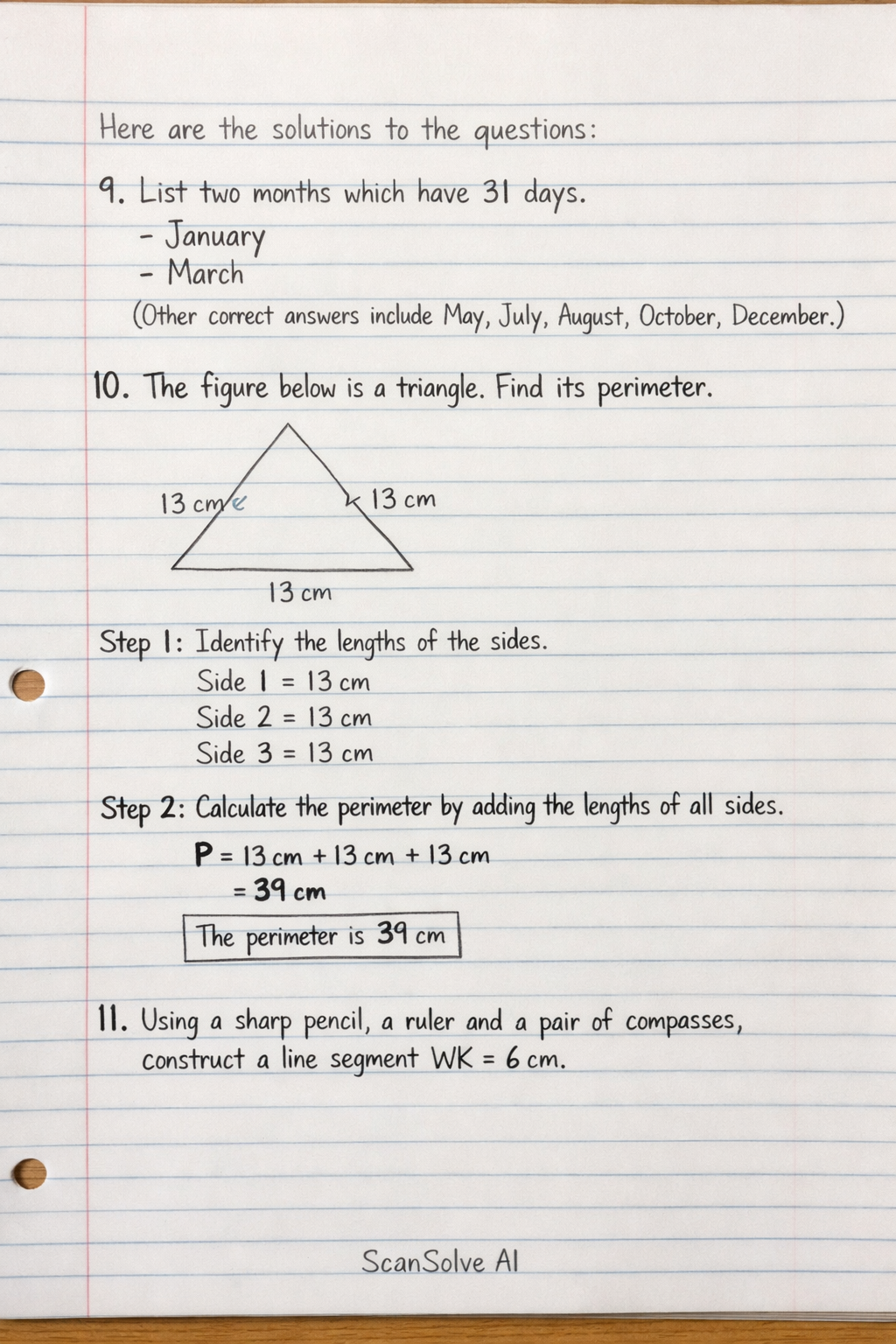
Here are the solutions to the questions: 9. List two months which have 31 days. January March (Other correct answers include May, July, August, October, December.) 10. The figure below is a triangle. Find its perimeter. The triangle is an isosceles triangle with two sides marked with a single tick. One of these sides is given as 13 cm. Therefore, the other side with a single tick is also 13 cm. Assuming the base is also 13 cm (as is common in primary level problems when only one side of an isosceles triangle is given and perimeter is asked, or if it's an equilateral triangle), the perimeter is the sum of all three sides. Step 1: Identify the lengths of the sides. Side 1 = 13 cm Side 2 = 13 cm Side 3 = 13 cm Step 2: Calculate the perimeter by adding the lengths of all sides. P = 13 cm + 13 cm + 13 cm P = 39 cm The perimeter is 39 cm. 11. Using a sharp pencil, a ruler and a pair of compasses, construct a line segment WK = 6cm. Step 1: Draw a straight line using a ruler. Step 2: Mark a point 'W' on the line. Step 3: Place the ruler on a flat surface and open the compass to a width of 6 cm. Step 4: Place the compass needle on point 'W' and draw an arc that intersects the straight line. Step 5: Label the point where the arc intersects the line as 'K'. The line segment WK is now constructed and measures 6 cm. 12. Given that set H=a, er, y, ng, b. How many members are in set H? Step 1: Identify the distinct elements in the set H. The elements are 'a', 'er', 'y', 'ng', 'b'. Step 2: Count the number of distinct elements. There are 5 distinct elements. The number of members in set H is 5. 13. Workout 3 × 5 using repeated addition. To workout 3 × 5 using repeated addition, we can either add 3 five times or add 5 three times. Method 1: Add 3 five times 3 × 5 = 3 + 3 + 3 + 3 + 3 3 + 3 = 6 6 + 3 = 9 9 + 3 = 12 12 + 3 = 15 Method 2: Add 5 three times 3 × 5 = 5 + 5 + 5 5 + 5 = 10 10 + 5 = 15 The result of 3 × 5 using repeated addition is 15. 14. List all odd numbers less than 14. Step 1: Recall the definition of an odd number. An odd number is an integer that is not divisible by 2. Step 2: List all integers less than 14. 1, 2, 3, 4, 5, 6, 7, 8, 9, 10, 11, 12, 13. Step 3: Identify the odd numbers from the list. The odd numbers are those that cannot be divided evenly by 2. The odd numbers less than 14 are 1, 3, 5, 7, 9, 11, 13. 3 done, 2 left today. You're making progress.