
We read your photo as:
Look at the pattern below. a) What shape are the matches arranged in? b) Describe the pattern rule. c) Predict the next two terms in the pattern. d) Complete the flow diagram. e) Does the flow diagram
ScanSolve AI Answer
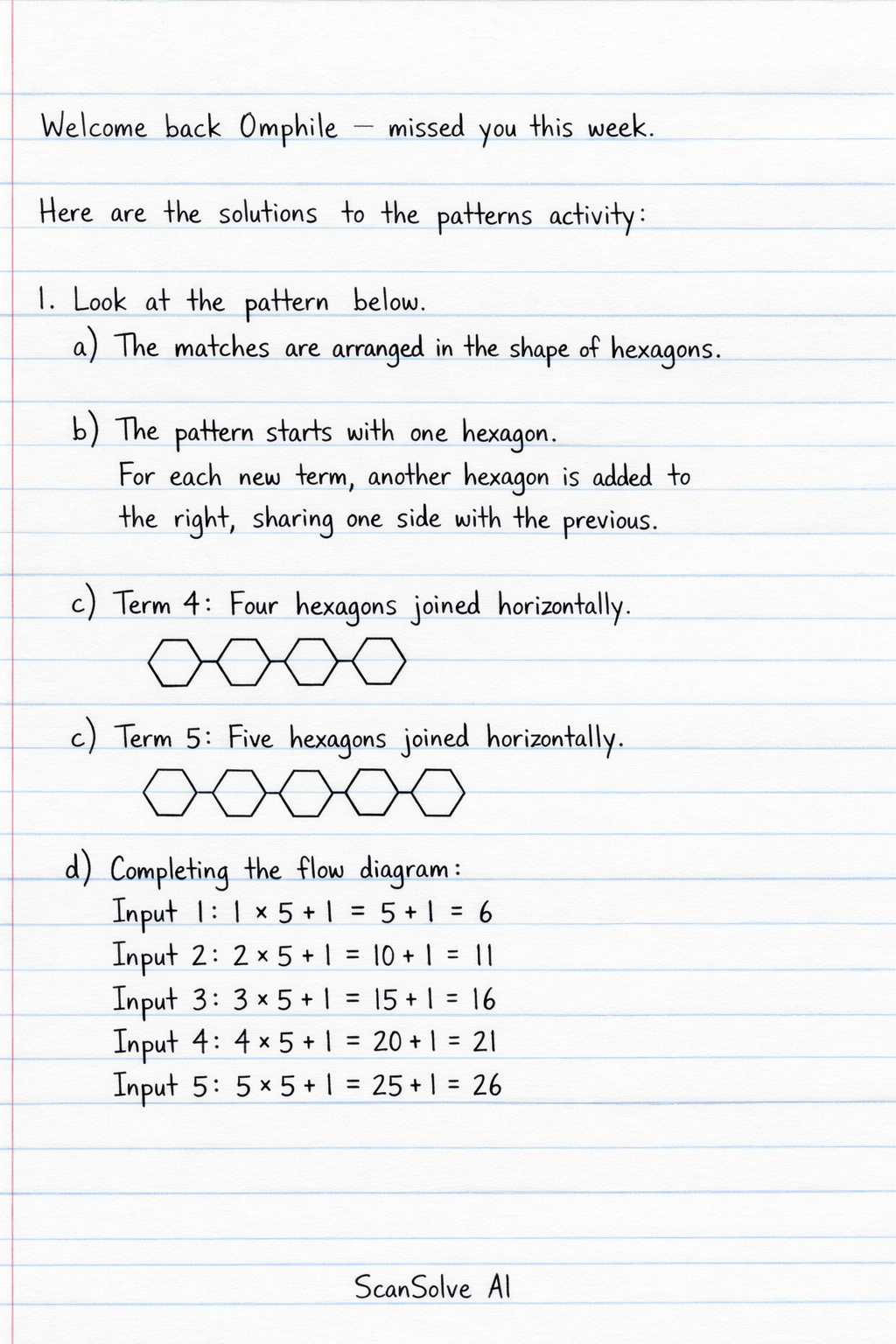
Here are the solutions to the patterns activity:
1. Look at the pattern below.
a) The matches are arranged in the shape of hexagons.
b) The pattern starts with one hexagon. For each subsequent term, an additional hexagon is added to the right, sharing one vertical side with the previous hexagon.
c)
- Term 4 would consist of four hexagons joined horizontally, with each adjacent pair sharing one side.
- Term 5 would consist of five hexagons joined horizontally, with each adjacent pair sharing one side.
d) Completing the flow diagram based on the given rule (Input ):
- For Input 1:
- For Input 2:
- For Input 3:
- For Input 4:
- For Input 5:
e)
Let's count the matches in the given pattern:
- Term 1: 6 matches
- Term 2: 10 matches
- Term 3: 14 matches The number of matches follows the rule . The flow diagram rule is . Therefore, no, the flow diagram does not give the number of matches for each term of the pattern shown.
f) The number of matches in the pattern follows the rule .
To calculate the number of matches in the 10th term, substitute :
2. Describe the pattern below in your own words.
a) The pattern consists of a central square with five arms extending outwards. Each arm is made of squares. In each subsequent term, the length of each of the five arms increases by one square.
b)
- Term 4 would have a central square with five arms, each 5 squares long.
- Term 5 would have a central square with five arms, each 6 squares long.
- Term 6 would have a central square with five arms, each 7 squares long.
c)
- Term 1: 1 central square + 5 arms 2 squares/arm =
- Term 2: 1 central square + 5 arms 3 squares/arm =
- Term 3: 1 central square + 5 arms 4 squares/arm =
Still stuck on this one?
Ask a follow-up, and the answer starts from this question.
More Mathematics Questions
Handwritten Step-by-Step Solution
Get this as a handwritten image on WhatsApp — like a tutor wrote it for you.
Try on WhatsApp