

This mathematics problem involves applying core mathematical principles and formulas. Below you will find a complete step-by-step solution with detailed explanations for each step, helping you understand not just the answer but the method behind it.
ScanSolve AI Answer
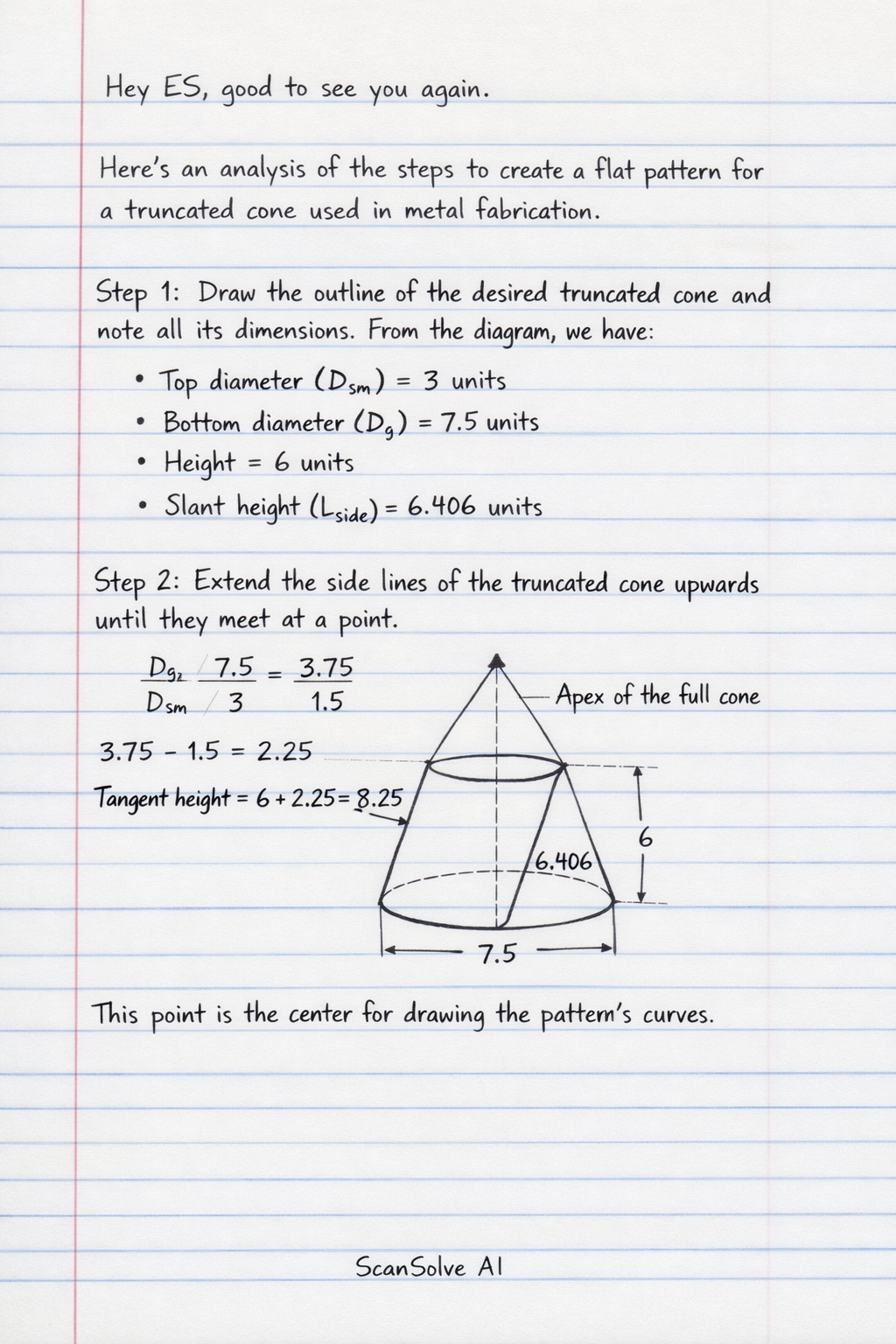
This image outlines the 6 steps to create a flat pattern for a truncated cone, which is often used in metal fabrication for processes like arc welding. Step 1: The first step is to draw the outline of the desired truncated cone and note all its dimensions. From the diagram, we have: • Top diameter (D_sm) = 3 units • Bottom diameter (D_g) = 7.5 units • Height = 6 units • Slant height (L_side) = 6.406 units Step 2: Extend the side lines of the truncated cone upwards until they meet at a point. This point is the apex of the full cone from which the truncated cone is derived, and it will serve as the center for drawing the pattern's curves. Step 3: Using the apex found in Step 2 as the center, draw two concentric circles (or arcs). The radius of the larger circle corresponds to the slant height from the apex to the bottom edge of the cone, and the radius of the smaller circle corresponds to the slant height from the apex to the top edge of the cone. These circles pass through the top and bottom corners of the original cone outline. Step 4: Calculate the "grand angle" for the pattern. This angle determines the sector of the annulus that will form the cone. The formula provided is: Angle = 180 (D_g - D_sm)L_side Now, substitute the dimensions from Step 1 into the formula: Angle = 180 ((7.5 - 3))/(6.406) Angle = 180 (4.5)/(6.406) Angle = 180 × 0.702466... Angle ≈ 126.44 degrees This calculated angle defines the sector you need to cut from the concentric circles. Step 5: Add extra material along one of the straight edges of the pattern. This material, typically 1/4" to 3/8", is for the overlap needed when joining the edges to form the cone, often by welding. Step 6: Erase any construction or "witness" lines to leave only the final cone pattern. This pattern can then be transferred to a material like sheet metal for cutting and forming. This process is fundamental in sheet metal fabrication, where flat patterns are created to be cut, rolled, and then joined (e.g., by MMAW) to form three-dimensional shapes like cones or frustums. Send me the next one 📸