
May I have at least 5 examples from each types of vector
ScanSolve AI Answer
Step-by-step solution
8 stepsHere are more examples to illustrate the different types of vectors. For some types, the concept is clear with one or two examples, and providing five distinct ones would be repetitive.
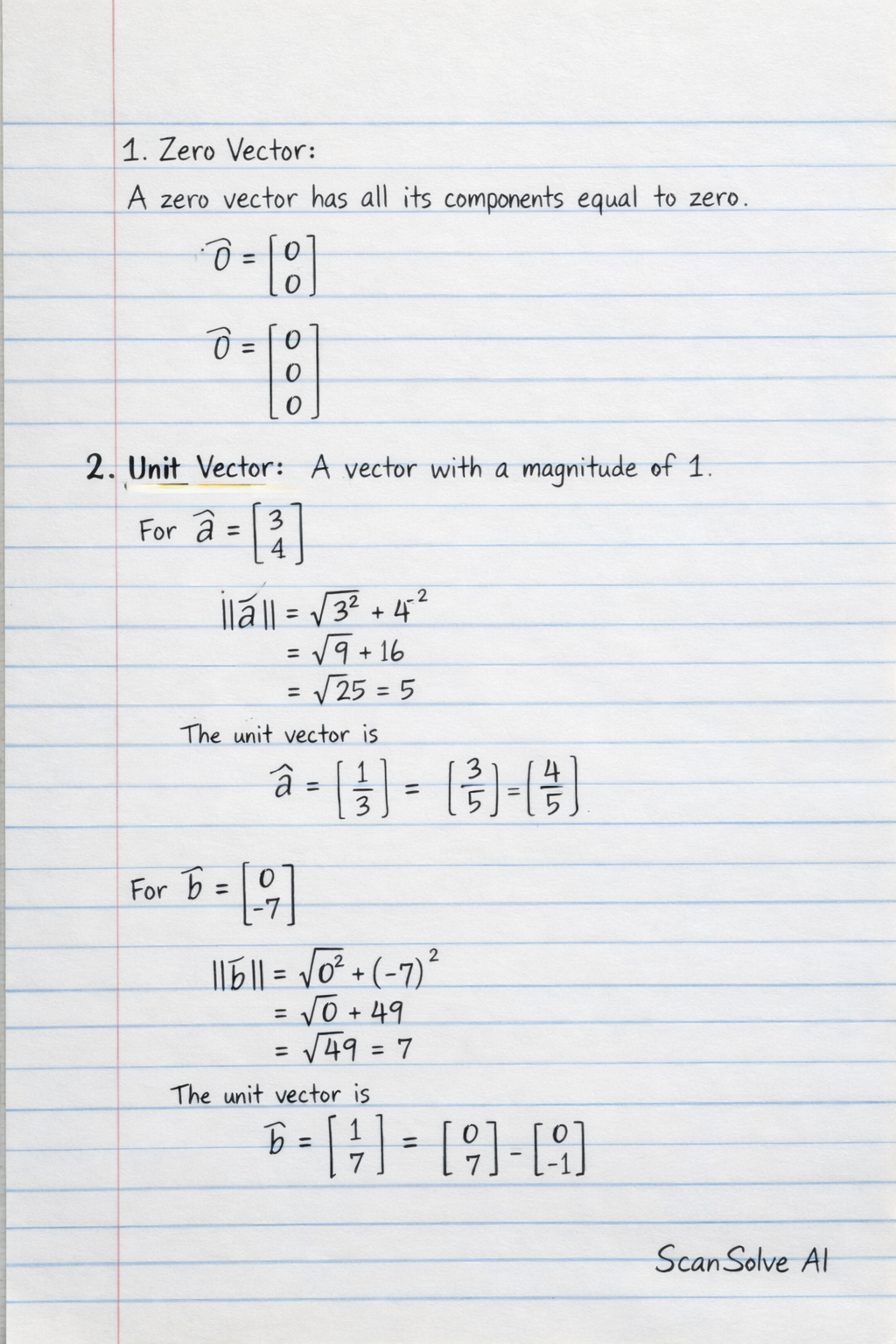
Zero Vector
A zero vector has all its components equal to zero.
Unit Vector
A vector with a magnitude of 1.
- For , its magnitude is . The unit vector is .
- For , its magnitude is . The unit vector is .
- For , its magnitude is . The unit vector is .
Position Vector
Represents the position of a point from the origin.
- Position vector of point is .
- Position vector of point is .
Displacement Vector
Represents the change in position from one point to another.
- From to :
- From to :
Equal Vectors
Two vectors are equal if they have the same magnitude and direction (i.e., identical components).
- Here, .
- Here, .
Negative Vector
Has the same magnitude but opposite direction.
- If , then .
- If , then .
Collinear Vectors
Lie on the same line or are parallel. One is a scalar multiple of the other.
- Let . If , then . and are collinear.
- Let . If , then . and are collinear.
Coplanar Vectors
Lie on the same plane. Three vectors , , and are coplanar if one can be expressed as a linear combination of the other two.
- Let , , and . Here, . All three vectors lie in the -plane, so they are coplanar.
- Let , , and . Here, (since , , ). Thus, , , and are coplanar.
Still stuck on this one?
Ask a follow-up, and the answer starts from this question.
More Mathematics Questions
Handwritten Step-by-Step Solution
Get this as a handwritten image on WhatsApp — like a tutor wrote it for you.
Try on WhatsApp