May I have mathematical examples of each type of vector?

Mathematics

ScanSolve AI Answer

Step-by-step solution

8 steps

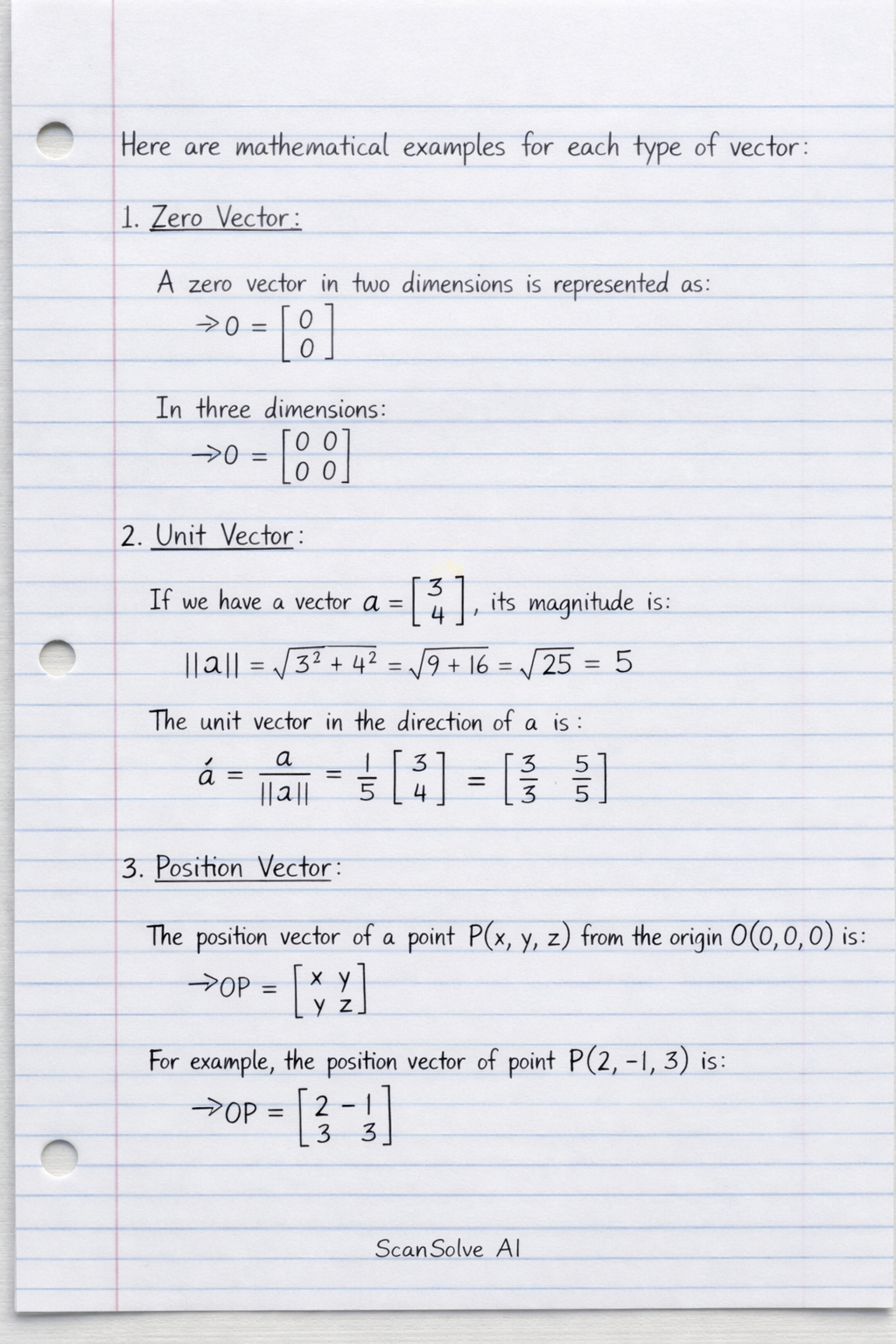
Here are mathematical examples for each type of vector:

  1. Zero Vector

    A zero vector in two dimensions is represented as:

    0⃗=[00]\vec{0} = \begin{bmatrix} 0 \\ 0 \end{bmatrix}

    In three dimensions:

    0⃗=[000]\vec{0} = \begin{bmatrix} 0 \\ 0 \\ 0 \end{bmatrix}
  2. Unit Vector

    If we have a vector a⃗=[34]\vec{a} = \begin{bmatrix} 3 \\ 4 \end{bmatrix}, its magnitude is ∣∣a⃗∣∣=32+42=9+16=25=5||\vec{a}|| = \sqrt{3^2 + 4^2} = \sqrt{9+16} = \sqrt{25} = 5.
    The unit vector in the direction of a⃗\vec{a} is:

    a^=a⃗∣∣a⃗∣∣=15[34]=[3545]\hat{a} = \frac{\vec{a}}{||\vec{a}||} = \frac{1}{5} \begin{bmatrix} 3 \\ 4 \end{bmatrix} = \begin{bmatrix} \frac{3}{5} \\ \frac{4}{5} \end{bmatrix}
  3. Position Vector

    The position vector of a point P(x,y,z)P(x, y, z) from the origin O(0,0,0)O(0, 0, 0) is:

    OP⃗=[xyz]\vec{OP} = \begin{bmatrix} x \\ y \\ z \end{bmatrix}

    For example, the position vector of point P(2,−1,3)P(2, -1, 3) is:

    OP⃗=[2−13]\vec{OP} = \begin{bmatrix} 2 \\ -1 \\ 3 \end{bmatrix}
  4. Displacement Vector

    If point AA is (x1,y1,z1)(x_1, y_1, z_1) and point BB is (x2,y2,z2)(x_2, y_2, z_2), the displacement vector from AA to BB is AB⃗=OB⃗−OA⃗\vec{AB} = \vec{OB} - \vec{OA}.
    For example, if A(1,2,3)A(1, 2, 3) and B(4,0,−1)B(4, 0, -1):

    AB⃗=[4−10−2−1−3]=[3−2−4]\vec{AB} = \begin{bmatrix} 4-1 \\ 0-2 \\ -1-3 \end{bmatrix} = \begin{bmatrix} 3 \\ -2 \\ -4 \end{bmatrix}
  5. Equal Vectors

    Two vectors a⃗\vec{a} and b⃗\vec{b} are equal if their corresponding components are equal.

    a⃗=[25]andb⃗=[25]\vec{a} = \begin{bmatrix} 2 \\ 5 \end{bmatrix} \quad \text{and} \quad \vec{b} = \begin{bmatrix} 2 \\ 5 \end{bmatrix}

    Here, a⃗=b⃗\vec{a} = \vec{b}.

  6. Negative Vector

    If a⃗=[3−21]\vec{a} = \begin{bmatrix} 3 \\ -2 \\ 1 \end{bmatrix}, its negative vector is:

    −a⃗=[−3−(−2)−1]=[−32−1]-\vec{a} = \begin{bmatrix} -3 \\ -(-2) \\ -1 \end{bmatrix} = \begin{bmatrix} -3 \\ 2 \\ -1 \end{bmatrix}
  7. Collinear Vectors

    Two vectors a⃗\vec{a} and b⃗\vec{b} are collinear if b⃗=ka⃗\vec{b} = k\vec{a} for some scalar kk.
    Let a⃗=[12]\vec{a} = \begin{bmatrix} 1 \\ 2 \end{bmatrix}. If k=3k=3, then:

    b⃗=3a⃗=3[12]=[36]\vec{b} = 3\vec{a} = 3 \begin{bmatrix} 1 \\ 2 \end{bmatrix} = \begin{bmatrix} 3 \\ 6 \end{bmatrix}

    Vectors a⃗\vec{a} and b⃗\vec{b} are collinear.

  8. Coplanar Vectors

    Three vectors a⃗\vec{a}, b⃗\vec{b}, and c⃗\vec{c} are coplanar if one can be expressed as a linear combination of the other two (i.e., c⃗=xa⃗+yb⃗\vec{c} = x\vec{a} + y\vec{b} for scalars x,yx, y).
    Let a⃗=[100]\vec{a} = \begin{bmatrix} 1 \\ 0 \\ 0 \end{bmatrix}, b⃗=[010]\vec{b} = \begin{bmatrix} 0 \\ 1 \\ 0 \end{bmatrix}, and c⃗=[230]\vec{c} = \begin{bmatrix} 2 \\ 3 \\ 0 \end{bmatrix}.
    Here, c⃗=2a⃗+3b⃗\vec{c} = 2\vec{a} + 3\vec{b}. All three vectors lie in the xyxy-plane (where z=0z=0), so they are coplanar.

Was this helpful?

Still stuck on this one?

Ask a follow-up, and the answer starts from this question.

Got a different question?Ask your own question
Handwritten step-by-step solution preview

Handwritten Step-by-Step Solution

Get this as a handwritten image on WhatsApp — like a tutor wrote it for you.

Try on WhatsApp