I need more examples and solution under dot multiplication and cross multiplication in application of vector.
|Mathematics
ScanSolve AI Answer
Answer
114.09∘
Here are examples for dot product and cross product applications:
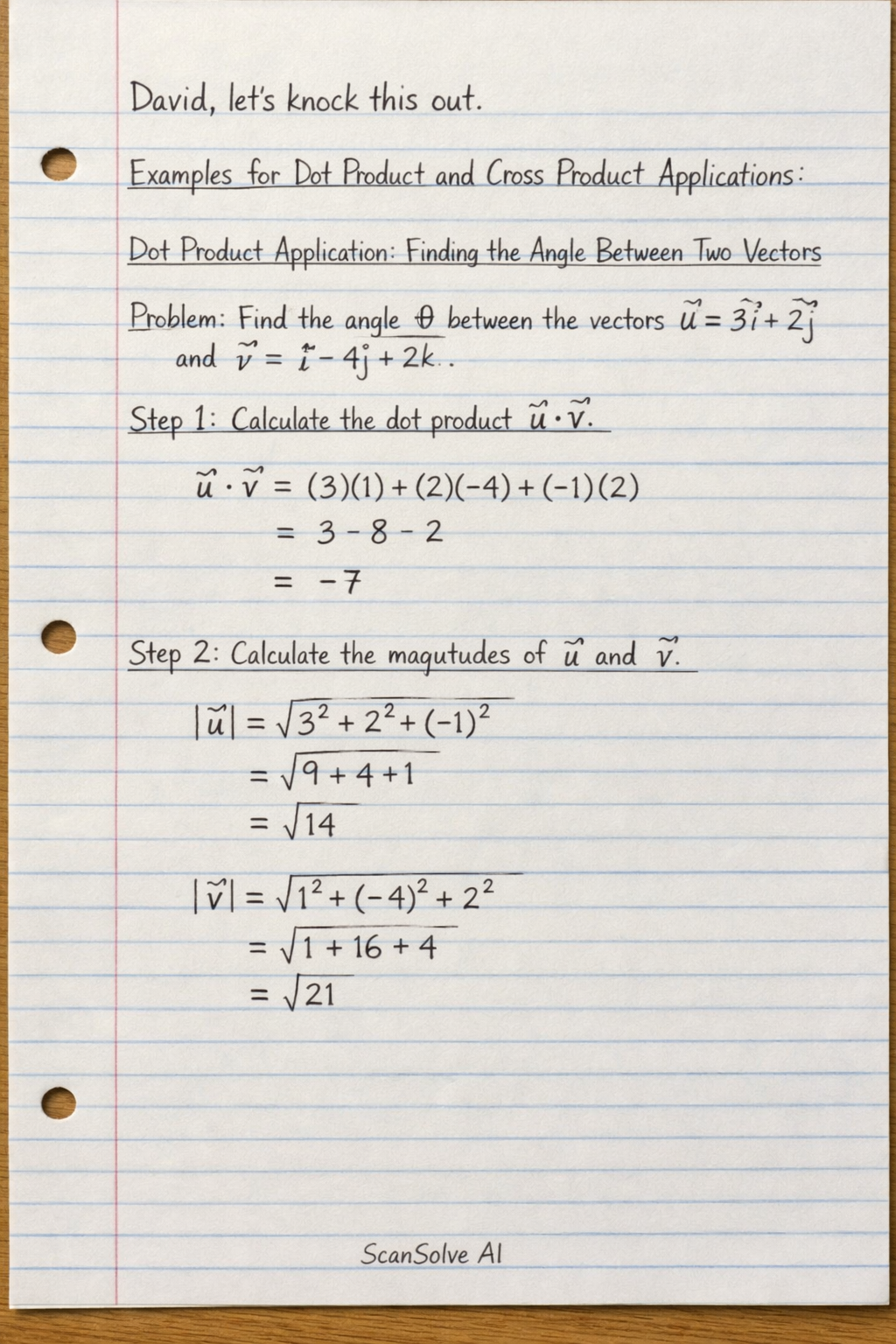
Dot Product Application: Finding the Angle Between Two Vectors
Problem: Find the angle θ between the vectors u=3i+2j−k and v=i−4j+2k.
Step 1: Calculate the dot product u⋅v.
The dot product of two vectors u=uxi+uyj+uzk and v=vxi+vyj+vzk is given by u⋅v=uxvx+uyvy+uzvz.
u⋅v=(3)(1)+(2)(−4)+(−1)(2)u⋅v=3−8−2u⋅v=−7
Step 2: Calculate the magnitudes of u and v.
The magnitude of a vector u=uxi+uyj+uzk is ∣u∣=ux2+uy2+uz2.
∣u∣=32+22+(−1)2=9+4+1=14∣v∣=12+(−4)2+22=1+16+4=21
Step 3: Use the dot product formula to find the angle.
The formula relating the dot product, magnitudes, and angle is u⋅v=∣u∣∣v∣cosθ.
Rearranging for cosθ:
cosθ=∣u∣∣v∣u⋅vcosθ=1421−7cosθ=294−7cosθ=76−7cosθ=6−1
Now, find θ:
θ=arccos(6−1)θ≈arccos(−0.4082)θ≈114.09∘
Cross Product Application: Finding a Perpendicular Vector and Area of a Parallelogram
Problem: Given vectors a=i+2j−k and b=3i−j+2k, find a vector perpendicular to both a and b, and then find the area of the parallelogram formed by these two vectors.
Step 1: Calculate the cross product a×b.
The cross product of two vectors a=axi+ayj+azk and b=bxi+byj+bzk is given by:
a×b=iaxbxjaybykazbza×b=i13j2−1k−12a×b=i((2)(2)−(−1)(−1))−j((1)(2)−(−1)(3))+k((1)(−1)−(2)(3))a×b=i(4−1)−j(2−(−3))+k(−1−6)a×b=3i−5j−7k
A vector perpendicular to both a and b is 3i−5j−7k.
Step 2: Calculate the magnitude of the cross product to find the area.
The area of the parallelogram formed by a and b is equal to the magnitude of their cross product, ∣a×b∣.
∣a×b∣=∣3i−5j−7k∣∣a×b∣=32+(−5)2+(−7)2∣a×b∣=9+25+49∣a×b∣=83
The area of the parallelogram is 83squareunits.
Send me the next one 📸
Was this helpful?
Need help with your own homework?
Get instant step-by-step solutions to any question. Free to start.
This mathematics problem involves applying core mathematical principles and formulas. Below you will find a complete step-by-step solution with detailed explanations for each step, helping you understand not just the answer but the method behind it.
ScanSolve AI Answer
Here are examples for dot product and cross product applications: Dot Product Application: Finding the Angle Between Two Vectors Problem: Find the angle between the vectors u = 3i + 2j - k and v = i - 4j + 2k. Step 1: Calculate the dot product u · v. The dot product of two vectors u = u_xi + u_yj + u_zk and v = v_xi + v_yj + v_zk is given by u · v = u_xv_x + u_yv_y + u_zv_z. u · v = (3)(1) + (2)(-4) + (-1)(2) u · v = 3 - 8 - 2 u · v = -7 Step 2: Calculate the magnitudes of u and v. The magnitude of a vector u = u_xi + u_yj + u_zk is |u| = sqrt(u_x^2 + u_y^2 + u_z^2). |u| = sqrt(3^2 + 2^2 + (-1)^2) = sqrt(9 + 4 + 1) = sqrt(14) |v| = sqrt(1^2 + (-4)^2 + 2^2) = sqrt(1 + 16 + 4) = sqrt(21) Step 3: Use the dot product formula to find the angle. The formula relating the dot product, magnitudes, and angle is u · v = |u| |v| . Rearranging for : = u · v|u| |v| = (-7)/(sqrt(14) 21) = (-7)/(sqrt(294)) = (-7)/(7sqrt(6)) = (-1)/(sqrt(6)) Now, find : = ((-1)/(sqrt(6))) ≈ (-0.4082) ≈ 114.09^ Cross Product Application: Finding a Perpendicular Vector and Area of a Parallelogram Problem: Given vectors a = i + 2j - k and b = 3i - j + 2k, find a vector perpendicular to both a and b, and then find the area of the parallelogram formed by these two vectors. Step 1: Calculate the cross product a × b. The cross product of two vectors a = a_xi + a_yj + a_zk and b = b_xi + b_yj + b_zk is given by: a × b = i & j & k \\ a_x & a_y & a_z \\ b_x & b_y & b_z a × b = i & j & k \\ 1 & 2 & -1 \\ 3 & -1 & 2 a × b = i((2)(2) - (-1)(-1)) - j((1)(2) - (-1)(3)) + k((1)(-1) - (2)(3)) a × b = i(4 - 1) - j(2 - (-3)) + k(-1 - 6) a × b = 3i - 5j - 7k A vector perpendicular to both a and b is 3i - 5j - 7k. Step 2: Calculate the magnitude of the cross product to find the area. The area of the parallelogram formed by a and b is equal to the magnitude of their cross product, |a × b|. |a × b| = |3i - 5j - 7k| |a × b| = sqrt(3^2 + (-5)^2 + (-7)^2) |a × b| = sqrt(9 + 25 + 49) |a × b| = sqrt(83) The area of the parallelogram is sqrt(83) square units. Send me the next one 📸