Overview on scalar dot product and vector cross product with examples

Mathematics

ScanSolve AI Answer

Answer

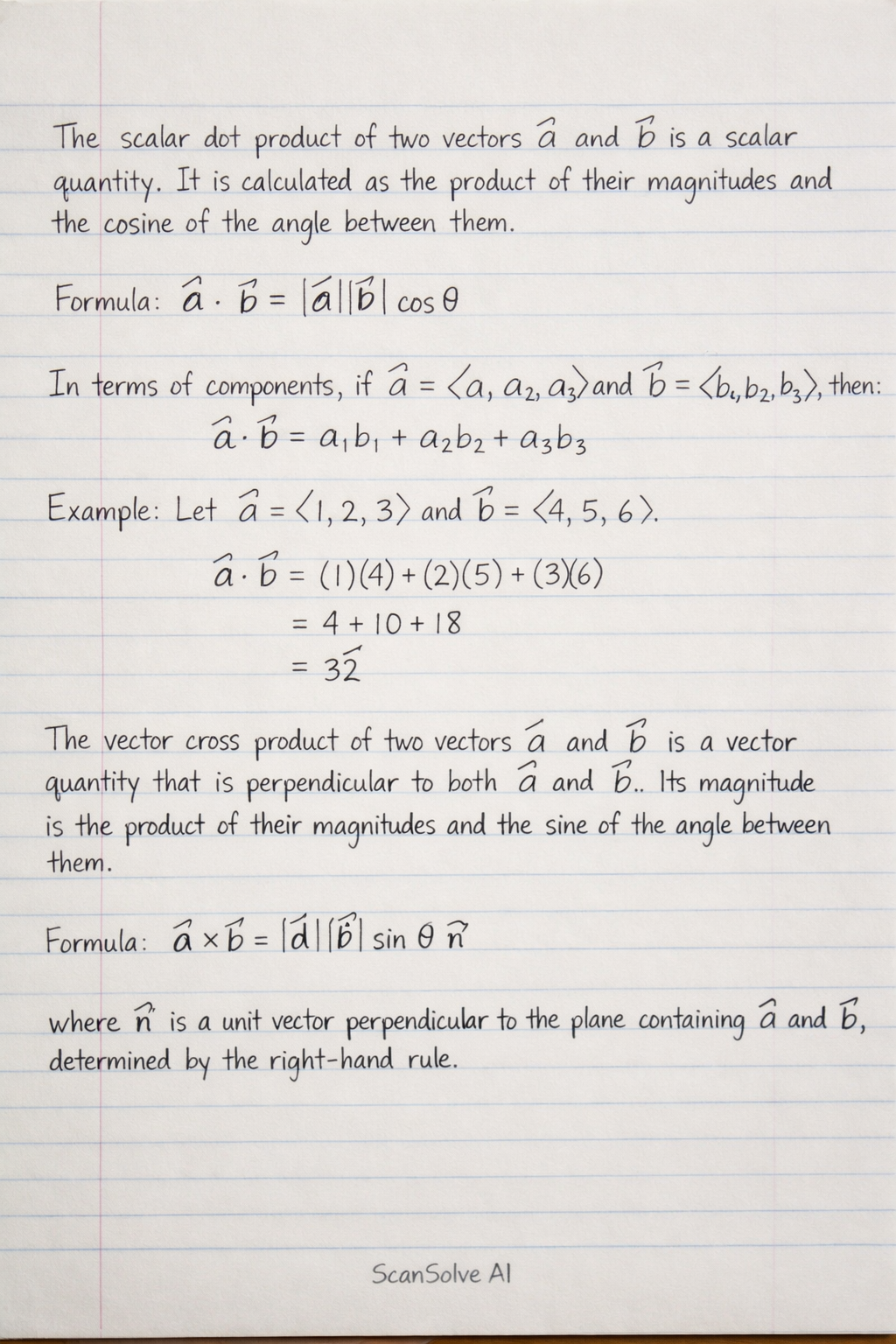
The scalar dot product of two vectors a⃗\vec{a} and b⃗\vec{b} is a scalar quantity. It is calculated as the product of their magnitudes and the cosine of the angle between them.

Formula:

a⃗⋅b⃗=∣a⃗∣∣b⃗∣cos⁡θ\vec{a} \cdot \vec{b} = |\vec{a}| |\vec{b}| \cos \theta

In terms of components, if a⃗=⟨a1,a2,a3⟩\vec{a} = \langle a_1, a_2, a_3 \rangle and b⃗=⟨b1,b2,b3⟩\vec{b} = \langle b_1, b_2, b_3 \rangle, then:

a⃗⋅b⃗=a1b1+a2b2+a3b3\vec{a} \cdot \vec{b} = a_1 b_1 + a_2 b_2 + a_3 b_3

Example:
Let a⃗=⟨1,2,3⟩\vec{a} = \langle 1, 2, 3 \rangle and b⃗=⟨4,5,6⟩\vec{b} = \langle 4, 5, 6 \rangle.

a⃗⋅b⃗=(1)(4)+(2)(5)+(3)(6)=4+10+18=32\vec{a} \cdot \vec{b} = (1)(4) + (2)(5) + (3)(6) = 4 + 10 + 18 = 32

The vector cross product of two vectors a⃗\vec{a} and b⃗\vec{b} is a vector quantity that is perpendicular to both a⃗\vec{a} and b⃗\vec{b}. Its magnitude is the product of their magnitudes and the sine of the angle between them.

Formula:

a⃗×b⃗=∣a⃗∣∣b⃗∣sin⁡θn^\vec{a} \times \vec{b} = |\vec{a}| |\vec{b}| \sin \theta \hat{n}

where n^\hat{n} is a unit vector perpendicular to the plane containing a⃗\vec{a} and b⃗\vec{b}, determined by the right-hand rule.

In terms of components, if a⃗=⟨a1,a2,a3⟩\vec{a} = \langle a_1, a_2, a_3 \rangle and b⃗=⟨b1,b2,b3⟩\vec{b} = \langle b_1, b_2, b_3 \rangle, then:

a⃗×b⃗=∣i^j^k^a1a2a3b1b2b3∣=(a2b3−a3b2)i^−(a1b3−a3b1)j^+(a1b2−a2b1)k^\vec{a} \times \vec{b} = \begin{vmatrix} \hat{i} & \hat{j} & \hat{k} \\ a_1 & a_2 & a_3 \\ b_1 & b_2 & b_3 \end{vmatrix} = (a_2 b_3 - a_3 b_2) \hat{i} - (a_1 b_3 - a_3 b_1) \hat{j} + (a_1 b_2 - a_2 b_1) \hat{k}

Example:
Let a⃗=⟨1,2,3⟩\vec{a} = \langle 1, 2, 3 \rangle and b⃗=⟨4,5,6⟩\vec{b} = \langle 4, 5, 6 \rangle.

a⃗×b⃗=∣i^j^k^123456∣\vec{a} \times \vec{b} = \begin{vmatrix} \hat{i} & \hat{j} & \hat{k} \\ 1 & 2 & 3 \\ 4 & 5 & 6 \end{vmatrix} =(2⋅6−3⋅5)i^−(1⋅6−3⋅4)j^+(1⋅5−2⋅4)k^= (2 \cdot 6 - 3 \cdot 5) \hat{i} - (1 \cdot 6 - 3 \cdot 4) \hat{j} + (1 \cdot 5 - 2 \cdot 4) \hat{k} =(12−15)i^−(6−12)j^+(5−8)k^= (12 - 15) \hat{i} - (6 - 12) \hat{j} + (5 - 8) \hat{k} =−3i^+6j^−3k^=⟨−3,6,−3⟩= -3 \hat{i} + 6 \hat{j} - 3 \hat{k} = \langle -3, 6, -3 \rangle
Was this helpful?

Still stuck on this one?

Ask a follow-up, and the answer starts from this question.

Got a different question?Ask your own question
Handwritten step-by-step solution preview

Handwritten Step-by-Step Solution

Get this as a handwritten image on WhatsApp — like a tutor wrote it for you.

Try on WhatsApp