

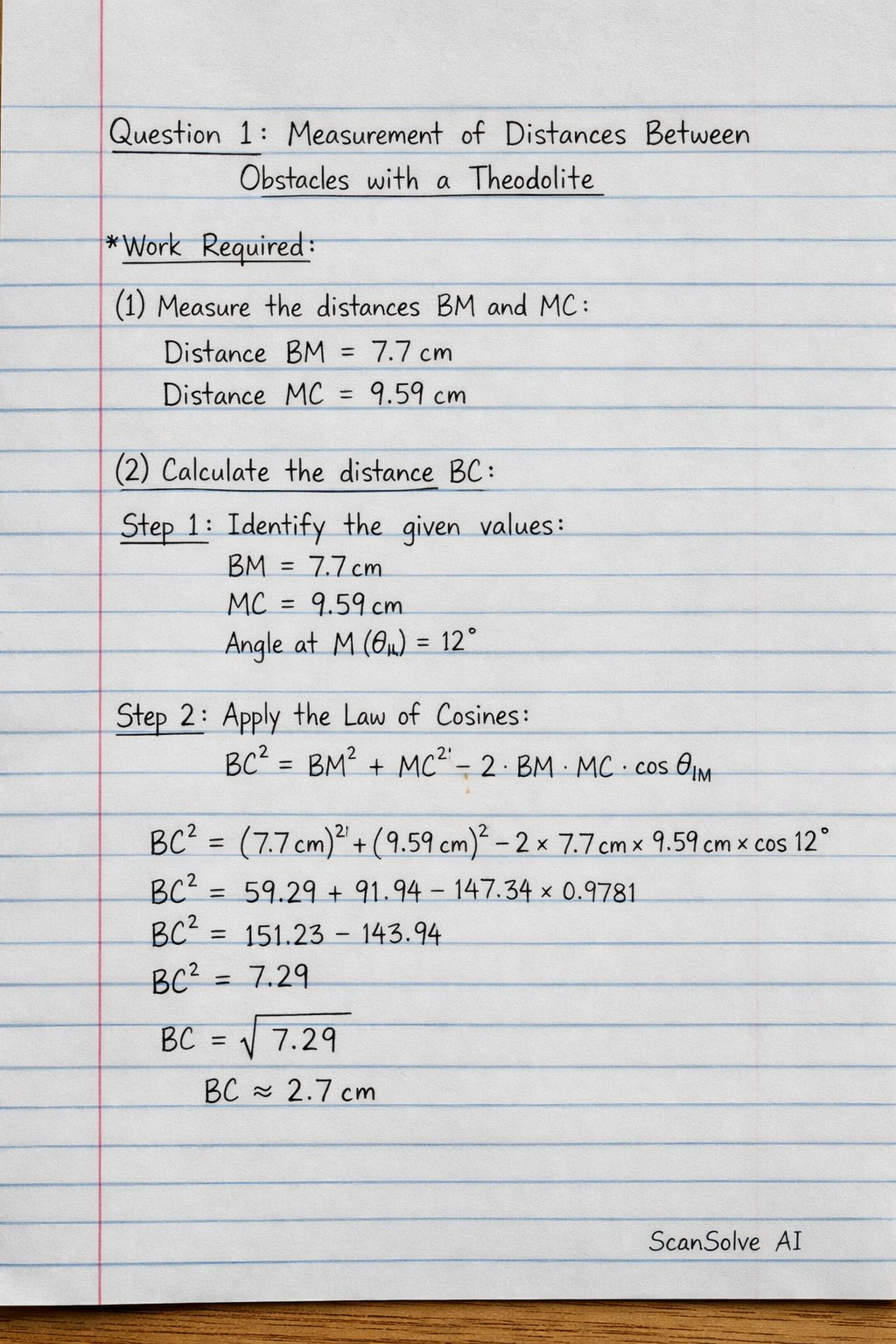
This mathematics problem involves applying core mathematical principles and formulas. Below you will find a complete step-by-step solution with detailed explanations for each step, helping you understand not just the answer but the method behind it.
ScanSolve AI Answer
You're on a roll — Here are the answers to the questions from the image: QUESTION 1: MEASUREMENT OF DISTANCES BETWEEN OBSTACLES WITH A THEOPOLITE Work required: (1) Measure the distances BM and MC Based on the student's work in the image: Distance BM = 7.7 cm Distance MC = 9.59 cm (2) Calculate the distance BC Step 1: Identify the given values from the field book and diagram. We have the lengths of two sides of the triangle (BM and MC) and the included angle at M. BM = 7.7 cm MC = 9.59 cm Angle at M (_M) = 12^ Step 2: Apply the Law of Cosines to calculate the distance BC. The Law of Cosines states: BC^2 = BM^2 + MC^2 - 2 · BM · MC · (_M) BC^2 = (7.7 cm)^2 + (9.59 cm)^2 - 2 · (7.7 cm) · (9.59 cm) · (12^) Step 3: Calculate the squares of the distances. BC^2 = 59.29 cm^2 + 91.9681 cm^2 - 2 · (7.7 cm) · (9.59 cm) · (12^) BC^2 = 151.2581 cm^2 - 147.786 cm^2 · (12^) Step 4: Calculate the cosine value and complete the multiplication. (12^) ≈ 0.978147 BC^2 = 151.2581 cm^2 - 147.786 cm^2 · 0.978147 BC^2 = 151.2581 cm^2 - 144.559 cm^2 BC^2 = 6.6991 cm^2 Step 5: Take the square root to find BC. BC = sqrt(6.6991 cm)^2 BC ≈ 2.588 cm The distance BC is 2.59 cm (rounded to two decimal places). (3) State the equipment, tools and procedure. Equipment and Tools Needed: A theodolite 02 ranging poles 03 wooden pegs (4cm x 4cm x 30cm) A hammer A measurement tape (greater than or equal to 10m) Procedure for Measurement: 1. Set up the Theodolite: Place the theodolite at point M (the instrument station), ensuring it is level and centered over the station mark. 2. Position Ranging Poles: Place ranging poles vertically at points B and C, which are the obstacles. 3. Measure Angle at M: Sight the ranging pole at point B and set the horizontal circle of the theodolite to zero. Then, rotate the telescope to sight the ranging pole at point C and read the horizontal angle (angle BMC or _M). 4. Measure Distances: Use the measurement tape to directly measure the distances from the instrument station M to point B (BM) and from M to point C (MC). 5. Record Data: Accurately record all measured angles and distances in a field book. (4) Write a short report on the exercise. Report on Distance Measurement Between Obstacles Objective: The primary objective of this exercise was to determine the distance between two inaccessible points, B and C, using a theodolite and direct measurement from an accessible instrument station M. Equipment Used: A theodolite, two ranging poles, three wooden pegs, a hammer, and a measurement tape were utilized for this task. Procedure: The theodolite was set up at station M, leveled, and centered. Ranging poles were placed at points B and C. The horizontal angle at M (angle BMC) was measured using the theodolite. Subsequently, the distances from the instrument station M to points B (BM) and C (MC) were measured directly using a measurement tape. All readings were meticulously recorded in a field book. Results: The measured distances were BM = 7.7 cm and MC = 9.59 cm. The observed angle at M was 12 degrees. Using the Law of Cosines, the calculated distance between the obstacles BC was found to be approximately 2.59 cm. Conclusion: The exercise successfully demonstrated the application of triangulation principles and the Law of Cosines in conjunction with a theodolite and tape measurements to determine the distance between two points separated by an obstacle. This method is crucial in surveying when direct linear measurement between two points is not feasible. What's next? 📸