

This chemistry question involves key chemical concepts and calculations. The detailed solution below walks through each step, from identifying the reaction type to computing the final answer.
ScanSolve AI Answer
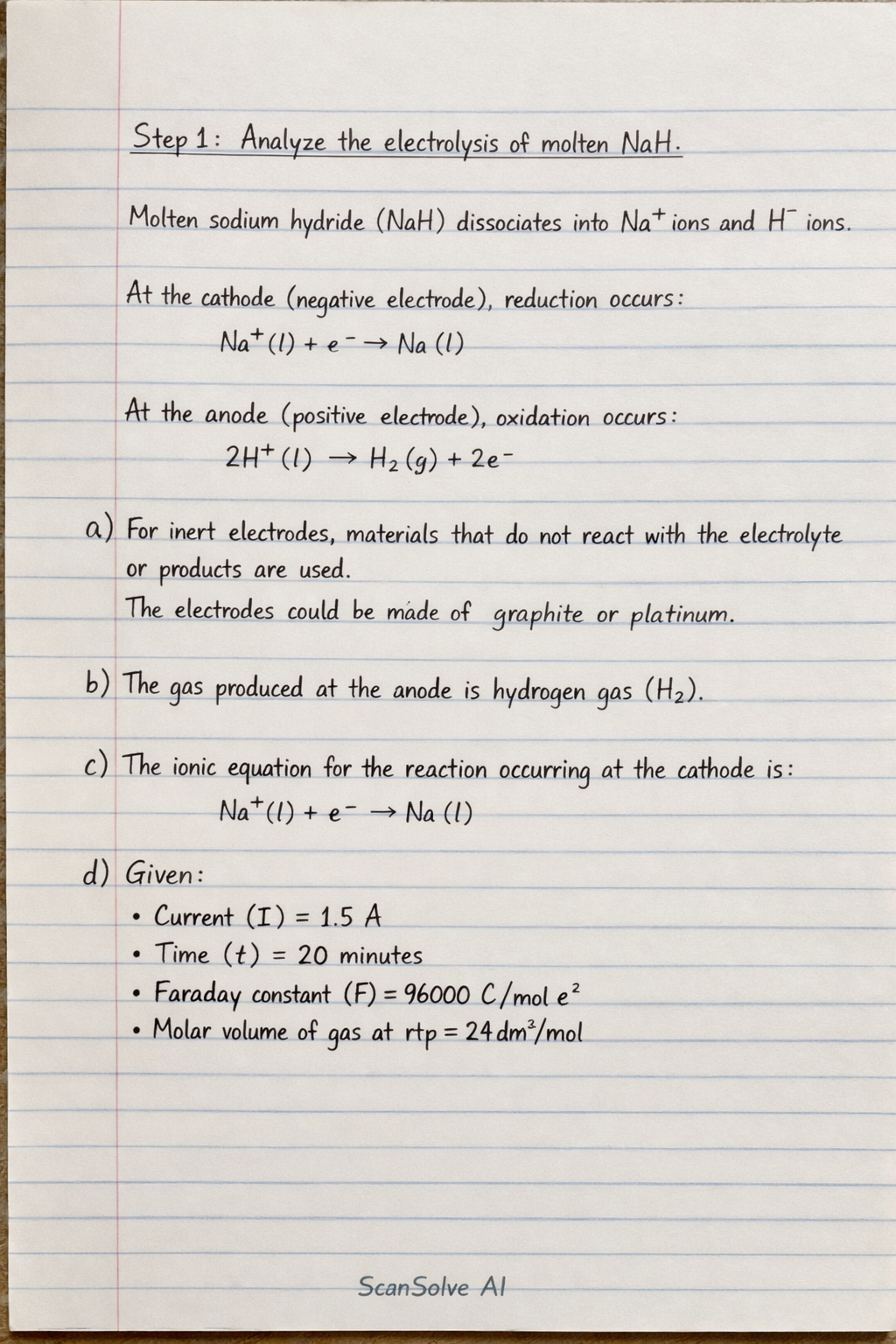
Step 1: Analyze the electrolysis of molten NaH. Molten sodium hydride (NaH) dissociates into Na^+ ions and H^- ions. At the cathode (negative electrode), reduction occurs: Na^+ (l) + e^- Na (l) At the anode (positive electrode), oxidation occurs: 2H^- (l) H_2 (g) + 2e^- a) For inert electrodes, materials that do not react with the electrolyte or products are used. The electrodes could be made of graphite or platinum. b) The gas produced at the anode is hydrogen gas (H_2). c) The ionic equation for the reaction occurring at the cathode is: Na^+ (l) + e^- Na (l) d) Given: Current (I) = 1.5 A Time (t) = 20 minutes Faraday constant (F) = 96000 C/mol e^- Molar volume of gas at rtp = 24 dm^3/mol i) Calculate the number of Faradays used in the experiment. First, convert time to seconds: t = 20 min × 60 s/min = 1200 s Next, calculate the total charge (Q) passed: Q = I × t = 1.5 A × 1200 s = 1800 C Now, calculate the number of Faradays: Number of Faradays = (Q)/(Faraday constant) = 1800 C96000 C/F = 0.01875 F The number of Faradays used is 0.01875 F. ii) Calculate the number of moles of Na atom produced. From the cathode reaction: Na^+ (l) + e^- Na (l). 1 mole of Na is produced by 1 mole of electrons (1 Faraday). Moles of Na = Number of Faradays = 0.01875 mol The number of moles of Na atom produced is 0.01875 mol. iii) Calculate the volume of gas produced at rtp. From the anode reaction: 2H^- (l) H_2 (g) + 2e^-. 1 mole of H_2 gas is produced by 2 moles of electrons (2 Faradays). Moles of H_2 = Number of Faradays2 = 0.01875 F2 = 0.009375 mol At rtp, 1 mole of gas occupies 24 dm^3. Volume of H_2 = Moles of H_2 × Molar volume at rtp Volume of H_2 = 0.009375 mol × 24 dm^3/mol = 0.225 dm^3 The volume of gas produced at rtp is 0.225 dm^3.