
We read your photo as:
Mr. Smith offers students two paying options for training. The first option costs R 1 025 per hour plus an additional of R4 800. The second option cost R1 345 per hour with no annual amount.
ScanSolve AI Answer
Step-by-step solution
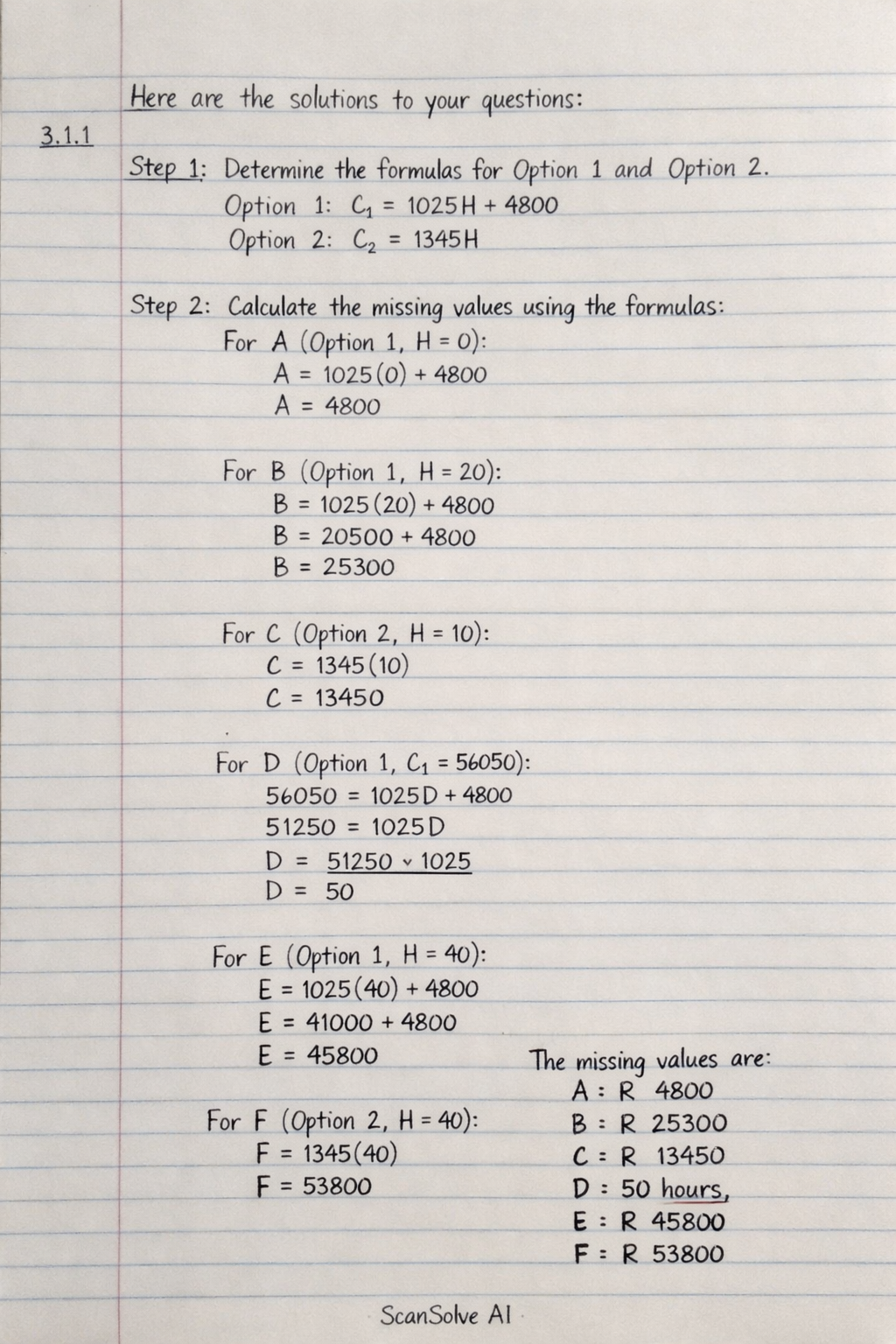
5 stepsHere are the solutions to your questions:
3.1.1
Determine the formulas for Option 1 and Option 2.
Option 1: Cost () = R 1 025 per hour + R 4 800. So, .
Option 2: Cost () = R 1 345 per hour. So, .Calculate the missing values using the formulas.
- For A (Option 1, ):
- For B (Option 1, ):
- For C (Option 2, ):
- For D (Option 1, ):
- For E (Option 1, ):
- For F (Option 2, ):
The missing values are:
- A:
- B:
- C:
- D:
- E:
- F:
3.1.2
The formula for Option 1 is:where is the cost and is the number of hours.
3.1.3
The dependent variable is the Cost (R).
Reason: The cost depends on the number of hours worked; as the number of hours changes, the total cost changes.3.1.4
To draw the graphs:- Heading: Cost of Training Options vs. Number of Hours
- X-axis: Label "Number of Hours (H)". Scale from 0 to 50, perhaps in increments of 5 or 10.
- Y-axis: Label "Cost (R)". Scale from 0 to 70000, perhaps in increments of 5000 or 10000.
- Plot points for Option 1: (0, 4800), (5, 9925), (10, 15050), (20, 25300), (30, 35550), (40, 45800), (50, 56050). Connect these points with a straight line and label it "Option 1".
- Plot points for Option 2: (0, 0), (5, 6725), (10, 13450), (20, 26900), (30, 40350), (40, 53800), (50, 67250). Connect these points with a straight line and label it "Option 2".
- Break-even point: Mark the intersection of the two lines.
3.1.5
Set the costs of the two options equal to find the break-even point.
Solve for .
Substitute into either cost formula to find the rand value.
Using Option 1:
Using Option 2:
The break-even point is .
Still stuck on this one?
Ask a follow-up, and the answer starts from this question.
More Mathematics Questions
Handwritten Step-by-Step Solution
Get this as a handwritten image on WhatsApp — like a tutor wrote it for you.
Try on WhatsApp