
We read your photo as:
Name three other angles, with reasons, equal to 32° and determine the values of M, T, and N.
ScanSolve AI Answer
Answer
Step-by-step solution
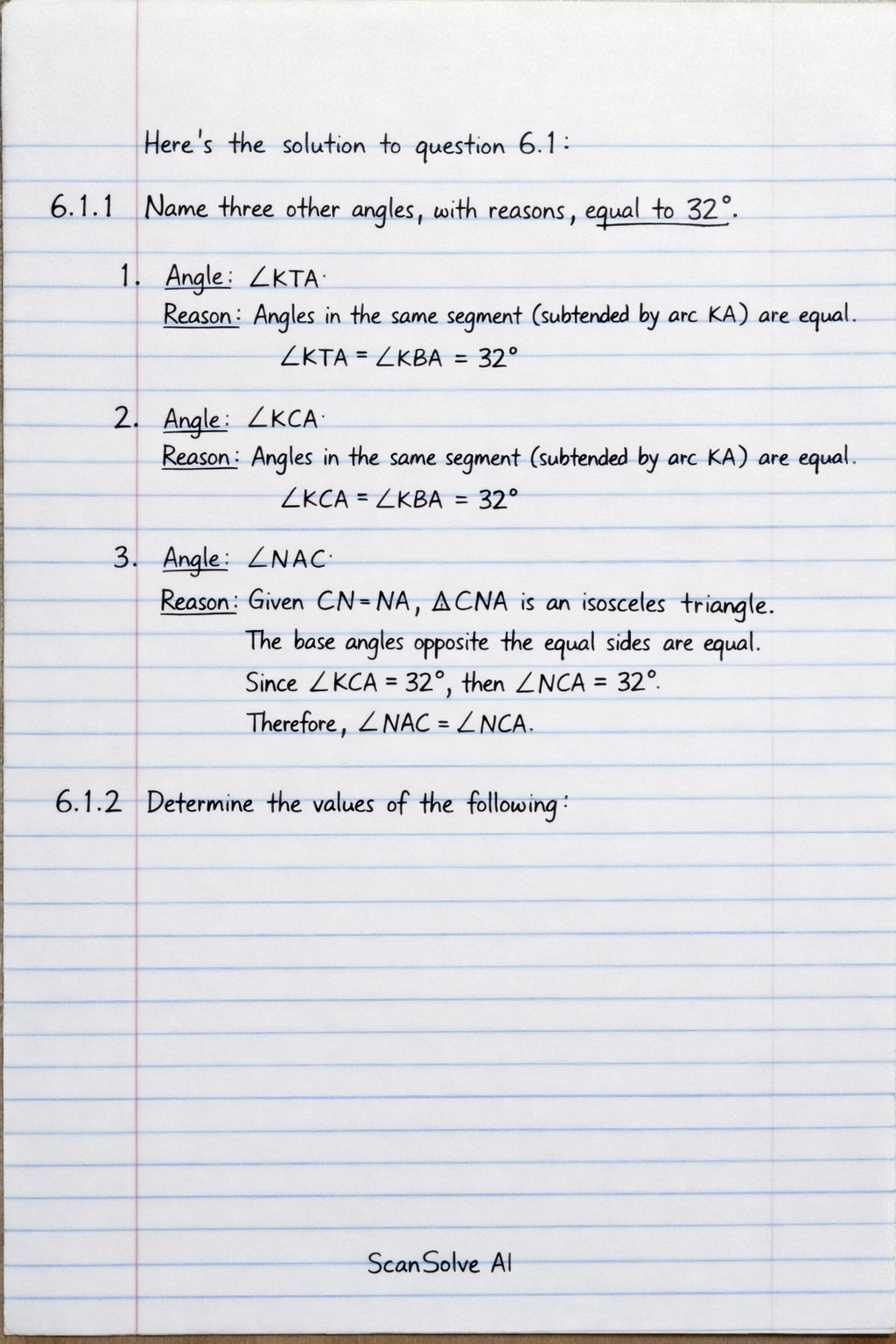
7 stepsHere's the solution to question 6.1:
6.1.1 Name three other angles, with reasons, equal to .
Given .
-
Angle: Reason: Angles in the same segment (subtended by arc KA) are equal.
-
Angle: Reason: Angles in the same segment (subtended by arc KA) are equal.
-
Angle: Reason: Given , is an isosceles triangle. The base angles opposite the equal sides are equal. Since , then . Therefore, .
6.1.2 Determine the values of the following:
6.1.2a) M
Assuming M refers to , the angle at the center.
Identify the relationship between the angle at the center and the angle at the circumference.
The angle at the center subtended by an arc is twice the angle at the circumference subtended by the same arc. Arc KA subtends at the center and at the circumference.
Calculate the angle.
The value of M is
6.1.2b)
refers to .Identify the relationship between and .
Both angles are subtended by the same arc KA in the circle.
State the value.
The value of is
6.1.2c) N
N refers to .Use the given information about .
We are given , which means is an isosceles triangle.
Determine the base angles of .
From 6.1.1, we found and .
Calculate using the sum of angles in a triangle.
The sum of angles in is .
The value of N is
Try one yourself
A new problem that tests the same skill.
Still stuck on this one?
Ask a follow-up, and the answer starts from this question.
More Mathematics Questions
Handwritten Step-by-Step Solution
Get this as a handwritten image on WhatsApp — like a tutor wrote it for you.
Try on WhatsApp