We read your photo as:

Find the nature of roots for quadratic equations and evaluate expressions involving roots.

Mathematics

ScanSolve AI Answer

Answer

b

112\frac{1}{12}

-3

x2+2x−3=0x^2 + 2x - 3 = 0

Step-by-step solution

19 steps

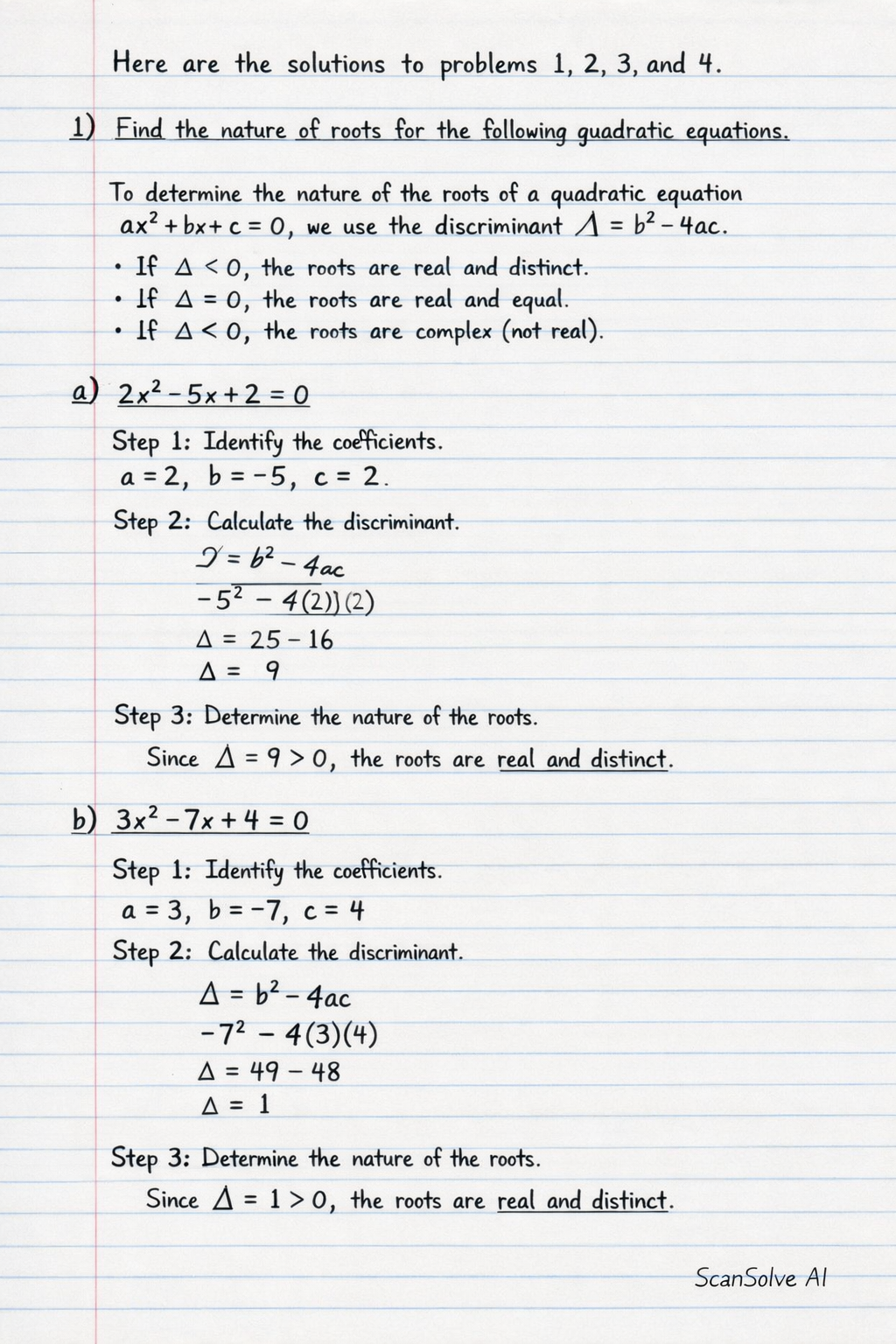
Here are the solutions to problems 1, 2, 3, and 4.

1) Find the nature of roots for the following quadratic equations

To determine the nature of the roots of a quadratic equation ax2+bx+c=0ax^2 + bx + c = 0, we use the discriminant Δ=b2−4ac\Delta = b^2 - 4ac.

  • If Δ>0\Delta > 0, the roots are real and distinct.
  • If Δ=0\Delta = 0, the roots are real and equal.
  • If Δ<0\Delta < 0, the roots are complex (not real).

Part a· 3 steps

2x2−5x+2=02x^2 - 5x + 2 = 0

  1. Identify the coefficients.

    Here, a=2a=2, b=−5b=-5, c=2c=2.

  2. Calculate the discriminant.

    Δ=b2−4ac=(−5)2−4(2)(2)\Delta = b^2 - 4ac = (-5)^2 - 4(2)(2) Δ=25−16\Delta = 25 - 16 Δ=9\Delta = 9
  3. Determine the nature of the roots.

    Since Δ=9>0\Delta = 9 > 0, the roots are real and distinct.

Part b

112\frac{1}{12}

3x2−7x+4=03x^2 - 7x + 4 = 0

  1. Identify the coefficients.

    Here, a=3a=3, b=−7b=-7, c=4c=4.

  2. Calculate the discriminant.

    Δ=b2−4ac=(−7)2−4(3)(4)\Delta = b^2 - 4ac = (-7)^2 - 4(3)(4) Δ=49−48\Delta = 49 - 48 Δ=1\Delta = 1
  3. Determine the nature of the roots.

    Since Δ=1>0\Delta = 1 > 0, the roots are real and distinct.

    2) If α\alpha and β\beta are the roots of the equation 3x2−5x+4=03x^2 - 5x + 4 = 0, find the value of α/β+β/α\alpha/\beta + \beta/\alpha.

  4. Identify the coefficients of the quadratic equation ax2+bx+c=0ax^2 + bx + c = 0.

    For 3x2−5x+4=03x^2 - 5x + 4 = 0, we have a=3a=3, b=−5b=-5, c=4c=4.

  5. Find the sum and product of the roots.

    Sum of roots: α+β=−ba=−−53=53\alpha + \beta = -\frac{b}{a} = -\frac{-5}{3} = \frac{5}{3}.
    Product of roots: αβ=ca=43\alpha\beta = \frac{c}{a} = \frac{4}{3}.

  6. Simplify the expression αβ+βα\frac{\alpha}{\beta} + \frac{\beta}{\alpha}.

    αβ+βα=α2+β2αβ\frac{\alpha}{\beta} + \frac{\beta}{\alpha} = \frac{\alpha^2 + \beta^2}{\alpha\beta}

    We know that α2+β2=(α+β)2−2αβ\alpha^2 + \beta^2 = (\alpha + \beta)^2 - 2\alpha\beta.
    Substitute this into the expression:

    α2+β2αβ=(α+β)2−2αβαβ\frac{\alpha^2 + \beta^2}{\alpha\beta} = \frac{(\alpha + \beta)^2 - 2\alpha\beta}{\alpha\beta}
  7. Substitute the values of (α+β)(\alpha + \beta) and αβ\alpha\beta.

    =(53)2−2(43)43= \frac{\left(\frac{5}{3}\right)^2 - 2\left(\frac{4}{3}\right)}{\frac{4}{3}} =259−8343= \frac{\frac{25}{9} - \frac{8}{3}}{\frac{4}{3}}

    To subtract the terms in the numerator, find a common denominator:

    =259−8×33×343= \frac{\frac{25}{9} - \frac{8 \times 3}{3 \times 3}}{\frac{4}{3}} =259−24943= \frac{\frac{25}{9} - \frac{24}{9}}{\frac{4}{3}} =1943= \frac{\frac{1}{9}}{\frac{4}{3}}
  8. Perform the division.

    =19×34= \frac{1}{9} \times \frac{3}{4} =336= \frac{3}{36} =112= \frac{1}{12}

    The value of αβ+βα\frac{\alpha}{\beta} + \frac{\beta}{\alpha} is 112\boxed{\frac{1}{12}}.

    3) If α\alpha and β\beta are the roots of the equation 2x2−4x+7=02x^2 - 4x + 7 = 0, find α2+β2\alpha^2 + \beta^2.

  9. Identify the coefficients of the quadratic equation ax2+bx+c=0ax^2 + bx + c = 0.

    For 2x2−4x+7=02x^2 - 4x + 7 = 0, we have a=2a=2, b=−4b=-4, c=7c=7.

  10. Find the sum and product of the roots.

    Sum of roots: α+β=−ba=−−42=42=2\alpha + \beta = -\frac{b}{a} = -\frac{-4}{2} = \frac{4}{2} = 2.
    Product of roots: αβ=ca=72\alpha\beta = \frac{c}{a} = \frac{7}{2}.

  11. Use the identity for α2+β2\alpha^2 + \beta^2.

    α2+β2=(α+β)2−2αβ\alpha^2 + \beta^2 = (\alpha + \beta)^2 - 2\alpha\beta
  12. Substitute the values of (α+β)(\alpha + \beta) and αβ\alpha\beta.

    α2+β2=(2)2−2(72)\alpha^2 + \beta^2 = (2)^2 - 2\left(\frac{7}{2}\right) α2+β2=4−7\alpha^2 + \beta^2 = 4 - 7 α2+β2=−3\alpha^2 + \beta^2 = -3

    The value of α2+β2\alpha^2 + \beta^2 is −3\boxed{-3}.

    4) Construct and simplify equations whose roots are −3,1-3, 1.

  13. Let the given roots be r1=−3r_1 = -3 and r2=1r_2 = 1.

  14. Calculate the sum of the roots (S).

    S=r1+r2=−3+1=−2S = r_1 + r_2 = -3 + 1 = -2
  15. Calculate the product of the roots (P).

    P=r1×r2=(−3)×(1)=−3P = r_1 \times r_2 = (-3) \times (1) = -3
  16. Form the quadratic equation using the general form x2−Sx+P=0x^2 - Sx + P = 0.

    x2−(−2)x+(−3)=0x^2 - (-2)x + (-3) = 0 x2+2x−3=0x^2 + 2x - 3 = 0

    The constructed quadratic equation is x2+2x−3=0\boxed{x^2 + 2x - 3 = 0}.

Was this helpful?

Try one yourself

A new problem that tests the same skill.

Still stuck on this one?

Ask a follow-up, and the answer starts from this question.

Got a different question?Ask your own question
Handwritten step-by-step solution preview

Handwritten Step-by-Step Solution

Get this as a handwritten image on WhatsApp — like a tutor wrote it for you.

Try on WhatsApp