
We read your photo as:
Define a null matrix and provide an example.
ScanSolve AI Answer
Answer
Step-by-step solution
7 stepsDefine a null matrix and provide an example.
A null matrix (or zero matrix) is a matrix in which every element is zero.
An example of a null matrix is:Define a diagonal matrix and provide an example.
A diagonal matrix is a square matrix in which all the elements outside the main diagonal are zero.
An example of a diagonal matrix is:State the condition for a skew-symmetric matrix.
A square matrix is classified as skew-symmetric if its transpose is equal to its negative, i.e., .
Solve Question 2.1.
If , the matrix is skew-symmetric. For a skew-symmetric matrix, the elements on the main diagonal must be zero. This is because for any diagonal element , the condition must hold, which implies , so .
The correct option is C.
The elements on the diagonal of the matrix are equal toSolve Question 2.2.
We need to identify the false statement.
- A. If , then . This statement is true. If a matrix is singular (), its adjoint is also singular ().
- B. Adjoint of a diagonal matrix of order is a diagonal matrix. This statement is true. The cofactors of off-diagonal elements of a diagonal matrix are zero, so its adjoint will also be diagonal.
- C. Product of two upper triangular matrices is an upper triangular matrix. This statement is true. This is a known property of triangular matrices.
- D. . This statement is false. The correct property is . The false statement is
Solve Question 2.3.
Given and . We need to find .
Let . So .
To find , we can multiply both sides by on the right:
Then .First, calculate :
The determinant of is .
The inverse of is .Now, calculate :
The correct option is C.
isSolve Question 2.4.
Given and is skew-symmetric.
If is skew-symmetric, then . (Note: denotes the transpose, so ).
Substitute into the given equation:
Now, we need to classify . Let's find the transpose of :
Since , substitute this into the expression:
From the derived relation , we can substitute with :
This condition means that $BA
Try one yourself
A new problem that tests the same skill.
Still stuck on this one?
Ask a follow-up, and the answer starts from this question.
More Mathematics Questions
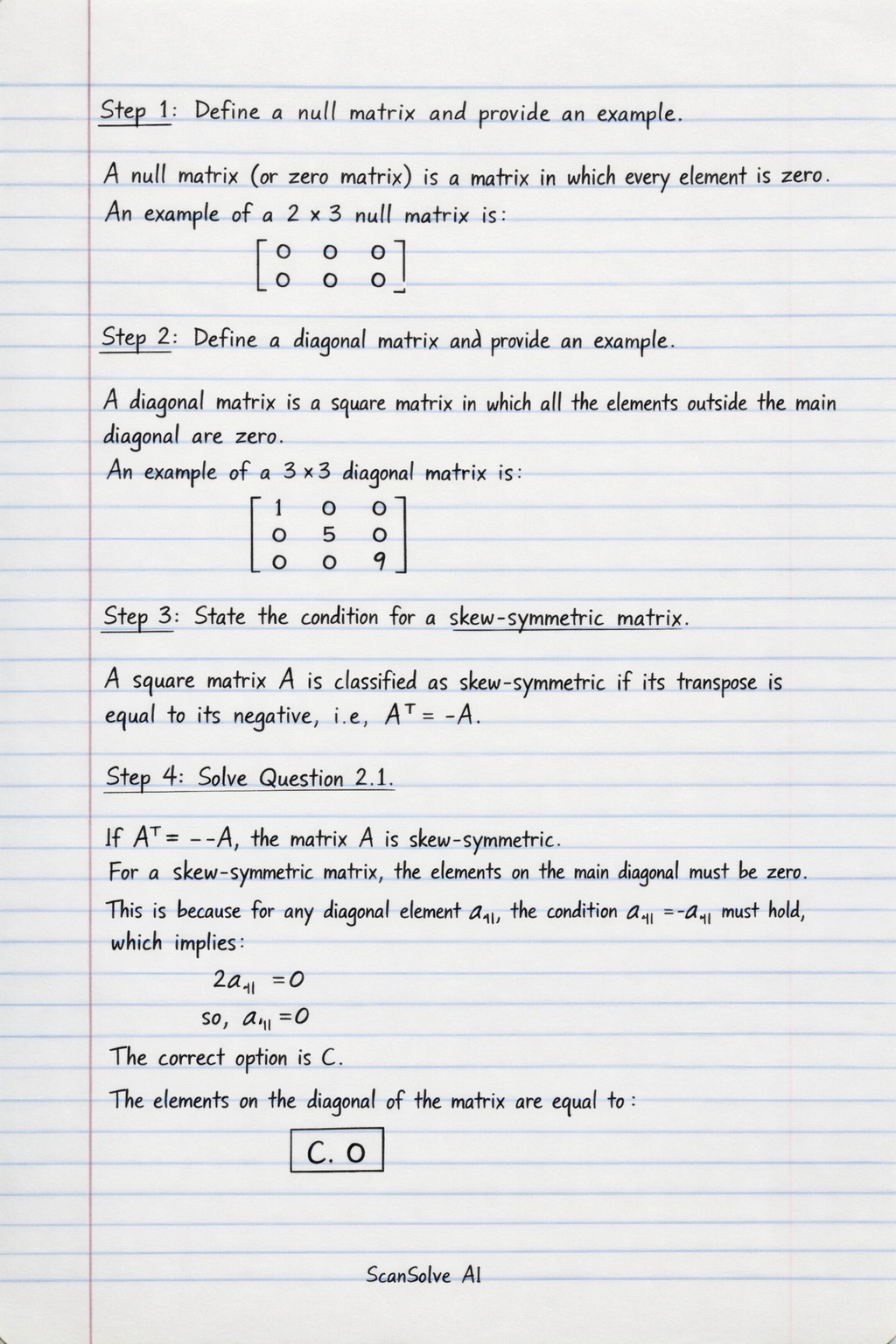
Handwritten Step-by-Step Solution
Get this as a handwritten image on WhatsApp — like a tutor wrote it for you.
Try on WhatsApp