
This mathematics problem involves applying core mathematical principles and formulas. Below you will find a complete step-by-step solution with detailed explanations for each step, helping you understand not just the answer but the method behind it.
ScanSolve AI Answer
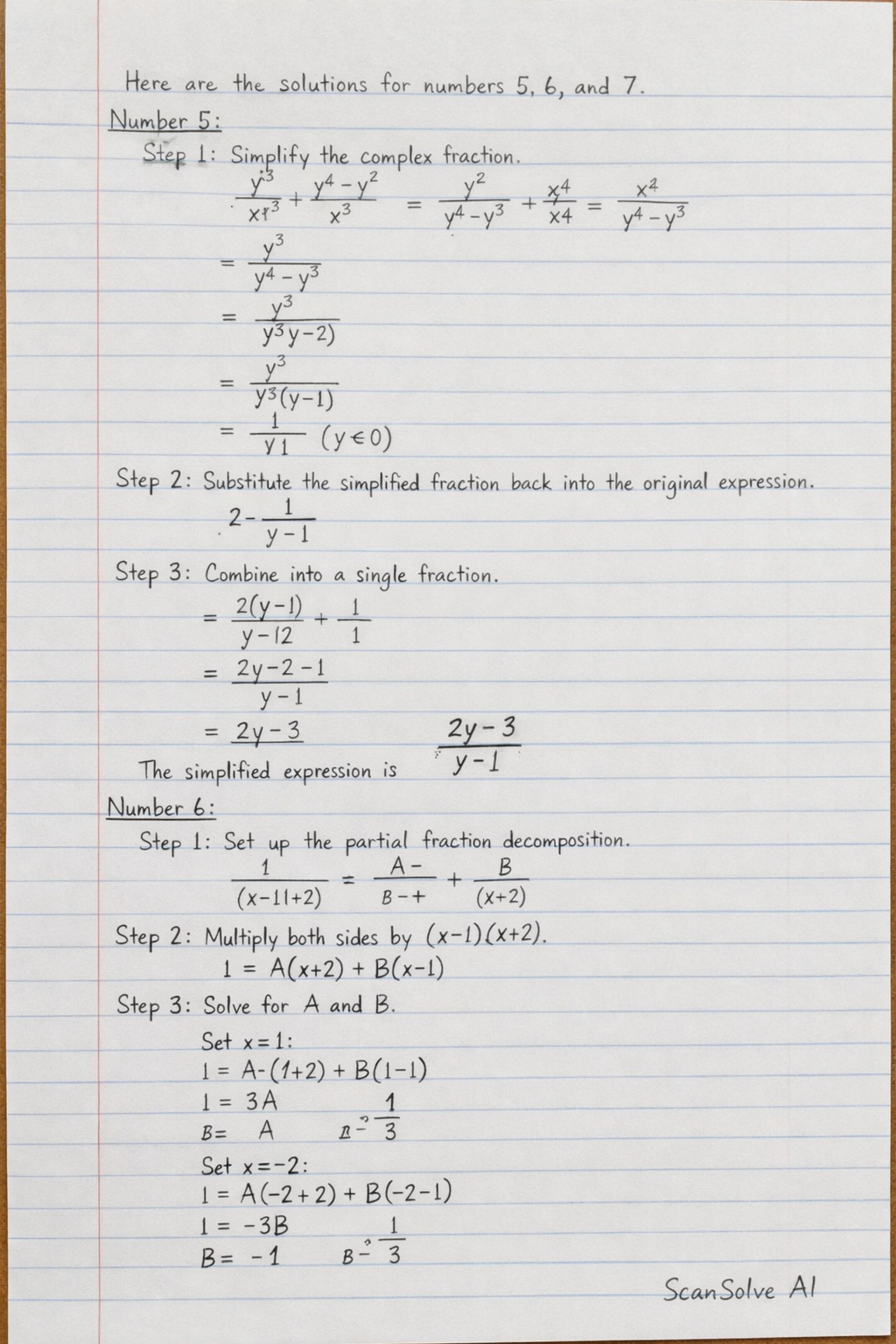
Here are the solutions for numbers 5, 6, and 7. Number 5: Step 1: Simplify the complex fraction. (y^3)/(x^4)(y^4-y^3)/(x^4) = (y^3)/(x^4) · (x^4)/(y^4-y^3) Cancel x^4: = (y^3)/(y^4-y^3) Factor out y^3 from the denominator: = (y^3)/(y^3(y-1)) Cancel y^3 (assuming y ≠ 0): = (1)/(y-1) Step 2: Substitute the simplified fraction back into the original expression. 2 - (1)/(y-1) Step 3: Combine into a single fraction. = (2(y-1))/(y-1) - (1)/(y-1) = (2y-2-1)/(y-1) = (2y-3)/(y-1) The simplified expression is (2y-3)/(y-1). Number 6: Step 1: Set up the partial fraction decomposition. (1)/((x-1)(x+2)) = (A)/(x-1) + (B)/(x+2) Step 2: Multiply both sides by (x-1)(x+2). 1 = A(x+2) + B(x-1) Step 3: Solve for A and B. Set x=1: 1 = A(1+2) + B(1-1) 1 = 3A A = (1)/(3) Set x=-2: 1 = A(-2+2) + B(-2-1) 1 = -3B B = -(1)/(3) Step 4: Write the partial fraction decomposition. (1)/((x-1)(x+2)) = (1)/(3)x-1 + (-1)/(3)x+2 = (1)/(3(x-1)) - (1)/(3(x+2)) The partial fraction decomposition is (1)/(3(x-1)) - (1)/(3(x+2)). Number 7: Step 1: Set up the partial fraction decomposition. (3)/((x-2)^2(x+1)) = (A)/(x-2) + (B)/((x-2)^2) + (C)/(x+1) Step 2: Multiply both sides by (x-2)^2(x+1). 3 = A(x-2)(x+1) + B(x+1) + C(x-2)^2 Step 3: Solve for A, B, and C. Set x=2: 3 = A(2-2)(2+1) + B(2+1) + C(2-2)^2 3 = 0 + 3B + 0 3B = 3 B = 1 Set x=-1: 3 = A(-1-2)(-1+1) + B(-1+1) + C(-1-2)^2 3 = 0 + 0 + C(-3)^2 3 = 9C C = (3)/(9) = (1)/(3) Set x=0 and substitute B=1, C=(1)/(3): 3 = A(0-2)(0+1) + B(0+1) + C(0-2)^2 3 = -2A + B + 4C 3 = -2A + 1 + 4((1)/(3)) 3 = -2A + 1 + (4)/(3) 3 - 1 - (4)/(3) = -2A 2 - (4)/(3) = -2A (6)/(3) - (4)/(3) = -2A (2)/(3) = -2A A = (2)/(3) · (-(1)/(2)) = -(1)/(3) Step 4: Write the partial fraction decomposition. (3)/((x-2)^2(x+1)) = (-1)/(3)x-2 + (1)/((x-2)^2) + (1)/(3)x+1 = -(1)/(3(x-2)) + (1)/((x-2)^2) + (1)/(3(x+1)) The partial fraction decomposition is -(1)/(3(x-2)) + (1)/((x-2)^2) + (1)/(3(x+1)).