

This mathematics problem involves applying core mathematical principles and formulas. Below you will find a complete step-by-step solution with detailed explanations for each step, helping you understand not just the answer but the method behind it.
ScanSolve AI Answer
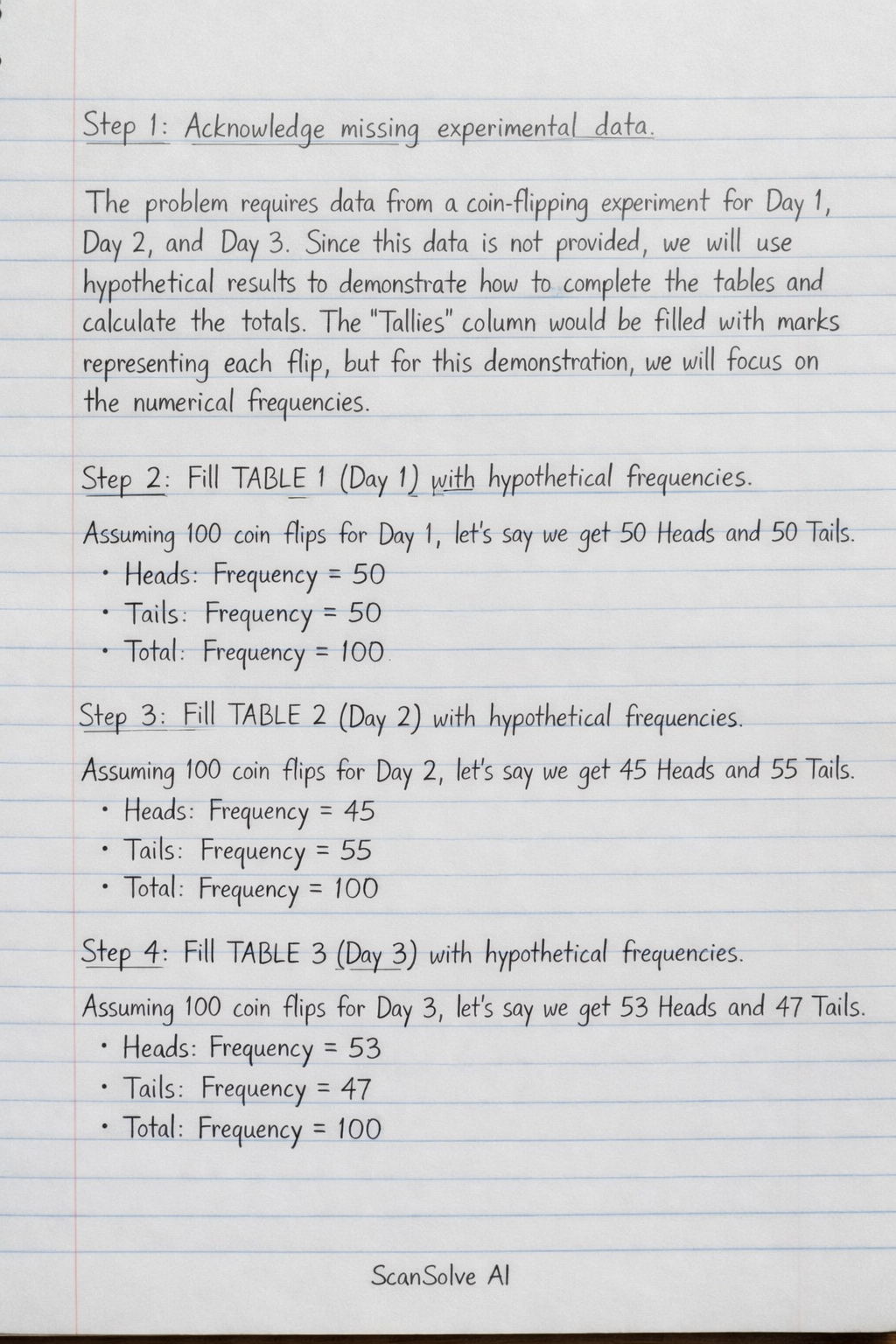
Step 1: Acknowledge missing experimental data. The problem requires data from a coin-flipping experiment for Day 1, Day 2, and Day 3. Since this data is not provided, we will use hypothetical results to demonstrate how to complete the tables and calculate the totals. The "Tallies" column would be filled with marks representing each flip, but for this demonstration, we will focus on the numerical frequencies. Step 2: Fill TABLE 1 (Day 1) with hypothetical frequencies. Assuming 100 coin flips for Day 1, let's say we get 50 Heads and 50 Tails. • Heads: Frequency = 50 • Tails: Frequency = 50 • Total: Frequency = 100 Step 3: Fill TABLE 2 (Day 2) with hypothetical frequencies. Assuming 100 coin flips for Day 2, let's say we get 45 Heads and 55 Tails. • Heads: Frequency = 45 • Tails: Frequency = 55 • Total: Frequency = 100 Step 4: Fill TABLE 3 (Day 3) with hypothetical frequencies. Assuming 100 coin flips for Day 3, let's say we get 53 Heads and 47 Tails. • Heads: Frequency = 53 • Tails: Frequency = 47 • Total: Frequency = 100 Step 5: Calculate the total frequencies for Heads and Tails for TABLE 4 (1.2.1). To find the total frequencies, sum the hypothetical frequencies from Day 1, Day 2, and Day 3. Total Heads = 50 (Day 1) + 45 (Day 2) + 53 (Day 3) = 148 Total Tails = 50 (Day 1) + 55 (Day 2) + 47 (Day 3) = 152 The completed TABLE 4: Totals of Head and Tails is: |c|c|c| & Heads & Tails \\ Total & 148 & 152 \\ The total frequencies for heads and tails are: Heads: 148 Tails: 152