
We read your photo as:
Which of the following options represents a pair of integers whose sum and difference are both zero? a) one b) zero c) two d) Cannot be determined
Mathematics
ScanSolve AI Answer
Step-by-step solution
3 stepsAnalyze Option (b) - zero.
We are looking for a pair of integers such that their sum is zero AND their difference is zero.
We set up a system of equations:Solve the system of equations.
Add equation (1) and equation (2):
Substitute into equation (1):
Verify the solution.
The pair of integers is .
For this pair:
Sum:
Difference:Both the sum and the difference are 0. Since 0 is an integer, this pair satisfies the condition that both their sum and difference result in zero.
Therefore, there is a pair of integers whose sum and difference both result in zero.
The final answer is
Was this helpful?
Still stuck on this one?
Ask a follow-up, and the answer starts from this question.
Got a different question?Ask your own question
More Mathematics Questions
QGiven a pair of integers (a, b), can their sum and difference both be zero?QWhich of the following numbers is NOT a unit digit of a perfect square? a) 6 b) 1 c) 9 d) 8QThe relation in the set A is given by A = 1, 6, 9. If d=a-b. Is d = a-b given by: (A) 0, −5, −8 (B)…QWhich of the following numbers is not a probability? a) 0.1 b) −1 c) 1/4 d) 120%QA) The sum of three consecutive integers is 42. Find the integers. b) Find the range of these…
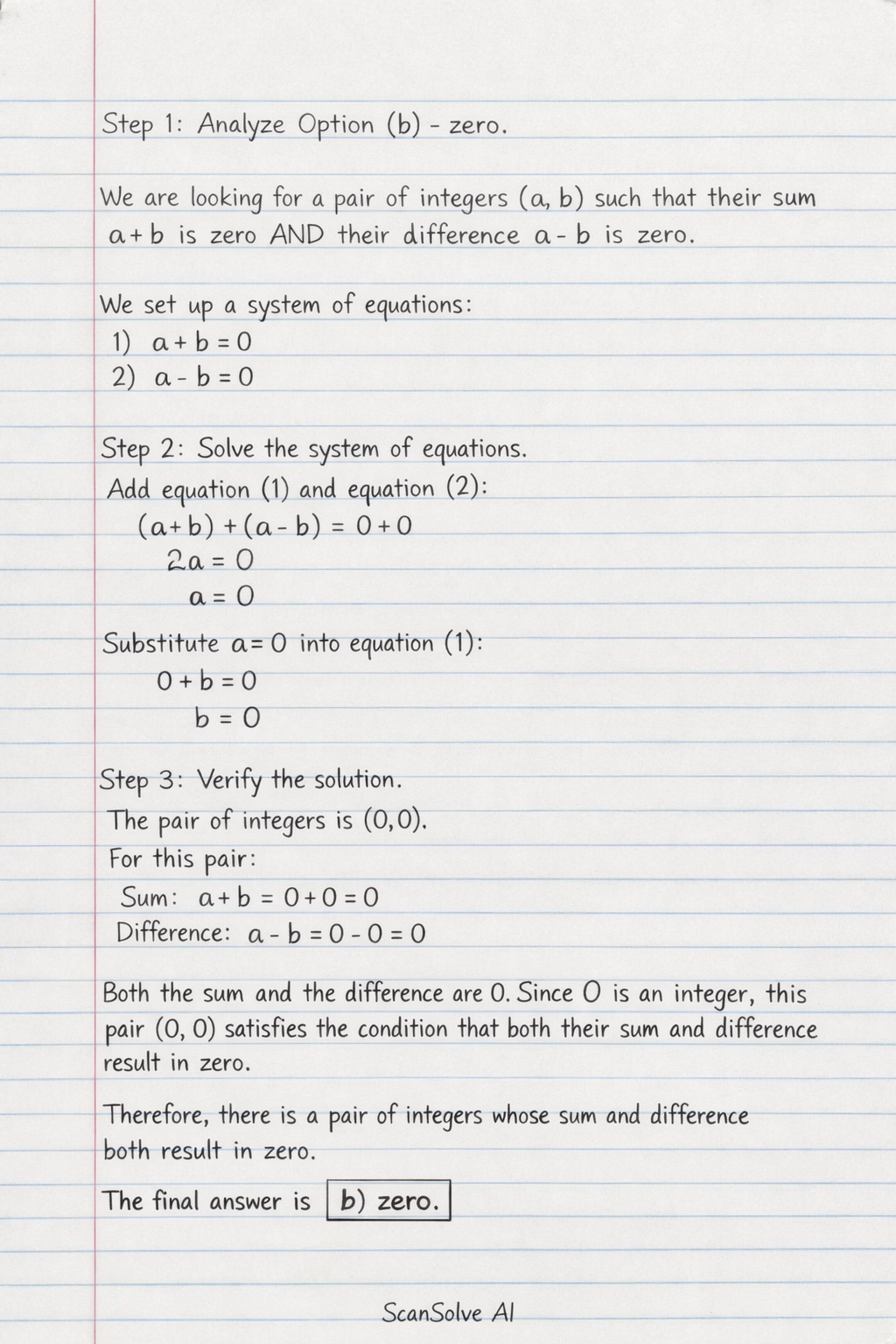
Handwritten Step-by-Step Solution
Get this as a handwritten image on WhatsApp — like a tutor wrote it for you.
Try on WhatsApp