
We read your photo as:
Which of the following numbers is NOT a unit digit of a perfect square? a) 6 b) 1 c) 9 d) 8
ScanSolve AI Answer
Answer
Step-by-step solution
5 stepsSolve Question 6.
The units digit of a perfect square can only be 0, 1, 4, 5, 6, or 9.
Checking the given options:- (a) 6: Can be a units digit of a perfect square (e.g., ).
- (b) 1: Can be a units digit of a perfect square (e.g., ).
- (c) 9: Can be a units digit of a perfect square (e.g., ).
- (d) 8: Cannot be a units digit of a perfect square.
The correct option is (d).
Solve Question 7.
The number of non-perfect square numbers between and is given by the formula .
Here, .
Number of numbers between and is .The correct option is (b).
Solve Question 8.
The sum of the first odd natural numbers is .
The series to terms represents the sum of the first odd natural numbers.
Therefore, the sum is equal to .The correct option is (c).
Solve Question 9.
The square of an even number is always an even number. This means its units digit must be 0, 4, or 6.
Let's check the options:- (a) 196: Units digit is 6. . Since 14 is an even number, 196 is the square of an even number.
- (b) 441: Units digit is 1. . Since 21 is an odd number, 441 is the square of an odd number.
- (c) 625: Units digit is 5. . Since 25 is an odd number, 625 is the square of an odd number.
- (d) 529: Units digit is 9. . Since 23 is an odd number, 529 is the square of an odd number.
The correct option is (a).
Solve Question 10.
The square of an odd number is always an odd number. This means its units digit must be 1, 5, or 9.
Let's check the options:- (a) 2116: Units digit is 6. This is an even number. , which is an even number.
- (b) 3844: Units digit is 4. This is an even number. , which is an even number.
- (c) 1369: Units digit is 9. This is an odd number. . Since 37 is an odd number, 1369 is the square of an odd number.
- (d) 2500: Units digit is 0. This is an even number. , which is an even number.
The correct option is (c).
Try one yourself
A new problem that tests the same skill.
Still stuck on this one?
Ask a follow-up, and the answer starts from this question.
More Mathematics Questions
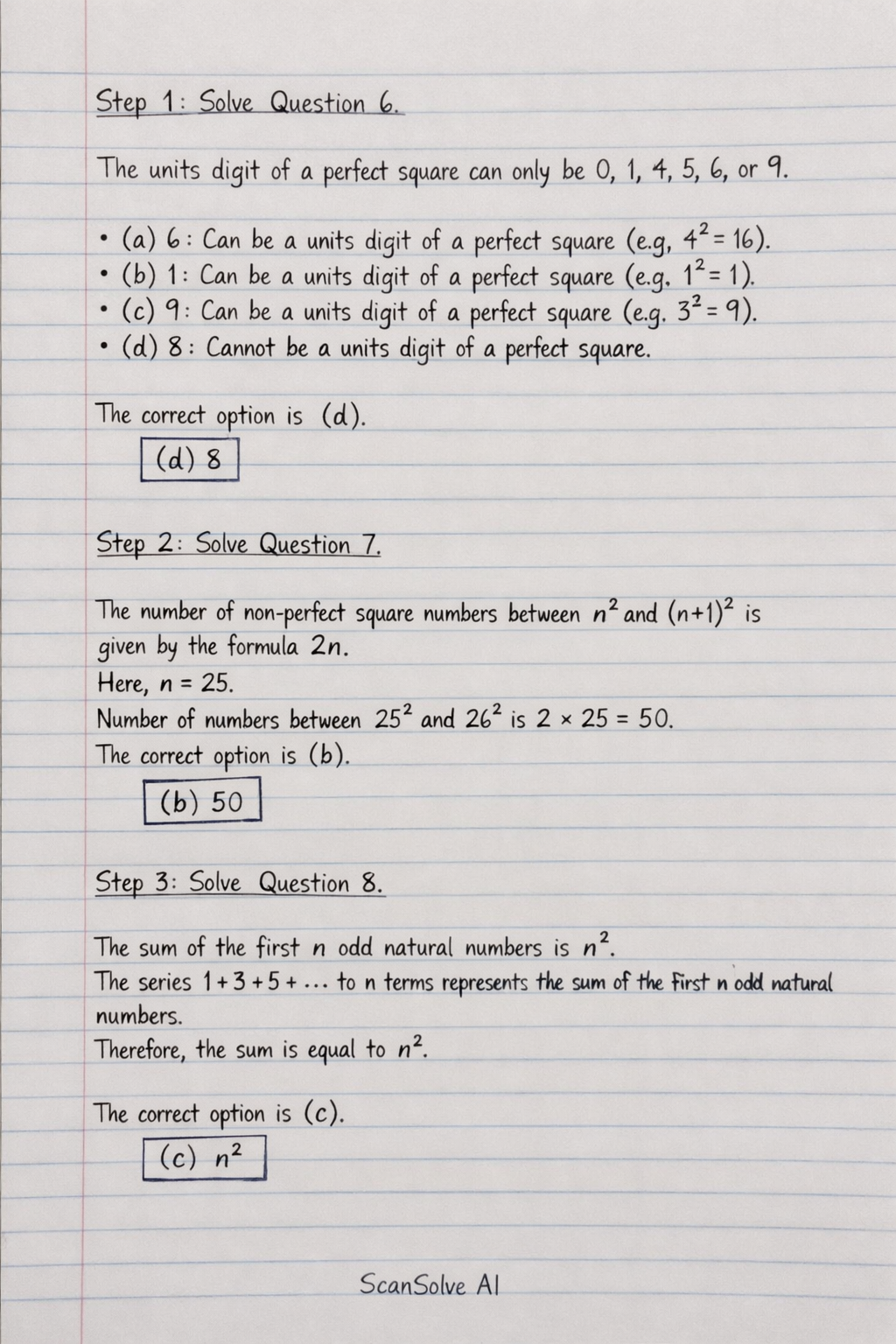
Handwritten Step-by-Step Solution
Get this as a handwritten image on WhatsApp — like a tutor wrote it for you.
Try on WhatsApp