We read your photo as:

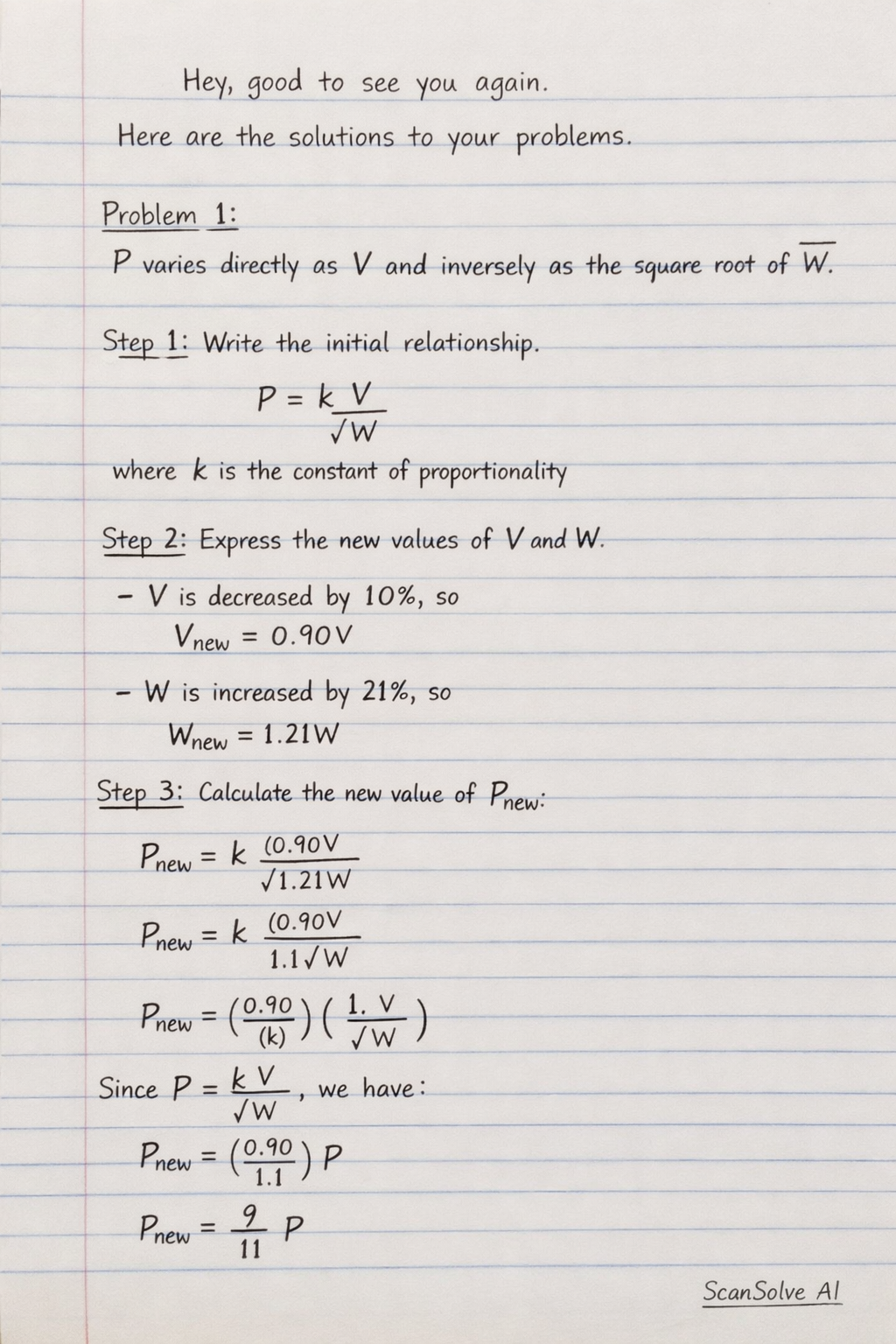
P varies directly as V and inversely as the square root of W. If V is decreased by 10% and W is increased by 21%, what is the percentage change in P?

Mathematics

ScanSolve AI Answer

This answer stops before the end.

It was cut off when it was first written. Ask ScanSolve this question again for the full working.

Here are the solutions to your problems.

:

P varies directly as V and inversely as the square root of W.

Step 1: Write the initial relationship.

P=kVWP = k \frac{V}{\sqrt{W}}

where kk is the constant of proportionality.

Step 2: Express the new values of V and W.
V is decreased by 10%, so Vnew=V−0.10V=0.90VV_{new} = V - 0.10V = 0.90V.
W is increased by 21%, so Wnew=W+0.21W=1.21WW_{new} = W + 0.21W = 1.21W.

Step 3: Calculate the new value of P (PnewP_{new}).

Pnew=kVnewWnew=k0.90V1.21WP_{new} = k \frac{V_{new}}{\sqrt{W_{new}}} = k \frac{0.90V}{\sqrt{1.21W}} Pnew=k0.90V1.1WP_{new} = k \frac{0.90V}{1.1\sqrt{W}} Pnew=0.901.1(kVW)P_{new} = \frac{0.90}{1.1} \left( k \frac{V}{\sqrt{W}} \right)

Since P=kVWP = k \frac{V}{\sqrt{W}}, we have:

Pnew=0.901.1PP_{new} = \frac{0.90}{1.1} P Pnew=911PP_{new} = \frac{9}{11} P

Step 4: Calculate the percentage change in P.
Percentage change =Pnew−PP×100%= \frac{P_{new} - P}{P} \times 100\%
Percentage change = \left( \frac{\frac{9}{11}P - P}{P} \right) \times 100\%$$ Percentage change = \left( \frac{9}{11} - 1 \right) \times 100% Percentage change $= \left( \frac{9 - 11}{11} \right) \times 100\% Percentage change = \left( -\frac{2}{11} \right) \times 100\%$$ Percentage change \approx -18.18%$

The percentage change in P is a decrease of approximately 18.18%.

Decrease of 18.18%\boxed{\text{Decrease of } 18.18\%}

:

R varies directly as S and inversely as the square root of T.

a) Write an equation connecting R, S and T.

Step 1: Write the general variation equation.

R=kSTR = k \frac{S}{\sqrt{T}}

where kk is the constant of proportionality.

b) Find the value of R when S = 360 and T = 1.5.

Step 1: Find the constant of proportionality (kk) using the given values R=480R = 480, S=150S = 150, and T=5T = 5.

480=k1505480 = k \frac{150}{\sqrt{5}} k=4805150k = \frac{480 \sqrt{5}}{150} k=48515k = \frac{48 \sqrt{5}}{15} k=1655k = \frac{16 \sqrt{5}}{5}

Step 2: Write the specific equation for R.

R=1655STR = \frac{16 \sqrt{5}}{5} \frac{S}{\sqrt{T}}

Step 3: Substitute the new values S=360S = 360 and T=1.5T = 1.5 into the equation.

R=16553601.5R = \frac{16 \sqrt{5}}{5} \frac{360}{\sqrt{1.5}} R=165536032R = \frac{16 \sqrt{5}}{5} \frac{360}{\sqrt{\frac{3}{2}}} R=165536032R = \frac{16 \sqrt{5}}{5} \frac{360}{\frac{\sqrt{3}}{\sqrt{2}}} R=1655⋅36023R = \frac{16 \sqrt{5}}{5} \cdot \frac{360 \sqrt{2}}{\sqrt{3}} R=16⋅3601053R = \frac{16 \cdot 360 \sqrt{10}}{5 \sqrt{3}} R=16⋅72103R = \frac{16 \cdot 72 \sqrt{10}}{\sqrt{3}} R=1152103R = \frac{1152 \sqrt{10}}{\sqrt{3}}

To rationalize the denominator:

R=115210⋅33⋅3R = \frac{1152 \sqrt{10} \cdot \sqrt{3}}{\sqrt{3} \cdot \sqrt{3}} R=1152303R = \frac{1152 \sqrt{30}}{3} R=38430R = 384 \sqrt{30}

The value of R is approximately 384×5.477=2103.17384 \times 5.477 = 2103.17.

R=38430≈2103.17\boxed{R = 384 \sqrt{30} \approx 2103.17}

c) Find the percentage change in R if S is increased by 5% and T decreased by 20%.

Step 1: Express the new values of S and T.
S is increased by 5%, so Snew=S+0.05S=1.05SS_{new} = S + 0.05S = 1.05S.
T is decreased by 20%, so Tnew=T−0.20T=0.80TT_{new} = T - 0.20T = 0.80T.

Step 2: Calculate the new value of R (RnewR_{new}).

Rnew=kSnewTnew=k1.05S0.80TR_{new} = k \frac{S_{new}}{\sqrt{T_{new}}} = k \frac{1.05S}{\sqrt{0.80T}} Rnew=1.050.80(kST)R_{new} = \frac{1.05}{\sqrt{0.80}} \left( k \frac{S}{\sqrt{T}} \right)

Since R=kSTR = k \frac{S}{\sqrt{T}}, we have:

Rnew=1.050.80RR_{new} = \frac{1.05}{\sqrt{0.80}} R

Convert decimals to fractions for precision: 1.05=21201.05 = \frac{21}{20} and 0.80=450.80 = \frac{4}{5}.

0.80=45=45=25\sqrt{0.80} = \sqrt{\frac{4}{5}} = \frac{\sqrt{4}}{\sqrt{5}} = \frac{2}{\sqrt{5}} Rnew=212025RR_{new} = \frac{\frac{21}{20}}{\frac{2}{\sqrt{5}}} R Rnew=2120⋅52RR_{new} = \frac{21}{20} \cdot \frac{\sqrt{5}}{2} R
Was this helpful?

Still stuck on this one?

Ask a follow-up, and the answer starts from this question.

Got a different question?Ask your own question
Handwritten step-by-step solution preview

Handwritten Step-by-Step Solution

Get this as a handwritten image on WhatsApp — like a tutor wrote it for you.

Try on WhatsApp