We read your photo as:

Calculate the Pearson product-moment correlation coefficient (r) and find the variance and standard deviation for the given datasets.

Mathematics

ScanSolve AI Answer

Step-by-step solution

10 steps

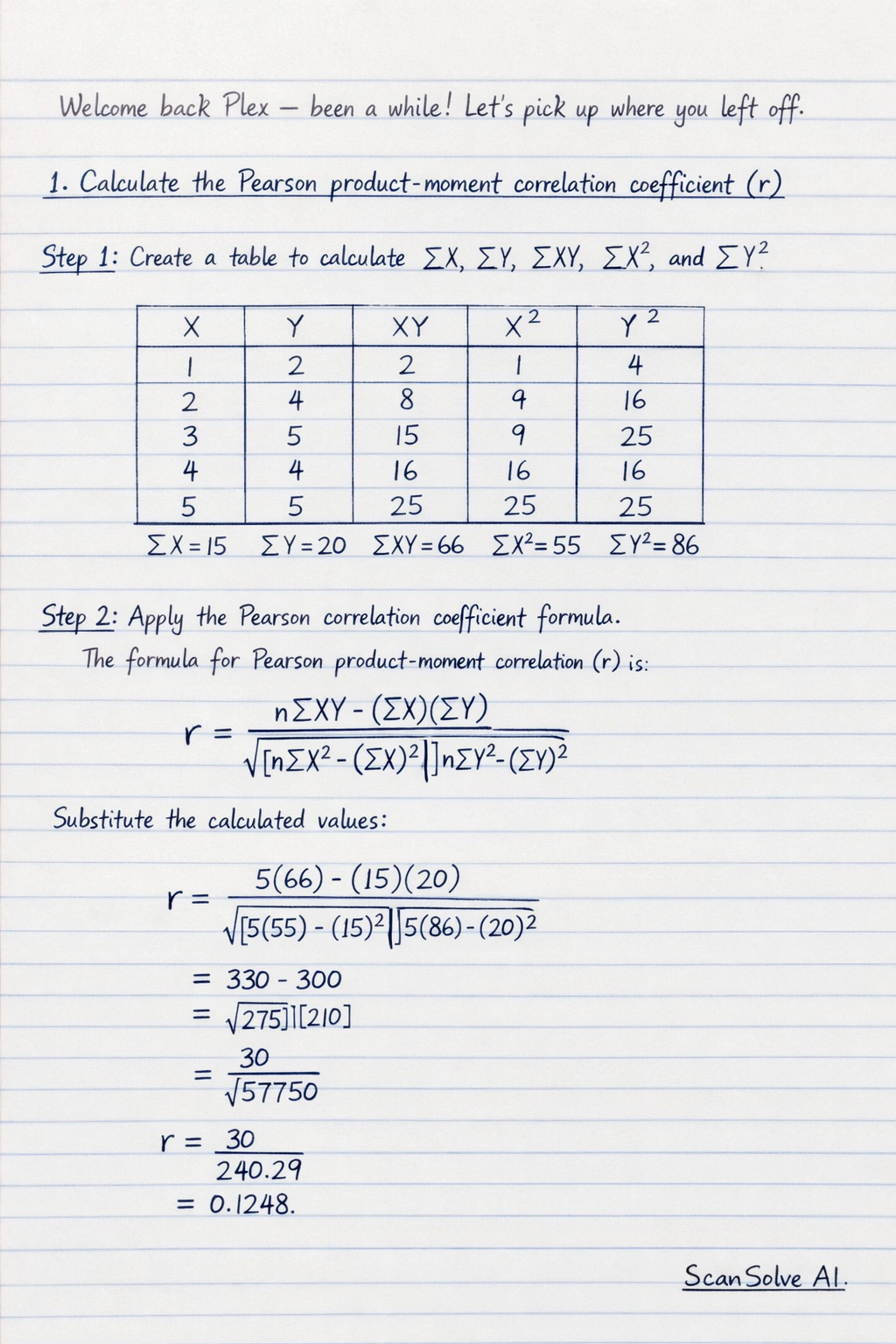
1. Calculate the Pearson product-moment correlation coefficient (r)

  1. Create a table to calculate ∑X\sum X, ∑Y\sum Y, ∑XY\sum XY, ∑X2\sum X^2, and ∑Y2\sum Y^2.

    Given data:
    English (X): 1, 2, 3, 4, 5
    Mathematics (Y): 2, 4, 5, 4, 5
    Number of students, n=5n = 5.

    XYXYX2Y21221424841635159254416161655252525∑X=15∑Y=20∑XY=66∑X2=55∑Y2=86\begin{array}{|c|c|c|c|c|} \hline X & Y & XY & X^2 & Y^2 \\ \hline 1 & 2 & 2 & 1 & 4 \\ 2 & 4 & 8 & 4 & 16 \\ 3 & 5 & 15 & 9 & 25 \\ 4 & 4 & 16 & 16 & 16 \\ 5 & 5 & 25 & 25 & 25 \\ \hline \sum X = 15 & \sum Y = 20 & \sum XY = 66 & \sum X^2 = 55 & \sum Y^2 = 86 \\ \hline \end{array}
  2. Apply the Pearson correlation coefficient formula.

    The formula for Pearson product-moment correlation coefficient (rr) is:

    r=n∑XY−(∑X)(∑Y)[n∑X2−(∑X)2][n∑Y2−(∑Y)2]r = \frac{n \sum XY - (\sum X)(\sum Y)}{\sqrt{[n \sum X^2 - (\sum X)^2][n \sum Y^2 - (\sum Y)^2]}}

    Substitute the calculated values:

    r=5(66)−(15)(20)[5(55)−(15)2][5(86)−(20)2]r = \frac{5(66) - (15)(20)}{\sqrt{[5(55) - (15)^2][5(86) - (20)^2]}}
  3. Simplify the expression.

    r=330−300[275−225][430−400]r = \frac{330 - 300}{\sqrt{[275 - 225][430 - 400]}} r=30[50][30]r = \frac{30}{\sqrt{[50][30]}} r=301500r = \frac{30}{\sqrt{1500}} r=3038.7298r = \frac{30}{38.7298} r≈0.7746r \approx 0.7746

    The Pearson product-moment correlation coefficient is 0.7746\boxed{\textbf{0.7746}}.

    2. Find the variance and standard deviation of the following set of data: 5, 8, 12, 15

  4. Calculate the mean (Xˉ\bar{X}) of the data.

    Given data: X={5,8,12,15}X = \{5, 8, 12, 15\}
    Number of data points, n=4n = 4.

    ∑X=5+8+12+15=40\sum X = 5 + 8 + 12 + 15 = 40 Xˉ=∑Xn=404=10\bar{X} = \frac{\sum X}{n} = \frac{40}{4} = 10
  5. Calculate the sum of squared differences from the mean, ∑(X−Xˉ)2\sum (X - \bar{X})^2.

    XX−Xˉ(X−Xˉ)255−10=−52588−10=−241212−10=241515−10=525∑(X−Xˉ)2=58\begin{array}{|c|c|c|} \hline X & X - \bar{X} & (X - \bar{X})^2 \\ \hline 5 & 5 - 10 = -5 & 25 \\ 8 & 8 - 10 = -2 & 4 \\ 12 & 12 - 10 = 2 & 4 \\ 15 & 15 - 10 = 5 & 25 \\ \hline \sum (X - \bar{X})^2 = 58 \\ \hline \end{array}
  6. Calculate the variance (σ2\sigma^2).

    Assuming this is a population, the variance formula is:

    σ2=∑(X−Xˉ)2n\sigma^2 = \frac{\sum (X - \bar{X})^2}{n} σ2=584=14.5\sigma^2 = \frac{58}{4} = 14.5
  7. Calculate the standard deviation (σ\sigma).

    The standard deviation is the square root of the variance:

    σ=σ2=14.5≈3.8079\sigma = \sqrt{\sigma^2} = \sqrt{14.5} \approx 3.8079

    The variance is 14.5\boxed{\textbf{14.5}} and the standard deviation is 3.8079\boxed{\textbf{3.8079}}.

    4. Using Spearman's rank, obtain the correlation coefficient of the data set below.

  8. Rank the X (Theory) and Y (Practical) values separately.

    Given data:
    Theory (X): 8, 3, 9, 2, 7, 10, 4, 6, 1, 5
    Practical (Y): 9, 5, 10, 1, 8, 7, 3, 4, 2, 6
    Number of data pairs, n=10n = 10.

  9. Create a table to calculate the ranks, differences in ranks (dd), and squared differences (d2d^2).

    XYRank X (Rx)Rank Y (Ry)d=Rx−Ryd28989−113535−24910910−112121117878−11107107394343116464241212−115656−11∑d2=24\begin{array}{|c|c|c|c|c|c|} \hline X & Y & \text{Rank X (Rx)} & \text{Rank Y (Ry)} & d = Rx - Ry & d^2 \\ \hline 8 & 9 & 8 & 9 & -1 & 1 \\ 3 & 5 & 3 & 5 & -2 & 4 \\ 9 & 10 & 9 & 10 & -1 & 1 \\ 2 & 1 & 2 & 1 & 1 & 1 \\ 7 & 8 & 7 & 8 & -1 & 1 \\ 10 & 7 & 10 & 7 & 3 & 9 \\ 4 & 3 & 4 & 3 & 1 & 1 \\ 6 & 4 & 6 & 4 & 2 & 4 \\ 1 & 2 & 1 & 2 & -1 & 1 \\ 5 & 6 & 5 & 6 & -1 & 1 \\ \hline \sum d^2 = 24 \\ \hline \end{array}
  10. Apply Spearman's rank correlation coefficient formula.

    The formula for Spearman's rank correlation coefficient (rsr_s) is:

    rs=1−6∑d2n(n2−1)r_s = 1 - \frac{6 \sum d^2}{n(n^2 - 1)}

    Substitute n=10n = 10 and ∑d2=24\sum d^2 = 24:

    rs=1−6(24)10(102−1)r_s = 1 - \frac{6(24)}{10(10^2 - 1)} rs=1−14410(100−1)r_s = 1 - \frac{144}{10(100 - 1)} rs=1−14410(99)r_s = 1 - \frac{144}{10(99)} rs=1−144990r_s = 1 - \frac{144}{990} rs=1−0.145454...r_s = 1 - 0.145454... rs≈0.8545r_s \approx 0.8545

    The Spearman's rank correlation coefficient is 0.8545\boxed{\textbf{0.8545}}.

Was this helpful?

Still stuck on this one?

Ask a follow-up, and the answer starts from this question.

Got a different question?Ask your own question
Handwritten step-by-step solution preview

Handwritten Step-by-Step Solution

Get this as a handwritten image on WhatsApp — like a tutor wrote it for you.

Try on WhatsApp