

This mathematics problem involves applying core mathematical principles and formulas. Below you will find a complete step-by-step solution with detailed explanations for each step, helping you understand not just the answer but the method behind it.
ScanSolve AI Answer
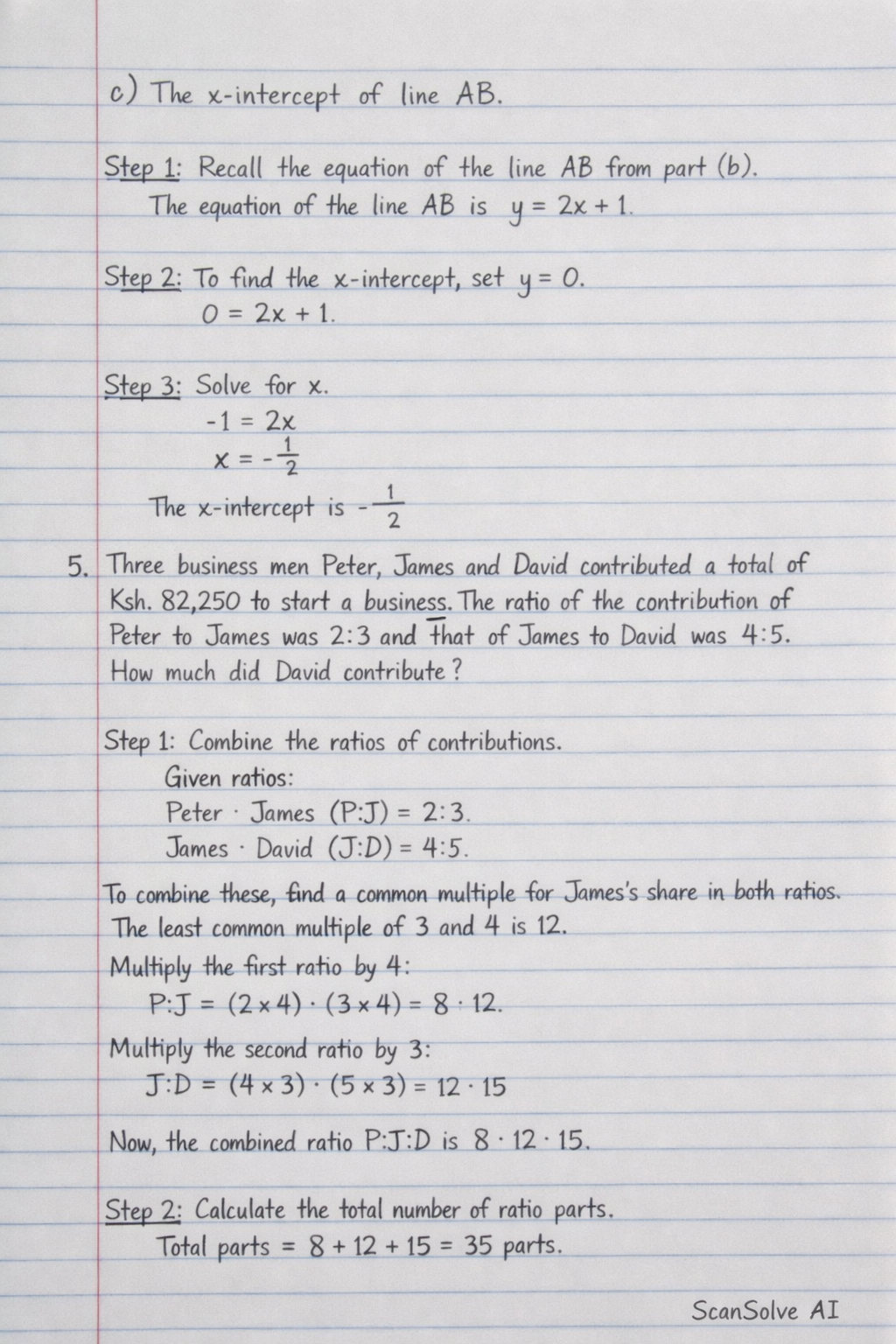
c) The x-intercept of line AB. Step 1: Recall the equation of the line AB from part (b). The equation of the line AB is y = 2x + 1. Step 2: To find the x-intercept, set y=0. 0 = 2x + 1 Step 3: Solve for x. -1 = 2x x = -(1)/(2) The x-intercept is -(1)/(2). 5. Three business men Peter, James and David contributed a total of Ksh. 82,250 to start a business. The ratio of the contribution of Peter to James was 2:3 and that of James to David was 4:5. How much did David contribute? Step 1: Combine the ratios of contributions. Given ratios: Peter : James (P:J) = 2:3 James : David (J:D) = 4:5 To combine these, find a common multiple for James's share in both ratios. The least common multiple of 3 and 4 is 12. Multiply the first ratio by 4: P:J = (2 × 4) : (3 × 4) = 8:12 Multiply the second ratio by 3: J:D = (4 × 3) : (5 × 3) = 12:15 Now, the combined ratio P:J:D is 8:12:15. Step 2: Calculate the total number of ratio parts. Total parts = 8 + 12 + 15 = 35 parts. Step 3: Determine David's contribution. David's share is 15 parts out of 35 total parts. David's contribution = (15)/(35) × Total contribution David's contribution = (15)/(35) × Ksh. 82,250 David's contribution = (3)/(7) × Ksh. 82,250 David's contribution = Ksh. (246750)/(7) David's contribution = Ksh. 35,250 David contributed Ksh. 35,250. 6. The length and width of a rectangle are stated as 18.5cm and 12.4cm respectively. Both measurements are given to the nearest 0.1cm. Calculate the percentage error in the area of the rectangle. Step 1: Determine the absolute error for length and width. Since the measurements are given to the nearest 0.1 cm, the maximum possible error for each measurement is half of 0.1 cm. Absolute error in length ( L) = (0.1)/(2) = 0.05 cm Absolute error in width ( W) = (0.1)/(2) = 0.05 cm Step 2: Calculate the nominal area of the rectangle. Nominal length (L) = 18.5 cm Nominal width (W) = 12.4 cm Nominal Area (A) = L × W = 18.5 cm × 12.4 cm = 229.4 cm^2. Step 3: Calculate the maximum absolute error in the area. For a product A = L × W, the maximum absolute error ( A) is given by the formula: A = L W + W L A = (18.5 cm)(0.05 cm) + (12.4 cm)(0.05 cm) A = 0.925 cm^2 + 0.62 cm^2 A = 1.545 cm^2 Step 4: Calculate the percentage error in the area. Percentage error = Maximum Absolute Error in AreaNominal Area × 100\% Percentage error = 1.545 cm^2229.4 cm^2 × 100\% Percentage error ≈ 0.006735 × 100\% Percentage error ≈ 0.6735\% The percentage error in the area of the rectangle is approximately 0.6735\%. 7. A refrigerator can be bought in cash for Ksh. 35,000. The same refrigerator can be purchased on hire purchase terms by first paying a deposit of Ksh 6,000 followed by 24 equal monthly The question is incomplete. It appears to be cut off. Please provide the full question for problem 7.