
We read your photo as:
Perform the following operations: a) 589 + 759 b) 8589 - 4289 c) 325 * 569 d) 0.27 / 0.3 e) 2 3/8 / 7 1/2
ScanSolve AI Answer
Answers
5 partsStep-by-step solution
19 stepsPart a· 1 step
Add the numbers.
The sum is 1348.
Part b· 1 step
Subtract the numbers.
The difference is 4300.
Part c184925
Multiply 325 by 9.
Multiply 325 by 60.
Multiply 325 by 500.
Add the partial products.
The product is .
Part d0.9
Convert the division to an equivalent form with a whole number divisor by multiplying both numbers by 10.
Perform the division.
The quotient is .
Part e
Convert the mixed numbers to improper fractions.
Rewrite the division as multiplication by the reciprocal of the second fraction.
Multiply the fractions.
Simplify the fraction by dividing the numerator and denominator by their greatest common divisor, which is 2.
The result is .
Part f
Convert the mixed numbers to improper fractions.
Find a common denominator for the fractions.
The least common multiple of 3 and 5 is 15.
Add the fractions.
Convert the improper fraction back to a mixed number.
So, .
The sum is .
Part g174
Perform long division.
Divide 40 by 23. .
Bring down the next digit (0).
Divide 170 by 23. .
Bring down the next digit (2).
Divide 92 by 23. .
The quotient is .
Try one yourself
A new problem that tests the same skill.
Still stuck on this one?
Ask a follow-up, and the answer starts from this question.
More Mathematics Questions
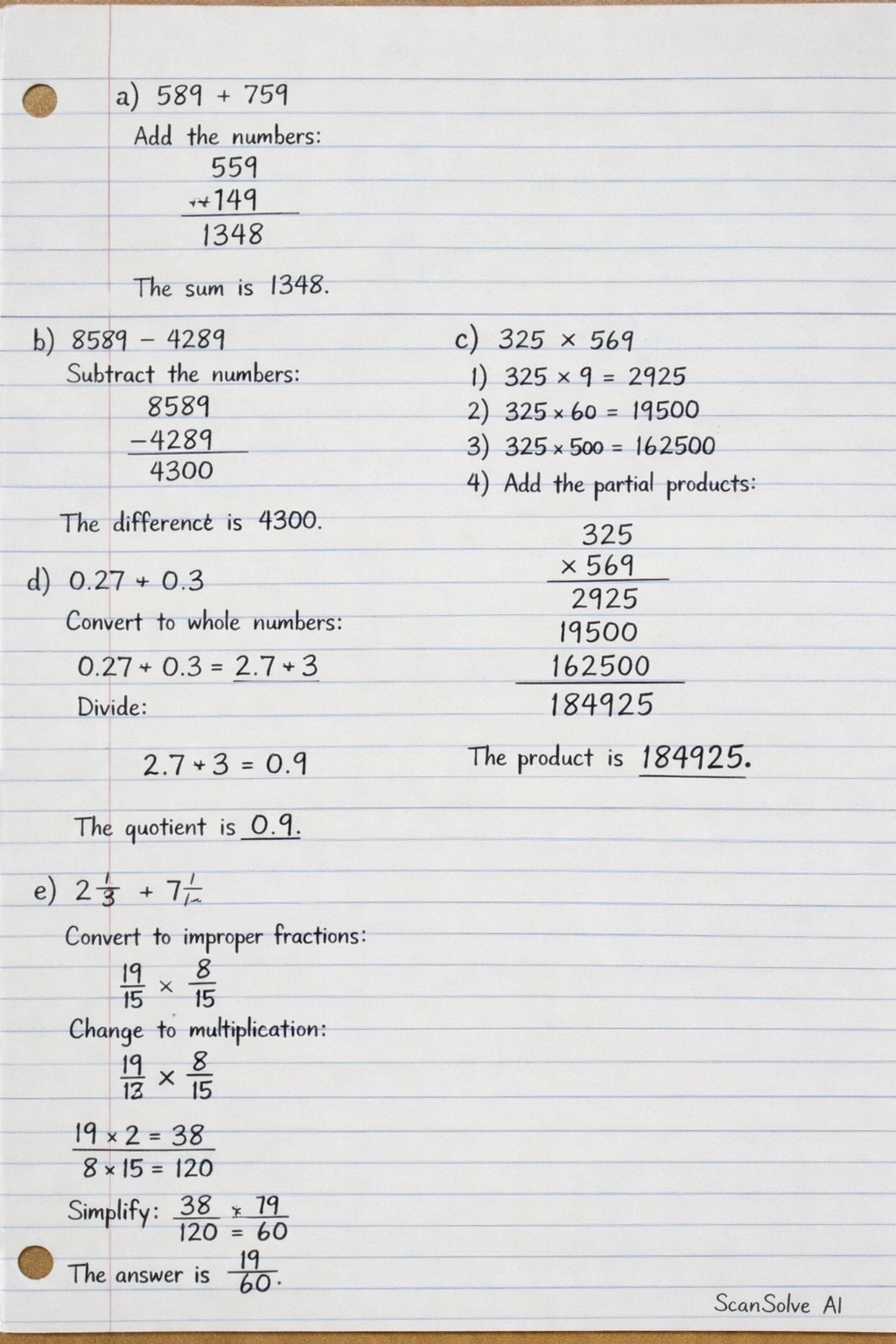
Handwritten Step-by-Step Solution
Get this as a handwritten image on WhatsApp — like a tutor wrote it for you.
Try on WhatsApp