
We read your photo as:
Perform the following operations: find the first six multiples of 9; find the factors of 12 and count them; find the GCF of 12 and 15; list the prime numbers from the set 2, 3, 4, 5, 6, 7, 8, 9, 10, 1
ScanSolve AI Answer
Step-by-step solution
3 stepsStep 1: Write the first six multiples of 9.
To find the multiples of 9, we multiply 9 by consecutive whole numbers starting from 1.
The first six multiples of 9 are .
Step 2: Find the factors of 12 and count them.
Part i
Factors of 12 are numbers that divide 12 exactly.
The factors of 12 are .
Part ii· 3 steps
Counting the factors
There are 6 factors.
The number of factors is .
Find the GCF of 12 and 15.
First, list the factors for each number.
Factors of 12: 1, 2, 3, 4, 6, 12
Factors of 15: 1, 3, 5, 15
The common factors are 1 and 3. The greatest common factor (GCF) is the largest of these common factors.
The GCF of 12 and 15 is .Write a set of prime numbers from the given set {2, 3, 4, 5, 6, 7, 8, 9, 10, 11, 12, 13, 14}.
A prime number is a natural number greater than 1 that has no positive divisors other than 1 and itself.
- 2 is prime.
- 3 is prime.
- 4 is not prime ().
- 5 is prime.
- 6 is not prime ().
- 7 is prime.
- 8 is not prime ().
- 9 is not prime ().
- 10 is not prime ().
- 11 is prime.
- 12 is not prime ().
- 13 is prime.
- 14 is not prime (). The set of prime numbers is .
Factorise 25 and write prime or composite number.
To factorise 25, we find its prime factors.
The factors of 25 are 1, 5, and 25. Since 25 has more than two factors (1, 5, and 25), it is a composite number.
Factorisation of 25:
25 is a .
Still stuck on this one?
Ask a follow-up, and the answer starts from this question.
More Mathematics Questions
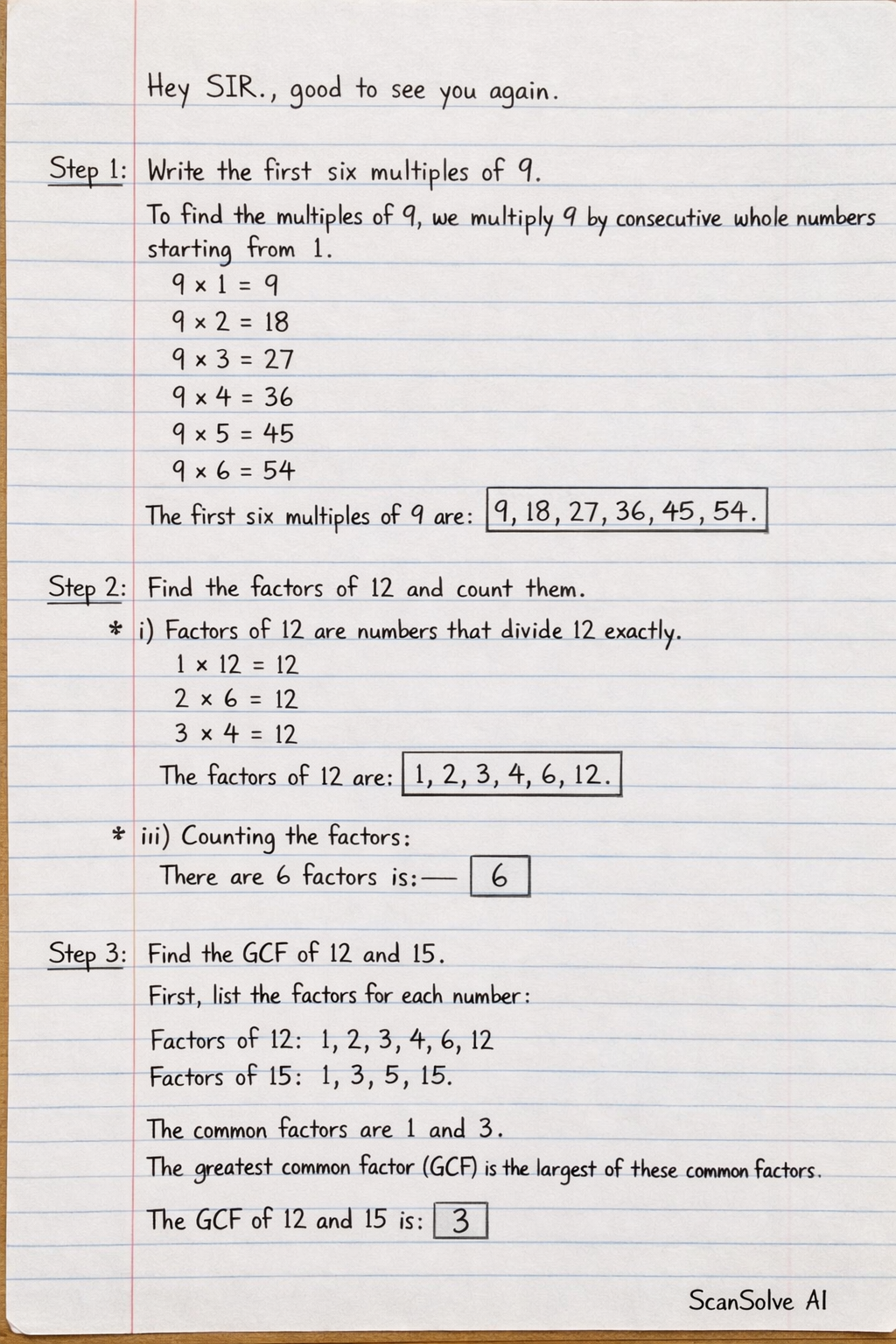
Handwritten Step-by-Step Solution
Get this as a handwritten image on WhatsApp — like a tutor wrote it for you.
Try on WhatsApp