
This mathematics problem involves applying core mathematical principles and formulas. Below you will find a complete step-by-step solution with detailed explanations for each step, helping you understand not just the answer but the method behind it.
ScanSolve AI Answer
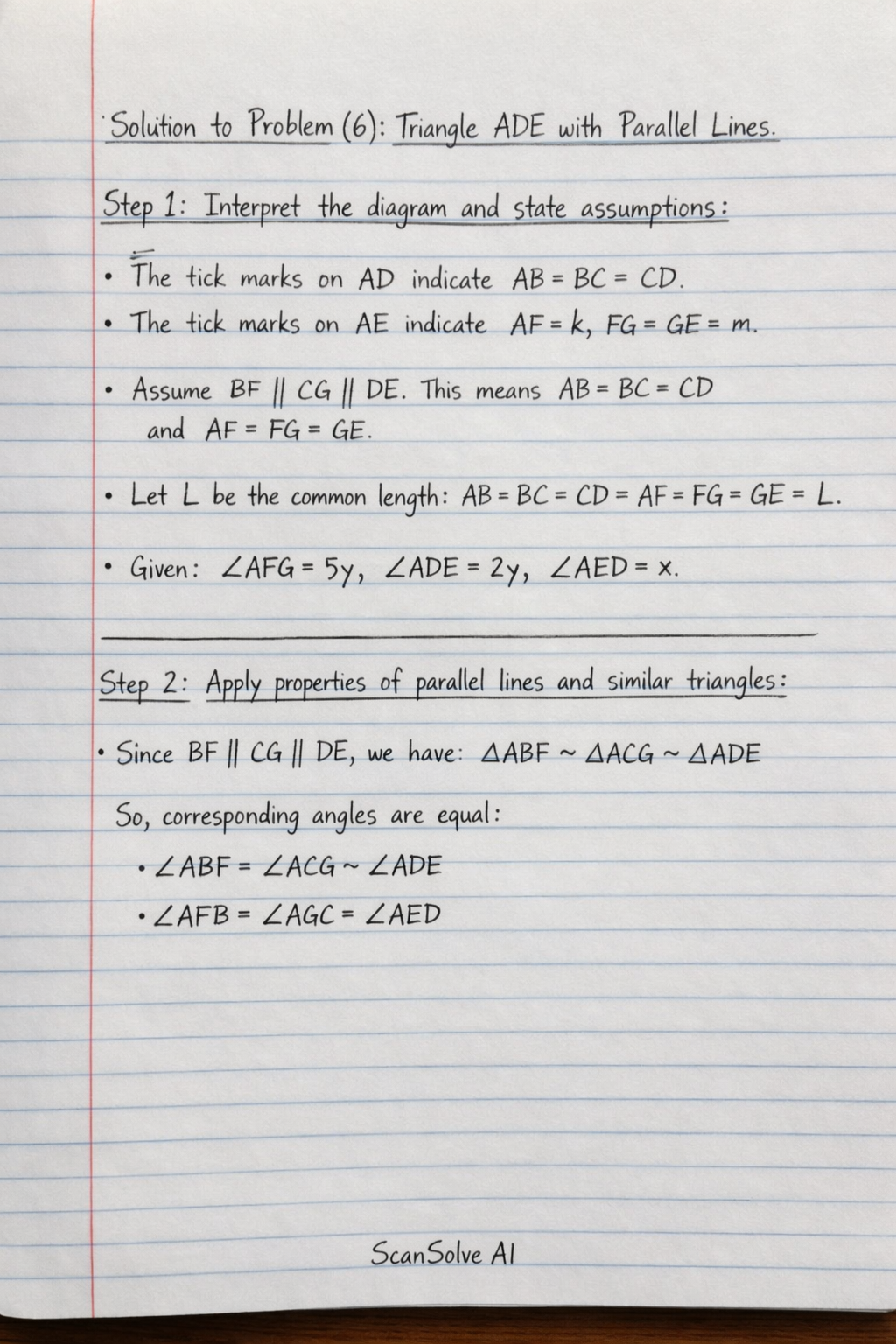
Here is the solution for problem (6) in a step-by-step mathematical format: Problem (6): Triangle ADE with parallel lines Step 1: Interpret the diagram and state assumptions. The tick marks on AD indicate AB = BC = CD. The tick marks on AE indicate AF = k (one tick) and FG = GE = m (two ticks). For the problem to be solvable with the given angle relationships, we must assume that the lines BF, CG, and DE are parallel. This implies that the segments on the transversals are proportional, which means AB=BC=CD and AF=FG=GE. Therefore, we assume AB=BC=CD=AF=FG=GE. Let this common length be L. Given angles: AFG = 5y, ADE = 2y, AED = x. Step 2: Apply properties of parallel lines and similar triangles. If BF CG DE, then ABF ACG ADE. From similarity, corresponding angles are equal: ABF = ACG = ADE AFB = AGC = AED Given ADE = 2y, we have: ABF = ACG = 2y Given AED = x, we have: AFB = AGC = x Step 3: Use angle relationships within AFG. Since we assumed AF=FG=L, AFG is an isosceles triangle with base AG. The angles in AFG are FAG (which is A), AFG = 5y, and FGA. We know FGA = AGC = x. The sum of angles in AFG is 180^: A + AFG + FGA = 180^ A + 5y + x = 180^ (1) Step 4: Use angle relationships within ADE. The angles in ADE are A, ADE = 2y, and AED = x. The sum of angles in ADE is 180^: A + ADE + AED = 180^ A + 2y + x = 180^ (2) Step 5: Solve the system of equations. Subtract equation (2) from equation (1): ( A + 5y + x ) - ( A + 2y + x ) = 180^ - 180^ 3y = 0 y = 0 Step 6: Conclusion. A value of y=0 is impossible for an angle in a triangle. This indicates that the given angle labels in the diagram are inconsistent with the geometric properties of parallel lines and similar triangles, even under the assumption that BF CG DE. Therefore, a numerical solution for x and y cannot be determined from the given information.