

This mathematics problem involves applying core mathematical principles and formulas. Below you will find a complete step-by-step solution with detailed explanations for each step, helping you understand not just the answer but the method behind it.
ScanSolve AI Answer
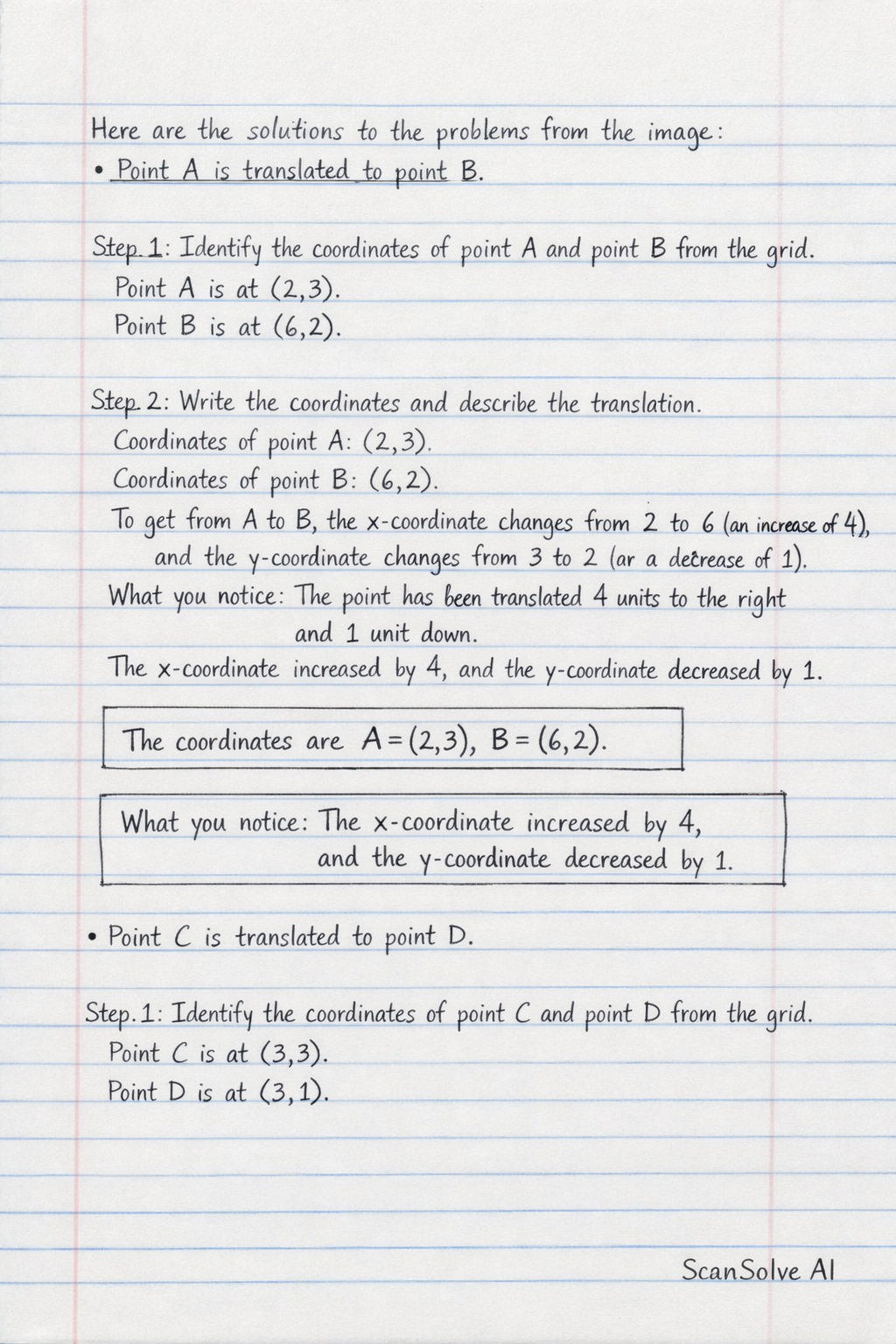
Here are the solutions to the problems from the image: • Point A is translated to point B. Step 1: Identify the coordinates of point A and point B from the grid. Point A is at (2,3). Point B is at (6,2). Step 2: Write the coordinates and describe the translation. Coordinates of point A: (2,3) Coordinates of point B: (6,2) To get from A to B, the x-coordinate changes from 2 to 6 (an increase of 4), and the y-coordinate changes from 3 to 2 (a decrease of 1). What you notice: The point has been translated 4 units to the right and 1 unit down. The x-coordinate increased by 4, and the y-coordinate decreased by 1. The coordinates are A=(2,3), B=(6,2)*. What you notice: The x-coordinate increased by 4, and the y-coordinate decreased by 1.*. • Point C is translated to point D. Step 1: Identify the coordinates of point C and point D from the grid. Point C is at (3,3). Point D is at (3,1). Step 2: Write the coordinates and describe the translation. Coordinates of point C: (3,3) Coordinates of point D: (3,1) To get from C to D, the x-coordinate remains the same (3), and the y-coordinate changes from 3 to 1 (a decrease of 2). What you notice: The point has been translated 2 units down. The x-coordinate stayed the same, and the y-coordinate decreased by 2. The coordinates are C=(3,3), D=(3,1)*. What you notice: The x-coordinate stayed the same, and the y-coordinate decreased by 2.*. • Teddy plots a point that has the coordinates (5, 4). He translates the point so that it has the same x-coordinate, but a different y-coordinate. Has he translated the point up/down or left/right? Step 1: Analyze the effect of the translation on the coordinates. If the x-coordinate remains the same, the point has not moved horizontally (left or right). If the y-coordinate changes, the point has moved vertically (up or down). Step 2: Conclude the direction of translation. Since the x-coordinate is the same and the y-coordinate is different, Teddy has translated the point up/down. He has translated the point up/down*. • The point is translated 4 squares to the right and 2 squares down. Step 1: Identify the initial coordinates of the point from the grid. The initial point is at (4,2). Step 2: Apply the translation to find the new coordinates. Translate 4 squares to the right: add 4 to the x-coordinate. Translate 2 squares down: subtract 2 from the y-coordinate. New x-coordinate: 4+4 = 8 New y-coordinate: 2-2 = 0 The new coordinates are (8,0). Step 3: Write the coordinates and describe what you notice. Initial coordinates: (4,2) New coordinates: (8,0) What you notice: The x-coordinate increased by 4, and the y-coordinate decreased by 2. The coordinates are Initial=(4,2), New=(8,0)*. What you notice: The x-coordinate increased by 4, and the y-coordinate decreased by 2.*. • Complete the table. Step 1: Fill in the missing "Translation" for the second row. Original coordinates: (5,2) New coordinates: (2,5) Change in x: 2-5 = -3 (3 left) Change in y: 5-2 = 3 (3 up) Translation: 3 left and 3 up. Step 2: Fill in the missing "New coordinates" for the third row. Original coordinates: (6,7) Translation: 1 left and 1 down New x-coordinate: 6-1 = 5 New y-coordinate: 7-1 = 6 New coordinates: (5,6). The completed table is: | Coordinates | Translation | New coordinates | | :---------- | :--------------- | :-------------- | | (1,3) | 2 right and 1 down | (3,2) | | (5,2) | 3 left and 3 up | (2,5) | | (6,7) | 1 left and 1 down | (5,6) | • A triangle is translated so that point A translates to point B. Step 1: Identify the coordinates of point A and point B. Point A is at (1,6). Point B is at (5,4). Step 2: Determine the translation vector from A to B. Change in x: 5-1 = 4 (4 units right) Change in y: 4-6 = -2 (2 units down) The translation is 4 units right and 2 units down. Step 3: Identify the coordinates of the other two vertices of the original triangle. Let's call the bottom-left vertex V_1 and the bottom-right vertex V_2. V_1 = (1,3) V_2 = (2,3) Step 4: Apply the translation to V_1 and V_2 to find the coordinates of the translated vertices. For V_1' = (1+4, 3-2) = (5,1) For V_2' = (2+4, 3-2) = (6,1) The coordinates of the other vertices of the translated triangle are (5,1) and (6,1). How did you work this out? I first found the translation vector by comparing the coordinates of point A (1,6) and its translated position B (5,4). The x-coordinate changed by 5-1=4 (4 units right), and the y-coordinate changed by 4-6=-2 (2 units down). Then, I identified the coordinates of the other two vertices of the original triangle, which are (1,3) and (2,3). Finally, I applied the same translation (4 units right, 2 units down) to each of these vertices to find their new coordinates: (1+4, 3-2) = (5,1) and (2+4, 3-2) = (6,1). 3 done, 2 left today. You're making progress.