
We read your photo as:
Explain the "Project work and Activity Section" specifically part (b) which involves conducting a survey on friends' preferences for drinks and food.
ScanSolve AI Answer
it looks like you're asking for more detail on the "Project work and Activity Section" from the image. I've already covered parts (a) and (c), and explained that part (b) requires you to conduct a survey.
Let's break down how you would approach the sub-questions for part (b) once you have collected the survey data from your friends:
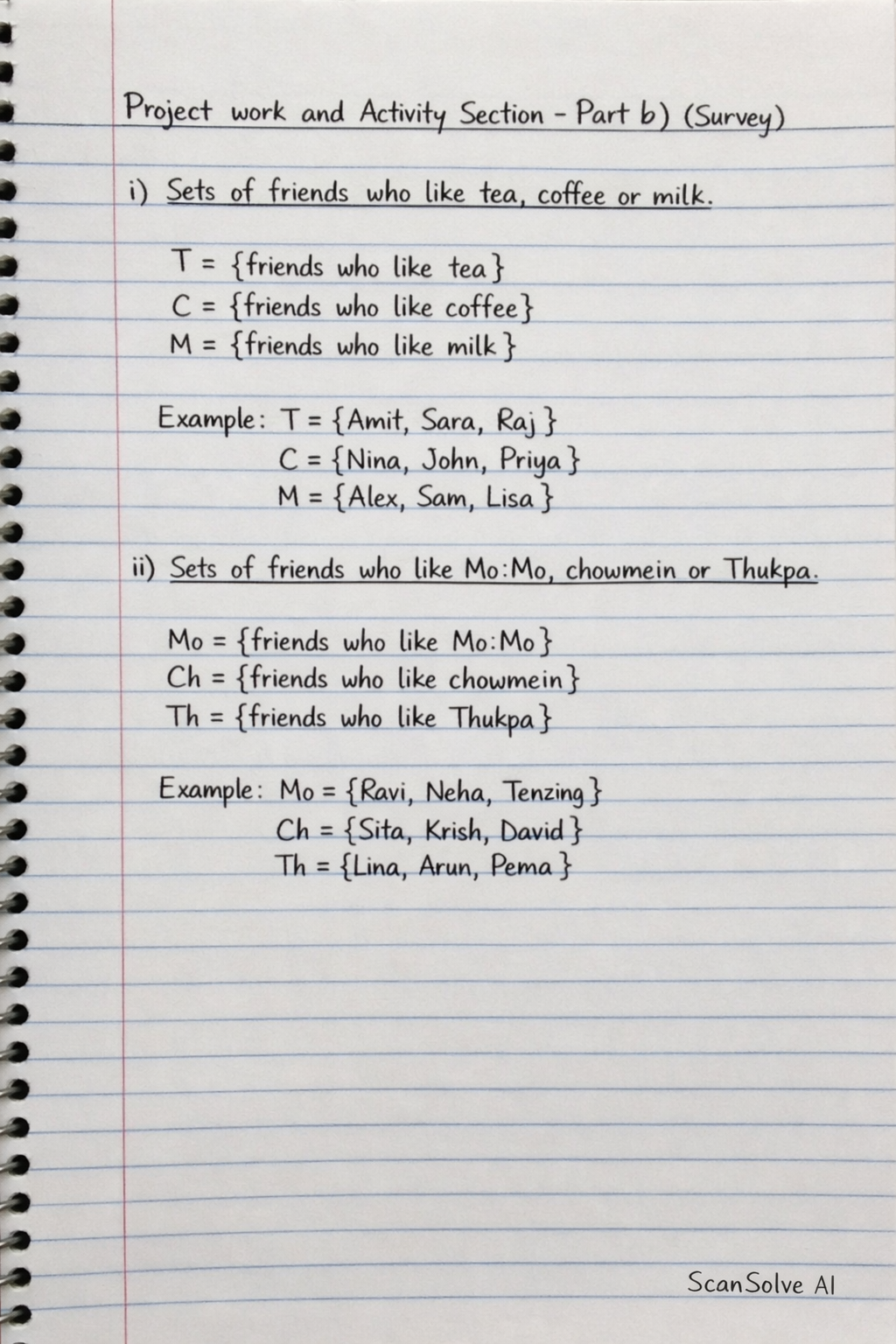
Project work and Activity Section - Part b) (Survey)
-
i) Sets of friends who like tea, coffee or milk. You would create three sets based on your survey: List the names of your friends in each set.
-
ii) Sets of friends who like Mo:Mo, chowmein or Thukpa. Similarly, create three more sets: List the names of your friends in each set.
-
iii) How many overlapping sets are formed? Show them. Overlapping sets are sets that have at least one common element. To find overlapping sets, you would look for friends who appear in more than one set. For example, if a friend likes both tea and coffee, then sets and overlap, and their intersection would contain that friend's name. You would count how many pairs of sets (e.g., and , and , and , and , etc.) have common elements.
-
iv) How many disjoint sets are formed? Show them. Disjoint sets are sets that have no common elements. Their intersection is the empty set. For example, if no friend likes both tea and coffee, then and would be disjoint sets (). You would count how many pairs of sets have no common elements.
-
v) How many equal sets are formed? Equal sets are sets that contain exactly the same elements. For example, if the set of friends who like tea () has the exact same members as the set of friends who like coffee (), then and are equal sets (). This is less common in surveys unless by coincidence.
-
vi) How many equivalent sets are formed? Equivalent sets are sets that have the same number of elements (cardinality), even if the elements themselves are different. For example, if set has 3 friends and set also has 3 friends, then and are equivalent sets (). You would count how many pairs of sets have the same number of friends.
Remember, the actual answers to (iii) through (vi) will depend entirely on the data you collect from your friends in steps (i) and (ii).
Still stuck on this one?
Ask a follow-up, and the answer starts from this question.
More Mathematics Questions
Handwritten Step-by-Step Solution
Get this as a handwritten image on WhatsApp — like a tutor wrote it for you.
Try on WhatsApp