
We read your photo as:
Provide properties of a parallelogram, rhombus, and trapezoid, and solve problems involving the area of a square and probability.
ScanSolve AI Answer
Step-by-step solution
16 stepsHere are the solutions to your questions.
1. Give 3 properties of the following shapes:
Part a
Parallelogram
- Opposite sides are parallel.
- Opposite sides are equal in length.
- Opposite angles are equal.
Part b
Rhombus
- All four sides are equal in length.
- Opposite angles are equal.
- Diagonals bisect each other at right angles.
Part c· 16 steps
Trapezoid
- It has at least one pair of parallel sides.
- The sum of angles between parallel sides is .
- The non-parallel sides are called legs.
2. Find the area of a square with length 9cm.
Recall the formula for the area of a square.
The area of a square is given by , where is the side length.
Substitute the given side length into the formula.
Calculate the area.
The area of the square is .
3. What is the probability of picking a red ball from a bag with 3 red balls and 2 blue balls.
Determine the total number of balls and the number of red balls.
Number of red balls = 3
Number of blue balls = 2
Total number of balls =Calculate the probability.
Probability of picking a red ball =
The probability of picking a red ball is .
4. A coin is flipped. What is the chance it lands on heads.
Identify the possible outcomes when flipping a coin.
The possible outcomes are Heads (H) or Tails (T). There are 2 possible outcomes.
Determine the number of favorable outcomes for landing on heads.
There is 1 favorable outcome (Heads).
Calculate the probability.
Probability of landing on heads =
The chance of landing on heads is .
5. What is the place value of 7 in 3,745.
Identify the digits in the number 3,745.
The digits are 3 (thousands place), 7 (hundreds place), 4 (tens place), and 5 (ones place).
Determine the place value of the digit 7.
The digit 7 is in the hundreds place.
The place value of 7 is .
The place value of 7 in 3,745 is .6. Find the perimeter of a rectangle with length 8cm and width 5cm.
Recall the formula for the perimeter of a rectangle.
The perimeter of a rectangle is given by , where is the length and is the width.
Substitute the given length and width into the formula.
Calculate the perimeter.
The perimeter of the rectangle is .
7. Convert 3.7kg to grams.
Recall the conversion factor between kilograms and grams.
Multiply the given mass in kilograms by the conversion factor.
Perform the multiplication.
is equal to .
Still stuck on this one?
Ask a follow-up, and the answer starts from this question.
More Mathematics Questions
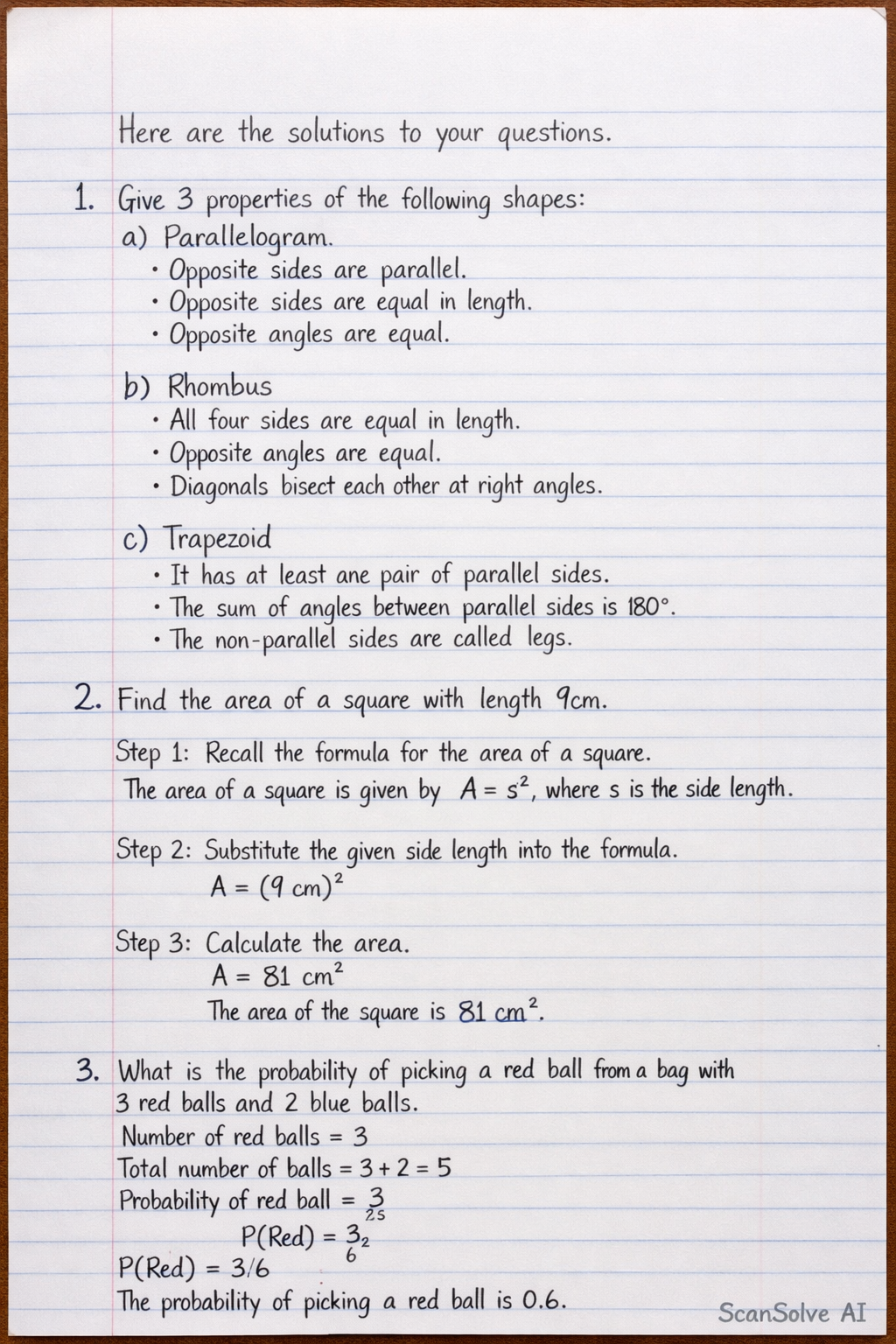
Handwritten Step-by-Step Solution
Get this as a handwritten image on WhatsApp — like a tutor wrote it for you.
Try on WhatsApp