

This mathematics problem involves applying core mathematical principles and formulas. Below you will find a complete step-by-step solution with detailed explanations for each step, helping you understand not just the answer but the method behind it.
ScanSolve AI Answer
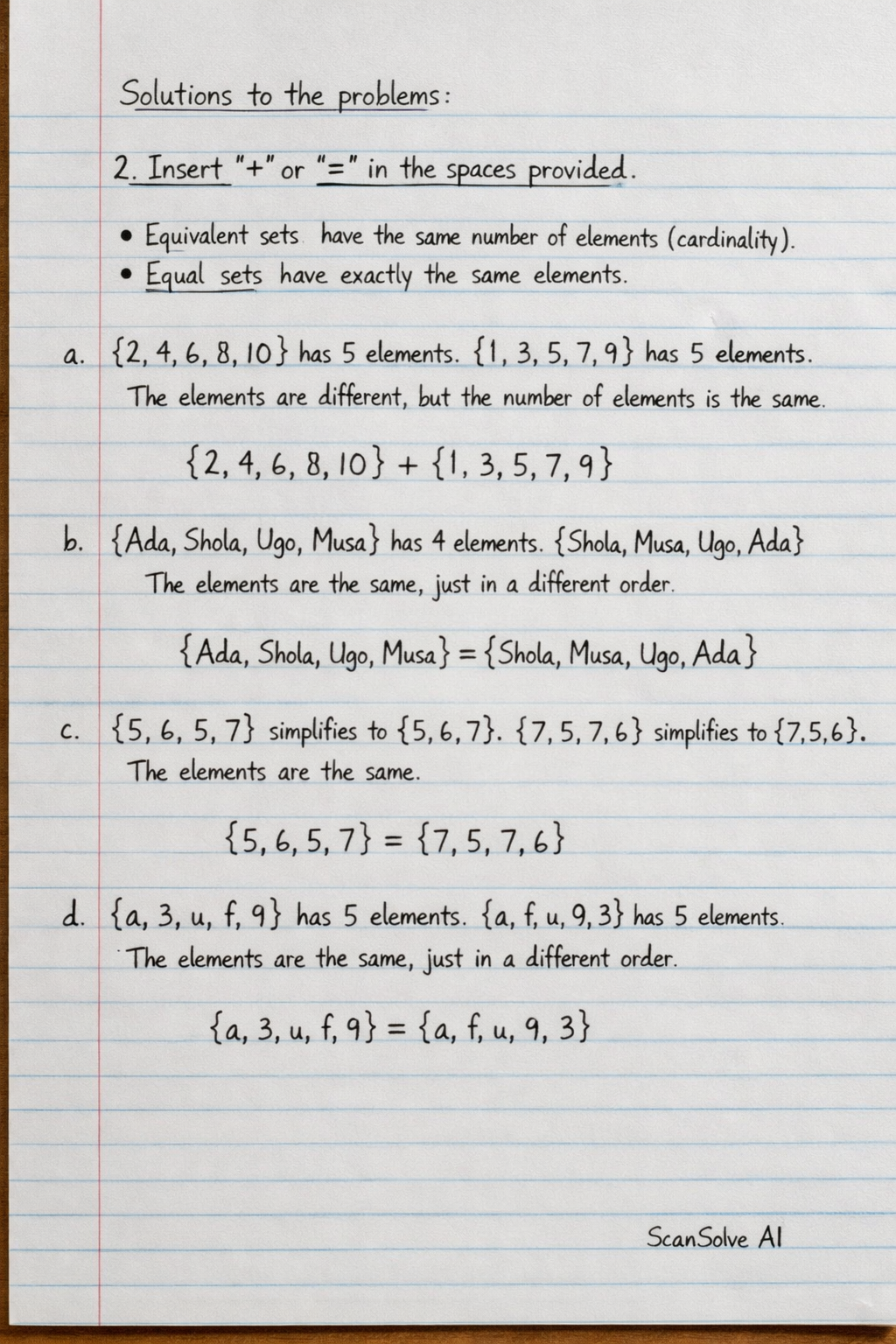
Here are the solutions to the problems: 2. Put '+' or '=' in the spaces provided. Equivalent sets have the same number of elements (cardinality). Equal sets have exactly the same elements. a. \2, 4, 6, 8, 10\ has 5 elements. \1, 3, 5, 7, 9\ has 5 elements. The elements are different, but the number of elements is the same. \2, 4, 6, 8, 10\ + \1, 3, 5, 7, 9\ b. \Ada, Shola, Ugo, Musa\ has 4 elements. \Shola, Musa, Ugo, Ada\ has 4 elements. The elements are the same, just in a different order. \Ada, Shola, Ugo, Musa\ = \Shola, Musa, Ugo, Ada\ c. \5, 6, 5, 7\ simplifies to \5, 6, 7\ (3 unique elements). \7, 5, 7, 6\ simplifies to \7, 5, 6\ (3 unique elements). The elements are the same. \5, 6, 5, 7\ = \7, 5, 7, 6\ d. \a, 3, u, f, 9\ has 5 elements. \a, f, u, 9, 3\ has 5 elements. The elements are the same, just in a different order. \a, 3, u, f, 9\ = \a, f, u, 9, 3\ e. \a, 3, a\ simplifies to \a, 3\ (2 unique elements). \a, 3\ has 2 elements. The elements are the same. \a, 3, a\ = \a, 3\ f. The first set (parallelogram) contains \a, b, c, d, 1, 4, 7, 9, 11, 13, 5, 8\. It has 12 unique elements. The second set (circle) contains \e, f, g, h, 2, 3, 6, 10, 11, 13, 5, 8\. It has 12 unique elements. The number of elements is the same, but the elements are different. + 3. Which of these sets are equal? Equal sets have exactly the same elements. a. A = \r, t, s\ B = \s, r, s, t\ simplifies to \s, r, t\ C = \t, r, s, t\ simplifies to \t, r, s\ D = \r, r, r, s, t\ simplifies to \r, s, t\ All sets contain the same unique elements \r, s, t\. Therefore, A, B, C, and D are all equal. b. (i) A = \x x is a letter in the word "follow"\ The unique letters in "follow" are \f, o, l, w\. So, A = \f, o, l, w\. (ii) B = The letters which appear in the word "wolf" The unique letters in "wolf" are \w, o, l, f\. So, B = \w, o, l, f\. (iii) C = \x x is a letter in the word "flow"\ The unique letters in "flow" are \f, l, o, w\. So, C = \f, l, o, w\. (iv) D = the letters f, l, o, w. So, D = \f, l, o, w\. All sets contain the same unique elements \f, l, o, w\. Therefore, A, B, C, and D are all equal. Which of these sets are equivalent? Equivalent sets have the same number of elements (cardinality). a. A = \1, 3, 4, 5\. Cardinality |A|=4. B = \a, a, b, c, d\ simplifies to \a, b, c, d\. Cardinality |B|=4. C = \3, 4, 1, 2\. Cardinality |C|=4. D = \e, f, g, h\. Cardinality |D|=4. E = \3, 1, 3, 4, 5\ simplifies to \3, 1, 4, 5\. Cardinality |E|=4. All sets have a cardinality of 4. Therefore, A, B, C, D, and E are all equivalent. b. A = \x x is a letter in the word "adore"\ The unique letters in "adore" are \a, d, o, r, e\. Cardinality |A|=5. B = The letters which appear in the word "arode" The unique letters in "arode" are \a, r, o, d, e\. Cardinality |B|=5. C = \x x is a letter in the word "radoe"\ The unique letters in "radoe" are \r, a, d, o, e\. Cardinality |C|=5. All sets have a cardinality of 5. Therefore, A, B, and C are all equivalent.