
We read your photo as:
Q1a. The 5th and 10th terms of an A.P. are 12 and -27 respectively. Find the A.P. and its 15th term. Q1b. If the first and last terms of an A.P., with d = 1 1/2 are 2 1/2 and 19 respectively, how many terms has the A.P.?
Mathematics
ScanSolve AI Answer
Answer
-42
Step-by-step solution
5 stepsSet up equations for the given terms of the A.P.
The formula for the -th term of an A.P. is , where is the first term and is the common difference.
Given :Given :
Solve the system of equations to find the common difference .
Subtract equation (1) from equation (2):
Substitute the value of into equation (1) to find the first term .
State the A.P.
The first term is and the common difference is .
The A.P. is
The A.P. isCalculate the 15th term ().
Using the formula :
The A.P. is and its 15th term is .
Was this helpful?
Try one yourself
A new problem that tests the same skill.
Still stuck on this one?
Ask a follow-up, and the answer starts from this question.
Got a different question?Ask your own question
More Mathematics Questions
QThe 1st, 5th and 7th terms of an AP form the first three consecutive terms of a GP. The common…Q25, 22, 19,... There are 22 terms find the Sum of the AP. 2) An A.p has 15 terms and a Common…Qb) The 3rd, 5th and 8th terms of another AP form the first three consecutive terms. If the common…QFind the eighth term and the sum of the first 15 terms of the AP. −7, −4, −1, .........QFind the 21st term of the A.P. – 4, – 1.5, 1, 3.5,...
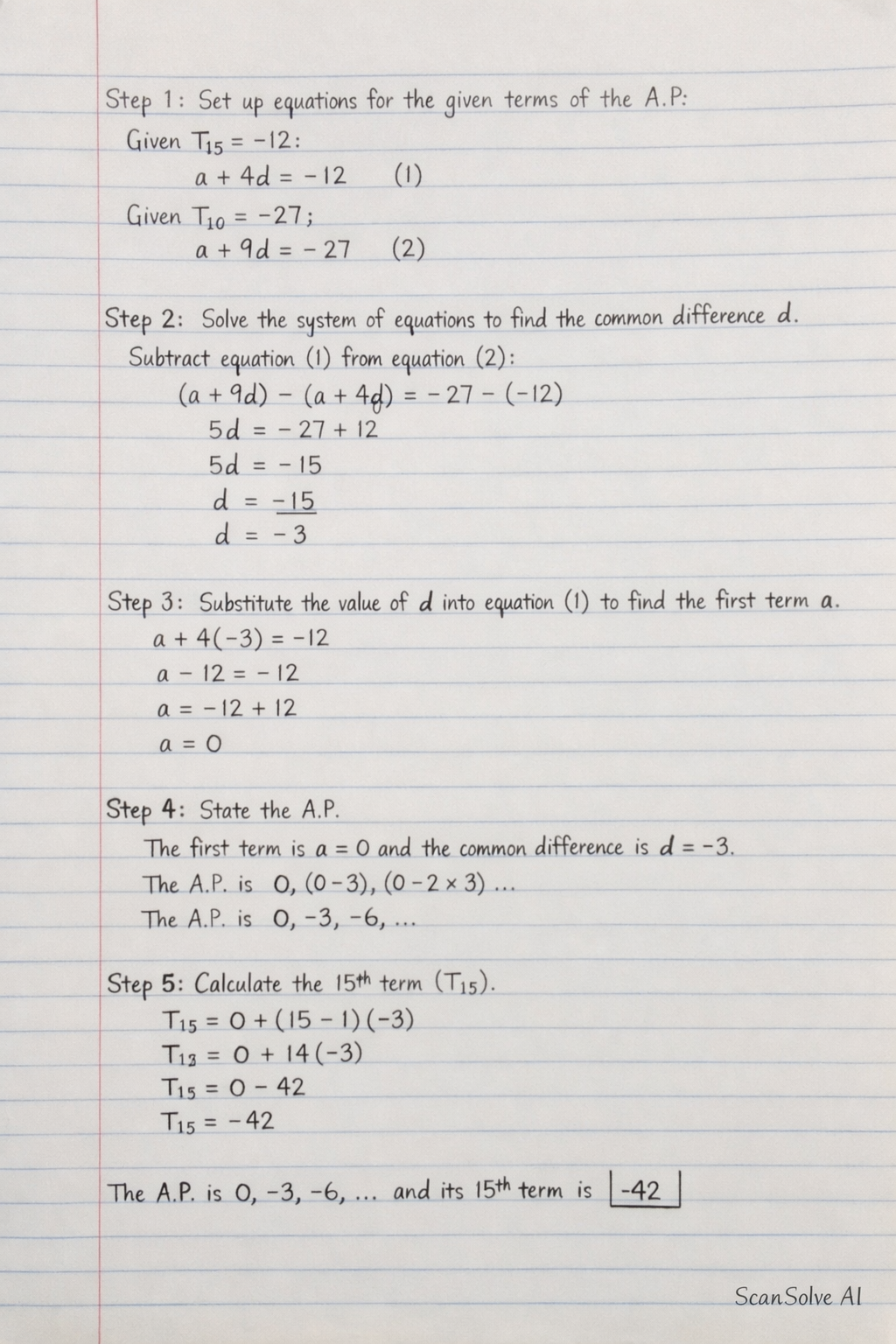
Handwritten Step-by-Step Solution
Get this as a handwritten image on WhatsApp — like a tutor wrote it for you.
Try on WhatsApp