
We read your photo as:
Find the quadratic equation whose roots are x = -3 and x = (1)/(2).
ScanSolve AI Answer
Answer
Step-by-step solution
18 stepsHere are the solutions to the problems.
:
Find the quadratic equation whose roots are and .
Calculate the sum and product of the roots.
Let the roots be and .
Sum of roots: .
Product of roots: .Form the quadratic equation using the formula .
Multiply the entire equation by 2 to clear the denominators.
The correct option is B.
:
Calculate in the figure below if , cm and cm.Identify the given values and the appropriate formula.
We are given two sides (cm, cm) and the included angle (). We need to find the third side . The Cosine Rule is suitable here:
Substitute the values into the Cosine Rule.
Recall that .
Solve for .
Rounding to two decimal places, cm.
The correct option is B.:
Calculate the length of a chord of a circle of radius 5cm if the perpendicular distance from the center to the chord is 3cm.Visualize the geometry and identify the relevant right-angled triangle.
Let the radius be cm. Let the perpendicular distance from the center to the chord be cm. Let half the length of the chord be . The radius, the perpendicular distance, and half the chord form a right-angled triangle, with the radius as the hypotenuse.
Apply the Pythagorean theorem.
Solve for and then find the full length of the chord.
The length of the full chord is .
The correct option is A.
:
A sector of a circle of 8cm has at the centre. Calculate its area.Identify the given values.
Radius cm.
Central angle .Use the formula for the area of a sector.
The area of a sector is given by .
Calculate the numerical value and round.
Using :
Rounding to two decimal places, cm.
The correct option is D.:
In the figure above, AD//GE, /BF/ = /CF/ and . Find .Identify the type of triangle formed by B, F, and C.
Given that /BF/ = /CF/, triangle BFC is an isosceles triangle.
Use the property of isosceles triangles.
In an isosceles triangle, the angles opposite the equal sides are equal. Therefore, .
Given , so .Use the sum of angles in a triangle.
The sum of angles in is .
The information AD//GE is not needed to solve for .
The correct option is B.:
The radii of two spheres are in the ratio 2:3. If the area of the smaller sphere is 32cm, calculate the area of the bigger sphere.Set up the ratio of the radii.
Let be the radius of the smaller sphere and be the radius of the bigger sphere.
Relate the ratio of radii to the ratio of surface areas.
The surface area of a sphere is given by .
Let be the area of the smaller sphere and be the area of the bigger sphere.
The ratio of their areas is:Substitute the given ratio and area to find the unknown area.
Given cm.
Cross-multiply to solve for :
The correct option is A.
Try one yourself
A new problem that tests the same skill.
Still stuck on this one?
Ask a follow-up, and the answer starts from this question.
More Mathematics Questions
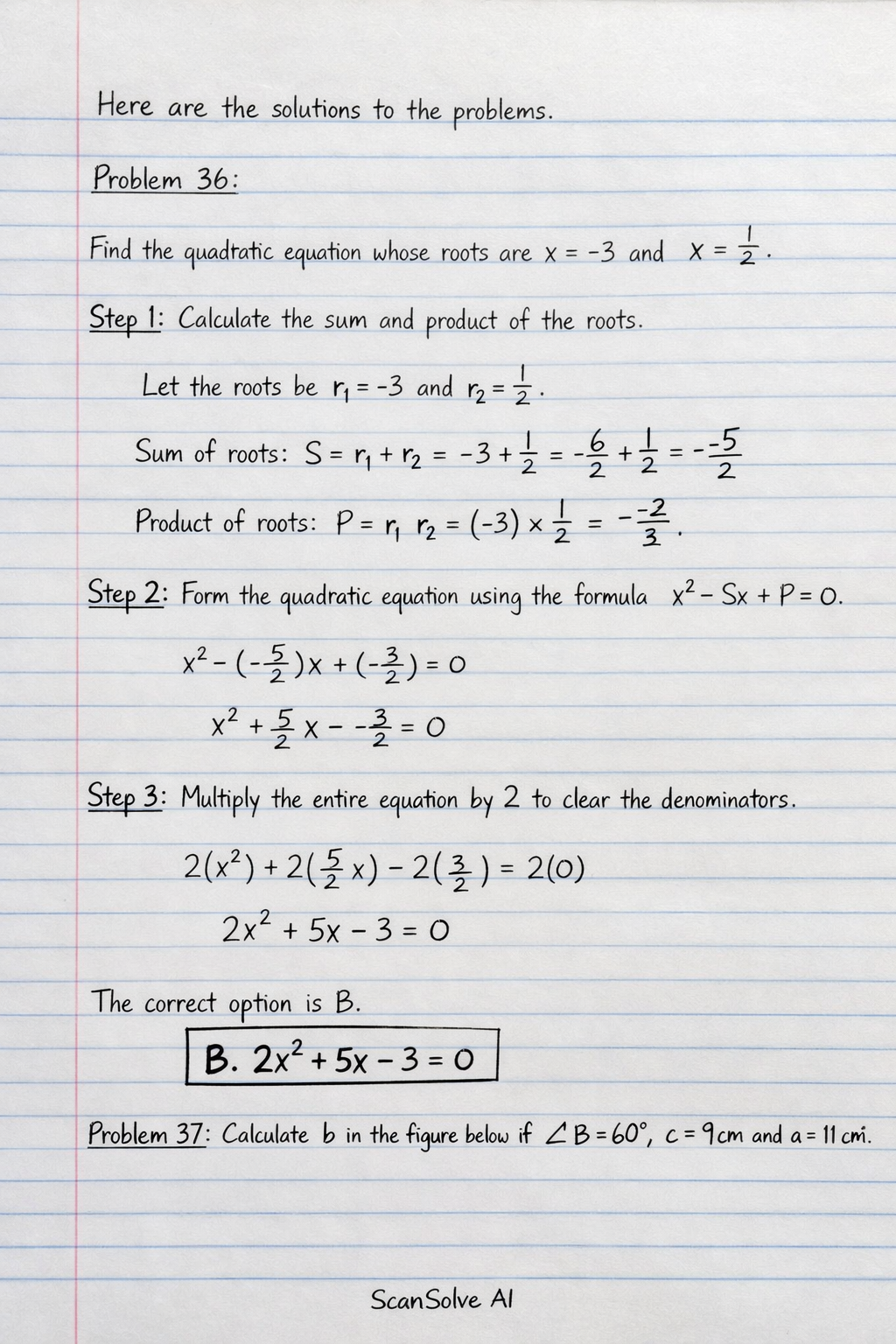
Handwritten Step-by-Step Solution
Get this as a handwritten image on WhatsApp — like a tutor wrote it for you.
Try on WhatsApp