

This mathematics problem involves applying core mathematical principles and formulas. Below you will find a complete step-by-step solution with detailed explanations for each step, helping you understand not just the answer but the method behind it.
ScanSolve AI Answer
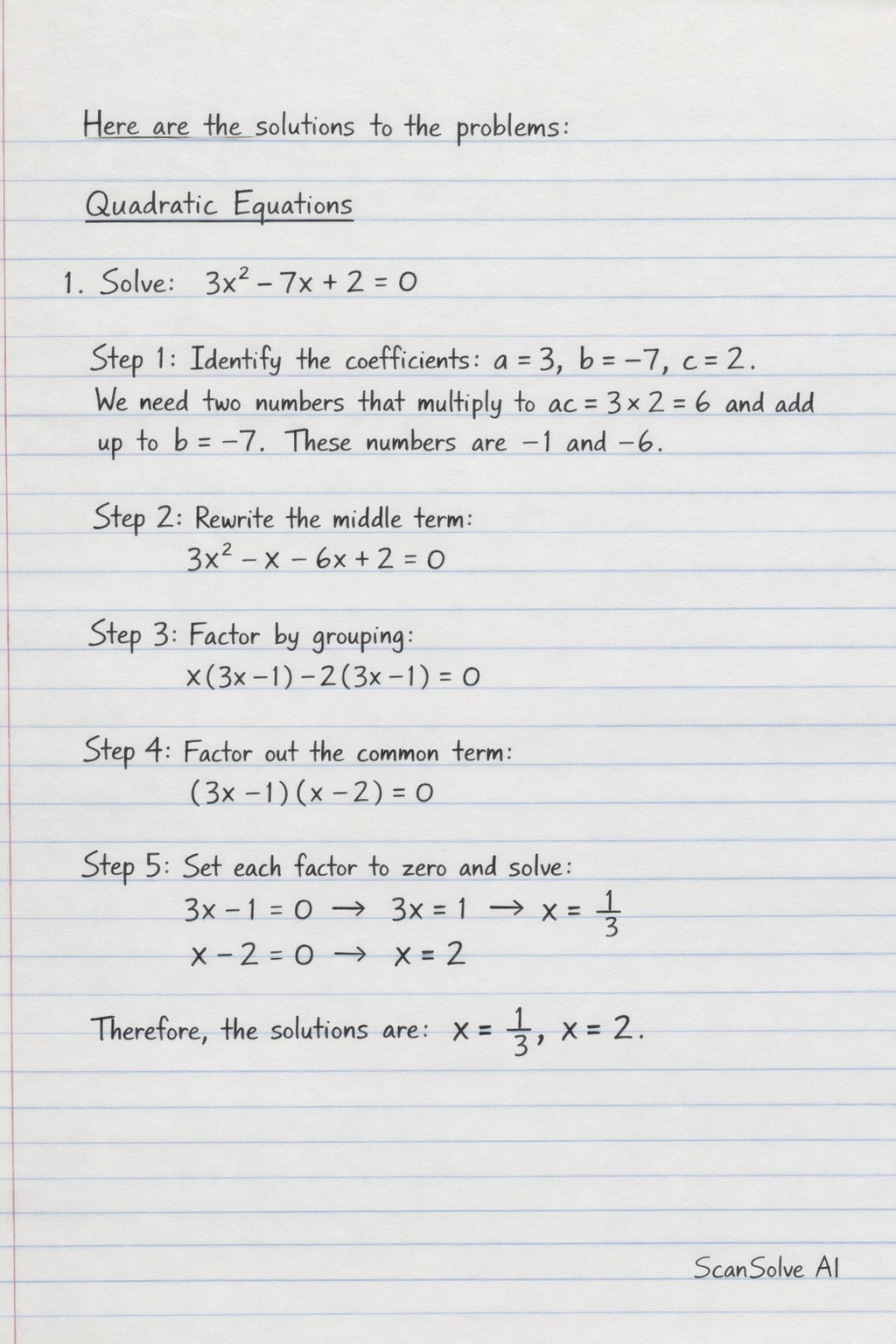
Here are the solutions to the problems: Quadratic Equations 1. Solve: 3x^2 - 7x + 2 = 0 Step 1: Identify the coefficients a=3, b=-7, c=2. We can solve this by factoring. We need two numbers that multiply to ac = 3 × 2 = 6 and add up to b = -7. These numbers are -1 and -6. Step 2: Rewrite the middle term using these numbers. 3x^2 - x - 6x + 2 = 0 Step 3: Factor by grouping. x(3x - 1) - 2(3x - 1) = 0 Step 4: Factor out the common term (3x - 1). (3x - 1)(x - 2) = 0 Step 5: Set each factor to zero and solve for x. 3x - 1 = 0 3x = 1 x = (1)/(3) x - 2 = 0 x = 2 The solutions are x = (1)/(3), x = 2. 2. Solve using completing the square: x^2 + 6x + 5 = 0 Step 1: Move the constant term to the right side of the equation. x^2 + 6x = -5 Step 2: To complete the square, take half of the coefficient of x (which is 6), square it, and add it to both sides. Half of 6 is 3, and 3^2 = 9. x^2 + 6x + 9 = -5 + 9 Step 3: Factor the left side as a perfect square and simplify the right side. (x + 3)^2 = 4 Step 4: Take the square root of both sides. Remember to include both positive and negative roots. x + 3 = ±sqrt(4) x + 3 = ± 2 Step 5: Solve for x for both positive and negative cases. x + 3 = 2 x = 2 - 3 x = -1 x + 3 = -2 x = -2 - 3 x = -5 The solutions are x = -1, x = -5. Surds and Indices 1. Simplify: sqrt(50) + 3sqrt(8) Step 1: Simplify each surd by finding the largest perfect square factor. sqrt(50) = sqrt(25 × 2) = sqrt(25) × sqrt(2) = 5sqrt(2) 3sqrt(8) = 3sqrt(4 × 2) = 3 × sqrt(4) × sqrt(2) = 3 × 2 × sqrt(2) = 6sqrt(2) Step 2: Add the simplified surds. 5sqrt(2) + 6sqrt(2) = (5 + 6)sqrt(2) = 11sqrt(2) The simplified expression is 11sqrt(2). 2. Simplify: (2^3 × 2^-5) Step 1: Use the rule of indices a^m × a^n = a^m+n. 2^3 × 2^-5 = 2^3 + (-5) Step 2: Perform the addition in the exponent. 2^3 - 5 = 2^-2 Step 3: Use the rule a^-n = (1)/(a^n) to express the result with a positive exponent. 2^-2 = (1)/(2^2) = (1)/(4) The simplified expression is (1)/(4). Logarithms 1. Simplify: _10(100) + _10(0.001) Step 1: Evaluate each logarithm separately. For _10(100): We ask, "To what power must 10 be raised to get 100?" 10^2 = 100 _10(100) = 2 For _10(0.001): We ask, "To what power must 10 be raised to get 0.001?" 0.001 = (1)/(1000) = (1)/(10^3) = 10^-3 _10(0.001) = -3 Step 2: Add the results. 2 + (-3) = 2 - 3 = -1 The simplified expression is -1. 2. Solve: _2(x) = 5 Step 1: Convert the logarithmic equation into its equivalent exponential form. The definition of a logarithm states that if _b(x) = y, then b^y = x. Here, b=2, y=5, and x is the unknown. x = 2^5 Step 2: Calculate the value of 2^5. 2^5 = 2 × 2 × 2 × 2 × 2 = 32 The solution is x = 32.