Solve quadratic equations i - ii using completing square method and iii - iv using factorization methods.
|Mathematics
Solve quadratic equations i - ii using completing square method and iii - iv using factorization methods.
ScanSolve AI Answer
Answer
2a−b±b2−4ac
let's solve these quadratic equations using the specified methods.
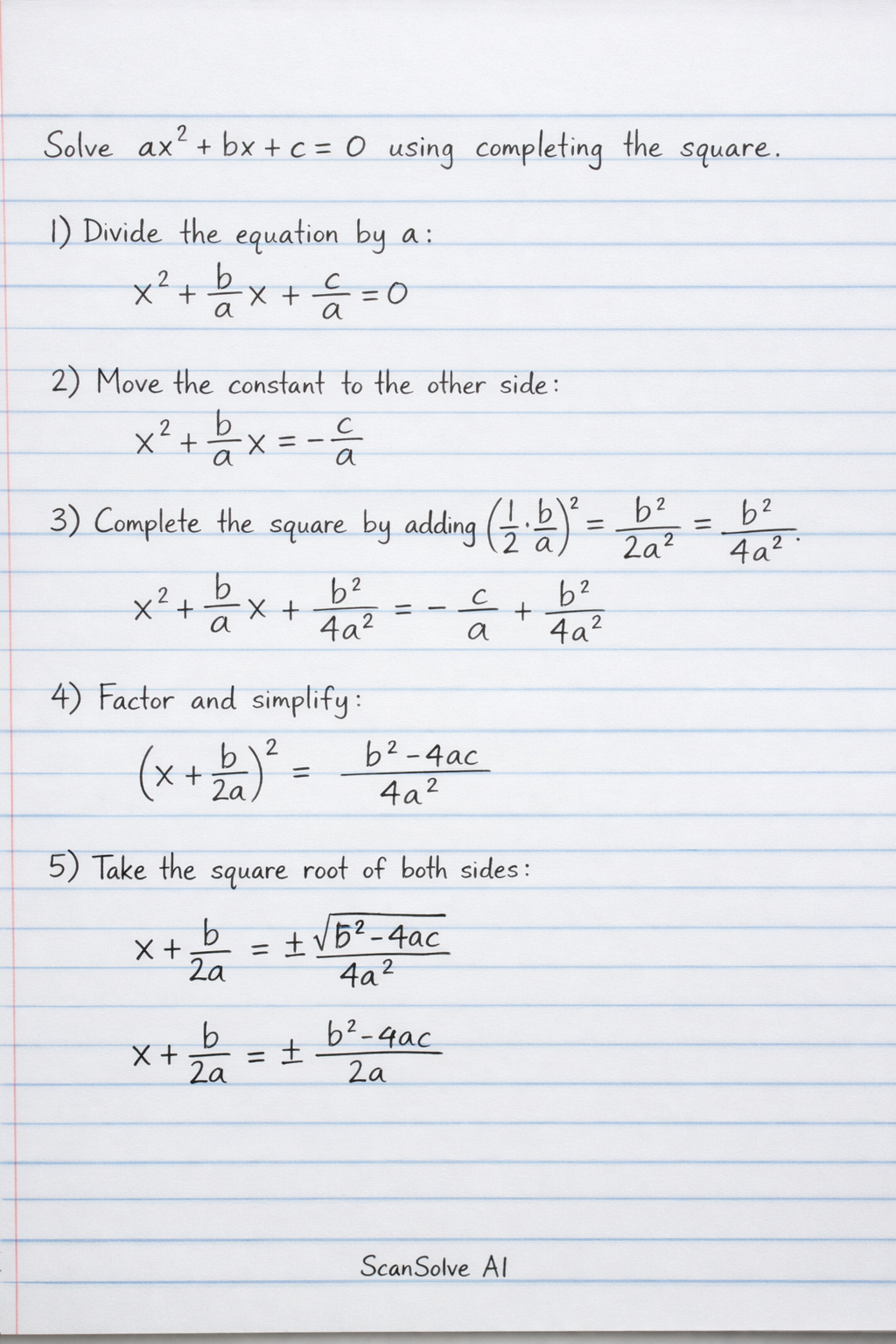
i) Solve ax2+bx+c=0 using the completing the square method.
Step 1: Divide the entire equation by a (assuming a=0).
x2+abx+ac=0
Step 2: Move the constant term to the right side of the equation.
x2+abx=−ac
Step 3: Complete the square on the left side. To do this, add (21⋅ab)2=(2ab)2=4a2b2 to both sides of the equation.
x2+abx+4a2b2=−ac+4a2b2
Step 4: Factor the left side as a perfect square and combine the terms on the right side.
(x+2ab)2=4a2b2−4ac
Step 5: Take the square root of both sides.
x+2ab=±4a2b2−4acx+2ab=±2ab2−4ac
Step 6: Isolate x to find the solutions.
x=−2ab±2ab2−4acx = \frac{-b \pm \sqrt{b^2 - 4ac}{2a}}
ii) Solve 4.6x2+3.5x−1.75=0 using the completing the square method.
Step 1: Divide the entire equation by 4.6.
x2+4.63.5x−4.61.75=0
To work with exact values, convert decimals to fractions: 4.6=523, 3.5=27, 1.75=47.
The equation becomes:
523x2+27x−47=0
Multiply by 20 to clear denominators:
92x2+70x−35=0
Now divide by 92:
x2+9270x−9235=0x2+4635x−9235=0
Step 2: Move the constant term to the right side.
x2+4635x=9235
Step 3: Complete the square. Add (21⋅4635)2=(9235)2=84641225 to both sides.
x2+4635x+84641225=9235+84641225(x+9235)2=92×9235×92+84641225(x+9235)2=84643220+84641225(x+9235)2=84644445
Step 4: Take the square root of both sides.
x+9235=±84644445x+9235=±924445
Step 5: Isolate x.
x=−9235±924445x=92−35±4445
Using 4445≈66.6708:
x1=92−35+66.6708=9231.6708≈0.3442x2=92−35−66.6708=92−101.6708≈−1.1051x = \frac{-35 \pm \sqrt{4445}{92} or approximately x_1 \approx 0.34, x_2 \approx -1.11}
iii) Solve 15x2+2x−8=0 using factorization.
Step 1: Find two numbers that multiply to ac=15×(−8)=−120 and add up to b=2.
The numbers are 12 and −10. (12×−10=−120 and 12+(−10)=2).
Step 2: Rewrite the middle term (2x) using these two numbers.
15x2+12x−10x−8=0
Step 3: Factor by grouping the terms.
(15x2+12x)−(10x+8)=03x(5x+4)−2(5x+4)=0
Step 4: Factor out the common binomial (5x+4).
(3x−2)(5x+4)=0
Step 5: Set each factor to zero and solve for x.
3x−2=0⇒3x=2⇒x=325x+4=0⇒5x=−4⇒x=−54x = \frac{2{3}, -\frac{4}{5}}
iv) Solve 4x2−25=0 using factorization.
Step 1: Recognize the equation as a difference of squares, a2−b2=(a−b)(a+b).
Here, a2=4x2, so a=4x2=2x.
And b2=25, so b=25=5.
Step 2: Apply the difference of squares formula.
(2x−5)(2x+5)=0
Step 3: Set each factor to zero and solve for x.
2x−5=0⇒2x=5⇒x=252x+5=0⇒2x=−5⇒x=−25x = \frac{5{2}, -\frac{5}{2}}
What's next?
Was this helpful?
Need help with your own homework?
Get instant step-by-step solutions to any question. Free to start.
This mathematics problem involves applying core mathematical principles and formulas. Below you will find a complete step-by-step solution with detailed explanations for each step, helping you understand not just the answer but the method behind it.
ScanSolve AI Answer
let's solve these quadratic equations using the specified methods. i) Solve ax^2 + bx + c = 0 using the completing the square method. Step 1: Divide the entire equation by a (assuming a ≠ 0). x^2 + (b)/(a)x + (c)/(a) = 0 Step 2: Move the constant term to the right side of the equation. x^2 + (b)/(a)x = -(c)/(a) Step 3: Complete the square on the left side. To do this, add ((1)/(2) · (b)/(a))^2 = ((b)/(2a))^2 = (b^2)/(4a^2) to both sides of the equation. x^2 + (b)/(a)x + (b^2)/(4a^2) = -(c)/(a) + (b^2)/(4a^2) Step 4: Factor the left side as a perfect square and combine the terms on the right side. (x + (b)/(2a))^2 = (b^2 - 4ac)/(4a^2) Step 5: Take the square root of both sides. x + (b)/(2a) = ±sqrt((b^2 - 4ac)/(4a^2)) x + (b)/(2a) = ±sqrt(b^2 - 4ac)2a Step 6: Isolate x to find the solutions. x = -(b)/(2a) ± sqrt(b^2 - 4ac)2a x = -b ± sqrt(b^2 - 4ac)2a ii) Solve 4.6x^2 + 3.5x - 1.75 = 0 using the completing the square method. Step 1: Divide the entire equation by 4.6. x^2 + (3.5)/(4.6)x - (1.75)/(4.6) = 0 To work with exact values, convert decimals to fractions: 4.6 = (23)/(5), 3.5 = (7)/(2), 1.75 = (7)/(4). The equation becomes: (23)/(5)x^2 + (7)/(2)x - (7)/(4) = 0 Multiply by 20 to clear denominators: 92x^2 + 70x - 35 = 0 Now divide by 92: x^2 + (70)/(92)x - (35)/(92) = 0 x^2 + (35)/(46)x - (35)/(92) = 0 Step 2: Move the constant term to the right side. x^2 + (35)/(46)x = (35)/(92) Step 3: Complete the square. Add ((1)/(2) · (35)/(46))^2 = ((35)/(92))^2 = (1225)/(8464) to both sides. x^2 + (35)/(46)x + (1225)/(8464) = (35)/(92) + (1225)/(8464) (x + (35)/(92))^2 = (35 × 92)/(92 × 92) + (1225)/(8464) (x + (35)/(92))^2 = (3220)/(8464) + (1225)/(8464) (x + (35)/(92))^2 = (4445)/(8464) Step 4: Take the square root of both sides. x + (35)/(92) = ±sqrt((4445)/(8464)) x + (35)/(92) = ±sqrt(4445)92 Step 5: Isolate x. x = -(35)/(92) ± sqrt(4445)92 x = -35 ± sqrt(4445)92 Using sqrt(4445) ≈ 66.6708: x_1 = (-35 + 66.6708)/(92) = (31.6708)/(92) ≈ 0.3442 x_2 = (-35 - 66.6708)/(92) = (-101.6708)/(92) ≈ -1.1051 x = -35 ± sqrt(4445)92 or approximately x_1 ≈ 0.34, x_2 ≈ -1.11 iii) Solve 15x^2 + 2x - 8 = 0 using factorization. Step 1: Find two numbers that multiply to ac = 15 × (-8) = -120 and add up to b = 2. The numbers are 12 and -10. (12 × -10 = -120 and 12 + (-10) = 2). Step 2: Rewrite the middle term (2x) using these two numbers. 15x^2 + 12x - 10x - 8 = 0 Step 3: Factor by grouping the terms. (15x^2 + 12x) - (10x + 8) = 0 3x(5x + 4) - 2(5x + 4) = 0 Step 4: Factor out the common binomial (5x+4). (3x - 2)(5x + 4) = 0 Step 5: Set each factor to zero and solve for x. 3x - 2 = 0 3x = 2 x = (2)/(3) 5x + 4 = 0 5x = -4 x = -(4)/(5) x = (2)/(3), -(4)/(5) iv) Solve 4x^2 - 25 = 0 using factorization. Step 1: Recognize the equation as a difference of squares, a^2 - b^2 = (a-b)(a+b). Here, a^2 = 4x^2, so a = sqrt(4x^2) = 2x. And b^2 = 25, so b = sqrt(25) = 5. Step 2: Apply the difference of squares formula. (2x - 5)(2x + 5) = 0 Step 3: Set each factor to zero and solve for x. 2x - 5 = 0 2x = 5 x = (5)/(2) 2x + 5 = 0 2x = -5 x = -(5)/(2) x = (5)/(2), -(5)/(2) What's next?