We read your photo as:

Question 16: a) Define P(A ∩ B) for independent events. b) Two cards are drawn without replacement. Find the probability both are face cards. c) Draw a tree diagram for face card probabilities.

Mathematics

ScanSolve AI Answer

This answer stops before the end.

It was cut off when it was first written. Ask ScanSolve this question again for the full working.

Here's the solution to question 16:

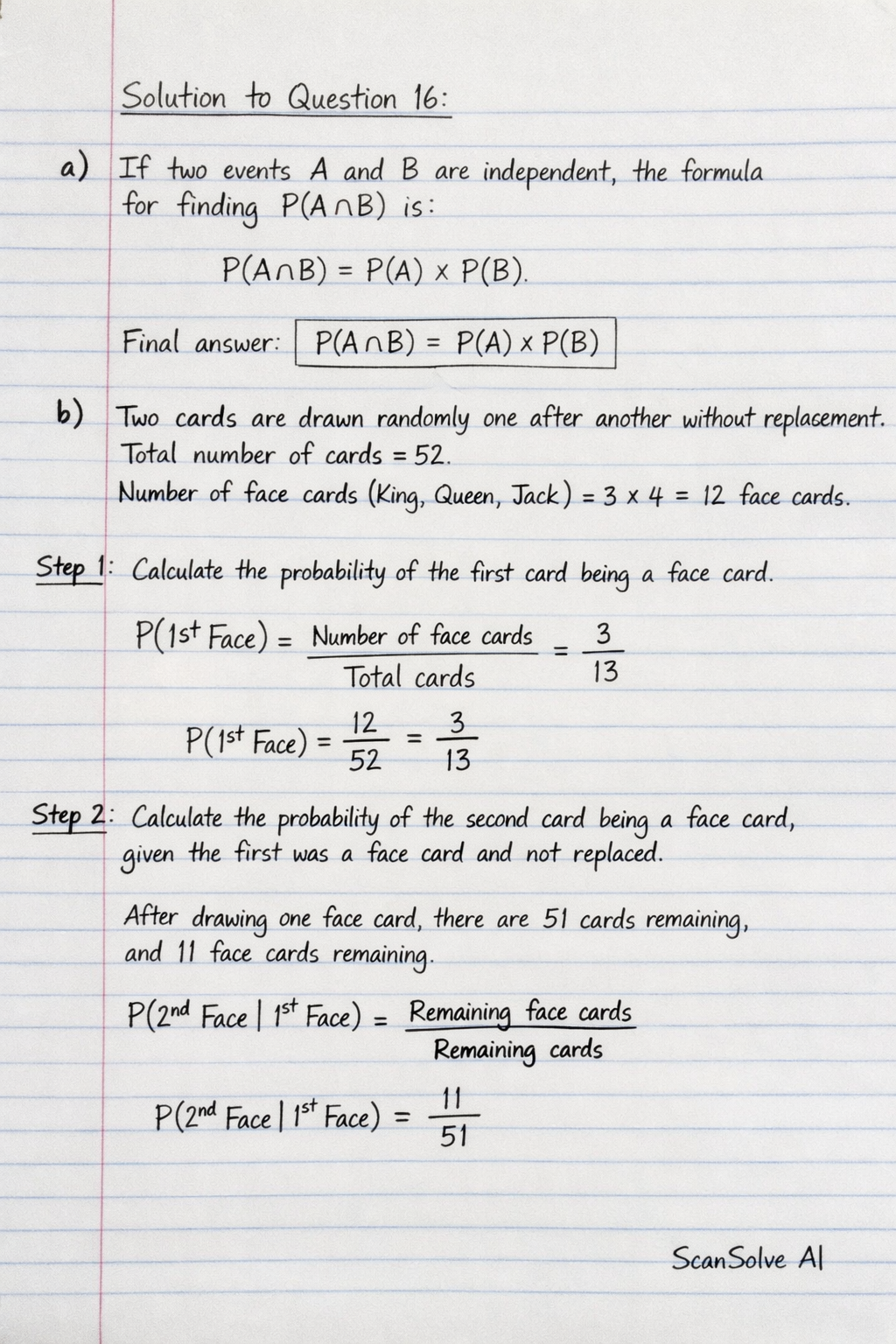
a) If two events AA and BB are independent events, the formula for finding P(A∩B)P(A \cap B) is:

P(A∩B)=P(A)×P(B)P(A \cap B) = P(A) \times P(B)

The final answer is P(A∩B)=P(A)×P(B)\boxed{P(A \cap B) = P(A) \times P(B)}.

b) Two cards are drawn randomly one after another without replacement.
Total number of cards = 52.
Number of face cards (King, Queen, Jack) = 3 cards/suit ×\times 4 suits = 12 face cards.

Step 1: Calculate the probability of the first card being a face card.

P(1st Face)=Number of face cardsTotal cards=1252=313P(\text{1st Face}) = \frac{\text{Number of face cards}}{\text{Total cards}} = \frac{12}{52} = \frac{3}{13}

Step 2: Calculate the probability of the second card being a face card, given the first was a face card and not replaced.
After drawing one face card, there are 51 cards remaining, and 11 face cards remaining.

P(2nd Face | 1st Face)=Remaining face cardsRemaining cards=1151P(\text{2nd Face | 1st Face}) = \frac{\text{Remaining face cards}}{\text{Remaining cards}} = \frac{11}{51}

Step 3: Calculate the probability of both cards being face cards.

P(Both Face)=P(1st Face)×P(2nd Face | 1st Face)P(\text{Both Face}) = P(\text{1st Face}) \times P(\text{2nd Face | 1st Face}) P(Both Face)=1252×1151=313×1151=33663=11221P(\text{Both Face}) = \frac{12}{52} \times \frac{11}{51} = \frac{3}{13} \times \frac{11}{51} = \frac{33}{663} = \frac{11}{221}

The final answer is 11221\boxed{\frac{11}{221}}.

c) Show the probability of all the possible outcomes of getting or not-getting a face card in a tree diagram (without replacement).

Let FF be the event of getting a face card.
Let F′F' be the event of not getting a face card.
Number of face cards = 12.
Number of non-face cards = 52−12=4052 - 12 = 40.

Tree Diagram:

First Draw:

  • Probability of getting a face card (F1F_1): P(F1)=1252=313P(F_1) = \frac{12}{52} = \frac{3}{13}
  • Probability of not getting a face card (F1′F'_1): P(F1′)=4052=1013P(F'_1) = \frac{40}{52} = \frac{10}{13}

Second Draw (without replacement):

  • If the first card was a face card (F1F_1):

    • Remaining cards = 51
    • Remaining face cards = 11
    • Remaining non-face cards = 40
    • Probability of getting a face card (F2∣F1F_2 | F_1): P(F2∣F1)=1151P(F_2 | F_1) = \frac{11}{51}
    • Probability of not getting a face card (F2′∣F1F'_2 | F_1): P(F2′∣F1)=4051P(F'_2 | F_1) = \frac{40}{51}
  • If the first card was not a face card (F1′F'_1):

    • Remaining cards = 51
    • Remaining face cards = 12
    • Remaining non-face cards = 39
    • Probability of getting a face card (F2∣F1′F_2 | F'_1): P(F2∣F1′)=1251=417P(F_2 | F'_1) = \frac{12}{51} = \frac{4}{17}
    • Probability of not getting a face card (F2′∣F1′F'_2 | F'_1): P(F2′∣F1′)=3951=1317P(F'_2 | F'_1) = \frac{39}{51} = \frac{13}{17}

Possible Outcomes and their Probabilities:

  1. Both Face Cards (F1F_1 and F2F_2):

    P(F1∩F2)=P(F1)×P(F2∣F1)=1252×1151=313×1151=11221P(F_1 \cap F_2) = P(F_1) \times P(F_2 | F_1) = \frac{12}{52} \times \frac{11}{51} = \frac{3}{13} \times \frac{11}{51} = \frac{11}{221}
  2. First Face, Second Not Face (F1F_1 and F2′F'_2):

    P(F1∩F2′)=P(F1)×P(F2′∣F1)=1252×4051=313×4051=40221P(F_1 \cap F'_2) = P(F_1) \times P(F'_2 | F_1) = \frac{12}{52} \times \frac{40}{51} = \frac{3}{13} \times \frac{40}{51} = \frac{40}{221}
  3. First Not Face, Second Face (F1′F'_1 and F2F_2):

    P(F1′∩F2)=P(F1′)×P(F2∣F1′)=4052×1251=1013×1251=40221P(F'_1 \cap F_2) = P(F'_1) \times P(F_2 | F'_1) = \frac{40}{52} \times \frac{12}{51} = \frac{10}{13} \times \frac{12}{51} = \frac{40}{221}
  4. Both Not Face Cards (F1′F'_1 and F2′F'_2):

    P(F1′∩F2′)=P(F1′)×P(F2′∣F1′)=4052×3951=1013×3951=130221P(F'_1 \cap F'_2) = P(F'_1) \times P(F'_2 | F'_1) = \frac{40}{52} \times \frac{39}{51} = \frac{10}{13} \times \frac{39}{51} = \frac{130}{221}

The tree diagram visually represents these branches and their associated probabilities.

d) If two cards are drawn randomly one after another with replacement.

Step 1: Calculate the probability that both cards are face cards (with replacement).
Number of face cards = 12.

P(Both Face, with replacement)=P(1st Face)×P(2nd Face)P(\text{Both Face, with replacement}) = P(\text{1st Face}) \times P(\text{2nd Face}) P(Both Face, with replacement)=1252×1252=313×313=9169P(\text{Both Face, with replacement}) = \frac{12}{52} \times \frac{12}{52} = \frac{3}{13} \times \frac{3}{13} = \frac{9}{169}

Step 2: Calculate the probability that both cards are ace (with replacement).
Number of ace cards = 4.

P(Both Ace, with replacement)=P(1st Ace)×P(2nd Ace)P(\text{Both Ace, with replacement}) = P(\text{1st Ace}) \times P(\text{2nd Ace}) P(Both Ace, with replacement)=452×452=113×113=1169P(\text{Both Ace, with replacement}) = \frac{4}{52} \times \frac{4}{52} = \frac{1}{13} \times \frac{1}{13} = \frac{1}{169}

Step 3: Determine how many times more is the probability that both are face cards than the probability that both cards are ace.

Was this helpful?

Still stuck on this one?

Ask a follow-up, and the answer starts from this question.

Got a different question?Ask your own question
Handwritten step-by-step solution preview

Handwritten Step-by-Step Solution

Get this as a handwritten image on WhatsApp — like a tutor wrote it for you.

Try on WhatsApp