We read your photo as:

QUESTION 3: Solve for a and b in the equations below: a + 3/b = 4 a - 12/b = -3

Mathematics

ScanSolve AI Answer

Step-by-step solution

19 steps

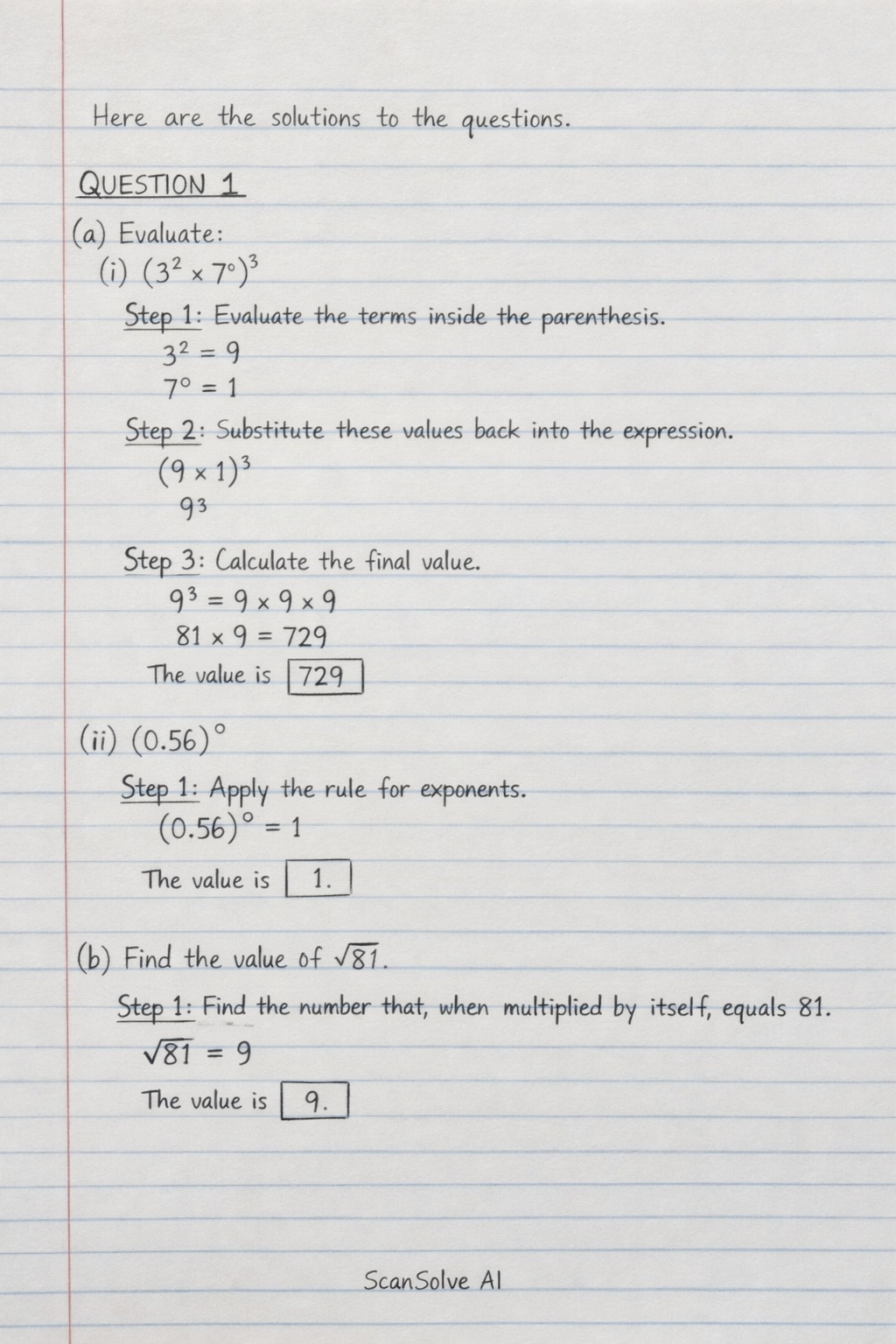
Here are the solutions to the questions.

QUESTION 1

a) Evaluate:

(i) (32×70)3(3^2 \times 7^0)^3

  1. Evaluate the terms inside the parenthesis.

    Recall that any non-zero number raised to the power of 0 is 1. So, 70=17^0 = 1.

    32=93^2 = 9 70=17^0 = 1
  2. Substitute these values back into the expression.

    (9×1)3(9 \times 1)^3 939^3
  3. Calculate the final value.

    93=9×9×9=81×9=7299^3 = 9 \times 9 \times 9 = 81 \times 9 = 729

    The value is 729\boxed{\text{729}}.

    (ii) (0.56)0(0.56)^0

  4. Apply the rule for exponents.

    Any non-zero number raised to the power of 0 is 1.

    (0.56)0=1(0.56)^0 = 1

    The value is 1\boxed{\text{1}}.

    b) Find the value of 81\sqrt{81}

  5. Find the number that, when multiplied by itself, equals 81.

    81=9\sqrt{81} = 9

    The value is 9\boxed{\text{9}}.

    c) Express 0.00698 in standard form.

  6. Move the decimal point to the right until the number is between 1 and 10.

    The number becomes 6.98.

  7. Count how many places the decimal point was moved.

    The decimal point was moved 3 places to the right.

  8. Write the number in standard form (A×10nA \times 10^n).

    Since the decimal was moved to the right, the exponent nn is negative.

    0.00698=6.98×10−30.00698 = 6.98 \times 10^{-3}

    The standard form is 6.98×10⁻³\boxed{6.98 \times 10^{-3}}.

    QUESTION 2

    a) Derive the quadratic formula by completing the square method, given an equation ax2+bx+c=0ax^2 + bx + c = 0, where a,ba, b and cc are constants.

  9. Start with the general quadratic equation and divide by aa (assuming a≠0a \neq 0).

    ax2+bx+c=0ax^2 + bx + c = 0 x2+bax+ca=0x^2 + \frac{b}{a}x + \frac{c}{a} = 0
  10. Move the constant term to the right side of the equation.

    x2+bax=−cax^2 + \frac{b}{a}x = -\frac{c}{a}
  11. Complete the square on the left side by adding (b2a)2(\frac{b}{2a})^2 to both sides.

    x2+bax+(b2a)2=−ca+(b2a)2x^2 + \frac{b}{a}x + \left(\frac{b}{2a}\right)^2 = -\frac{c}{a} + \left(\frac{b}{2a}\right)^2
  12. Factor the left side as a perfect square and simplify the right side.

    (x+b2a)2=−ca+b24a2\left(x + \frac{b}{2a}\right)^2 = -\frac{c}{a} + \frac{b^2}{4a^2}

    To combine the terms on the right, find a common denominator:

    (x+b2a)2=−4ac4a2+b24a2\left(x + \frac{b}{2a}\right)^2 = -\frac{4ac}{4a^2} + \frac{b^2}{4a^2} (x+b2a)2=b2−4ac4a2\left(x + \frac{b}{2a}\right)^2 = \frac{b^2 - 4ac}{4a^2}
  13. Take the square root of both sides.

    x+b2a=±b2−4ac4a2x + \frac{b}{2a} = \pm\sqrt{\frac{b^2 - 4ac}{4a^2}} x+b2a=±b2−4ac4a2x + \frac{b}{2a} = \pm\frac{\sqrt{b^2 - 4ac}}{\sqrt{4a^2}} x+b2a=±b2−4ac2ax + \frac{b}{2a} = \pm\frac{\sqrt{b^2 - 4ac}}{2a}
  14. Isolate xx to obtain the quadratic formula.

    x=−b2a±b2−4ac2ax = -\frac{b}{2a} \pm \frac{\sqrt{b^2 - 4ac}}{2a} x=−b±b2−4ac2ax = \frac{-b \pm \sqrt{b^2 - 4ac}}{2a}

    The quadratic formula is x=−b±b2−4ac2a\boxed{x = \frac{-b \pm \sqrt{b^2 - 4ac}}{2a}}.

    b) Solve for aa and bb in the equations below:

    9a+12b=−3(1)\frac{9}{a} + \frac{12}{b} = -3 \quad (1) 3a+6b=4(2)\frac{3}{a} + \frac{6}{b} = 4 \quad (2)
  15. Let x=1ax = \frac{1}{a} and y=1by = \frac{1}{b} to transform the system into linear equations.

    9x+12y=−3(1′)9x + 12y = -3 \quad (1') 3x+6y=4(2′)3x + 6y = 4 \quad (2')
  16. Use the elimination method to solve for xx and yy.

    Multiply equation (2') by 3 to make the coefficients of xx equal.

    3×(3x+6y)=3×43 \times (3x + 6y) = 3 \times 4 9x+18y=12(3′)9x + 18y = 12 \quad (3')
  17. Subtract equation (1') from equation (3').

    (9x+18y)−(9x+12y)=12−(−3)(9x + 18y) - (9x + 12y) = 12 - (-3) 6y=156y = 15 y=156y = \frac{15}{6} y=52y = \frac{5}{2}
  18. Substitute the value of yy into equation (2') to solve for xx.

    3x+6(52)=43x + 6\left(\frac{5}{2}\right) = 4 3x+3×5=43x + 3 \times 5 = 4 3x+15=43x + 15 = 4 3x=4−153x = 4 - 15 3x=−113x = -11 x=−113x = -\frac{11}{3}
  19. Convert back to aa and bb using a=1xa = \frac{1}{x} and b=1yb = \frac{1}{y}.

    a=1−113=−311a = \frac{1}{-\frac{11}{3}} = -\frac{3}{11} b=152=25b = \frac{1}{\frac{5}{2}} = \frac{2}{5}

    The values are a=−311,b=25\boxed{a = -\frac{3}{11}, b = \frac{2}{5}}.

Was this helpful?

Still stuck on this one?

Ask a follow-up, and the answer starts from this question.

Got a different question?Ask your own question
Handwritten step-by-step solution preview

Handwritten Step-by-Step Solution

Get this as a handwritten image on WhatsApp — like a tutor wrote it for you.

Try on WhatsApp