
We read your photo as:
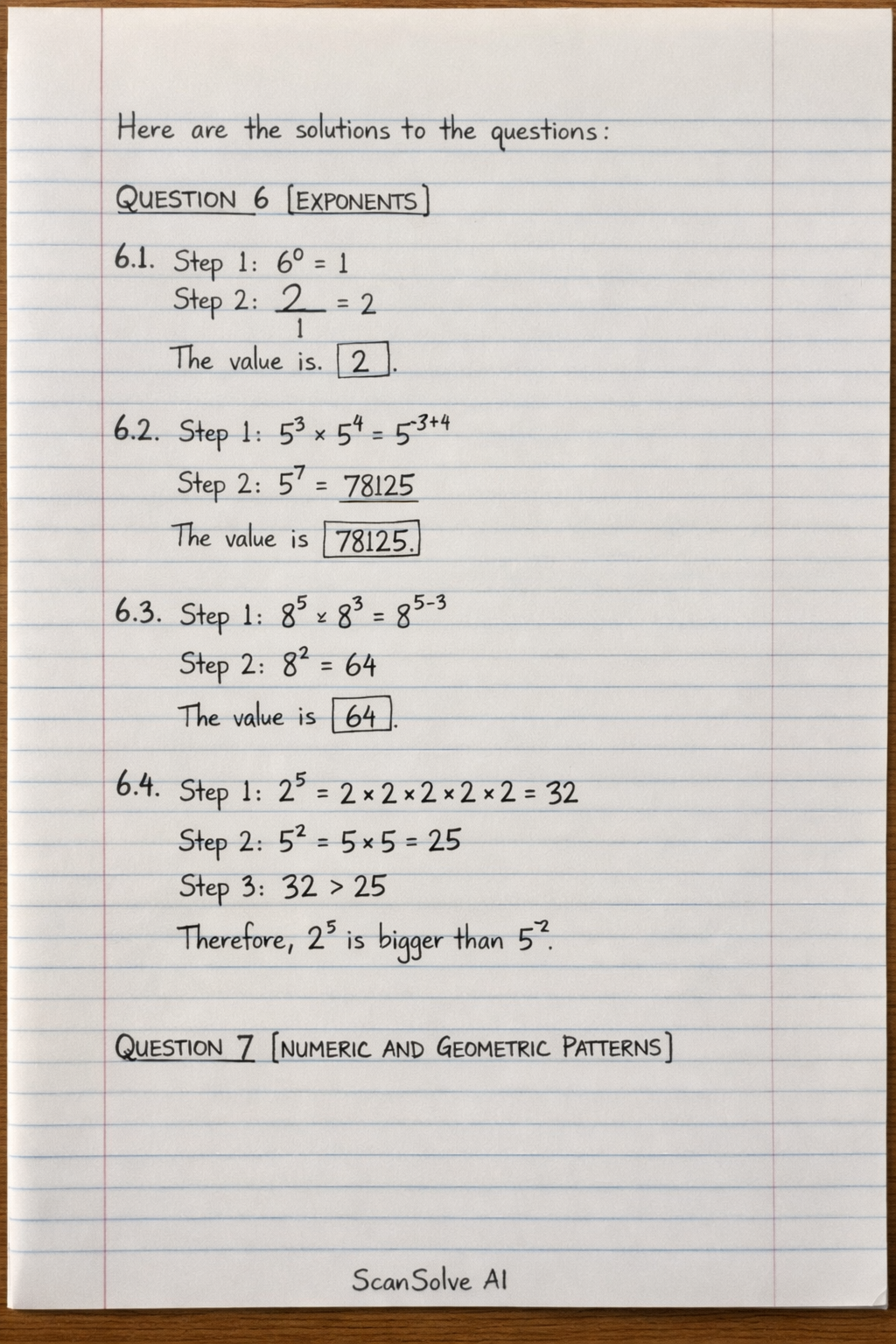
QUESTION 6 [EXPONENTS] Calculate the values of the following: 6.1 2/60, 6.2 53 x 54, 6.3 85 + 83, 6.4 Show by means of calculations that 25 is bigger than 52.
ScanSolve AI Answer
Step-by-step solution
17 stepsHere are the solutions to the questions:
QUESTION 6 [EXPONENTS]
6.1.
Evaluate the term with the exponent.
Any non-zero number raised to the power of 0 is 1.
Substitute this value back into the expression and simplify.
The value is .
6.2.
Apply the rule for multiplying exponents with the same base
.
Add the exponents and calculate the final value.
The value is .
6.3.
Apply the rule for dividing exponents with the same base
.
Subtract the exponents and calculate the final value.
The value is .
6.4.
Calculate the value of .
Calculate the value of .
Compare the two values.
Therefore, is bigger than .
QUESTION 7 [NUMERIC AND GEOMETRIC PATTERNS]
7.1.1.
Find the common difference between consecutive terms.
Add the common difference to the last given term to find the next term.
The next term is .
7.1.2.
Identify the first term () and the common difference ().
Use the general formula for an arithmetic sequence, .
Simplify the expression to find the general rule.
The general rule is .
7.1.3.
Use the general rule found in 7.1.2.
Substitute into the rule to find the 50th term.
Perform the multiplication and subtraction.
The 50th term is .
Still stuck on this one?
Ask a follow-up, and the answer starts from this question.
More Mathematics Questions
Handwritten Step-by-Step Solution
Get this as a handwritten image on WhatsApp — like a tutor wrote it for you.
Try on WhatsApp