Here are the solutions to the trigonometric equations.
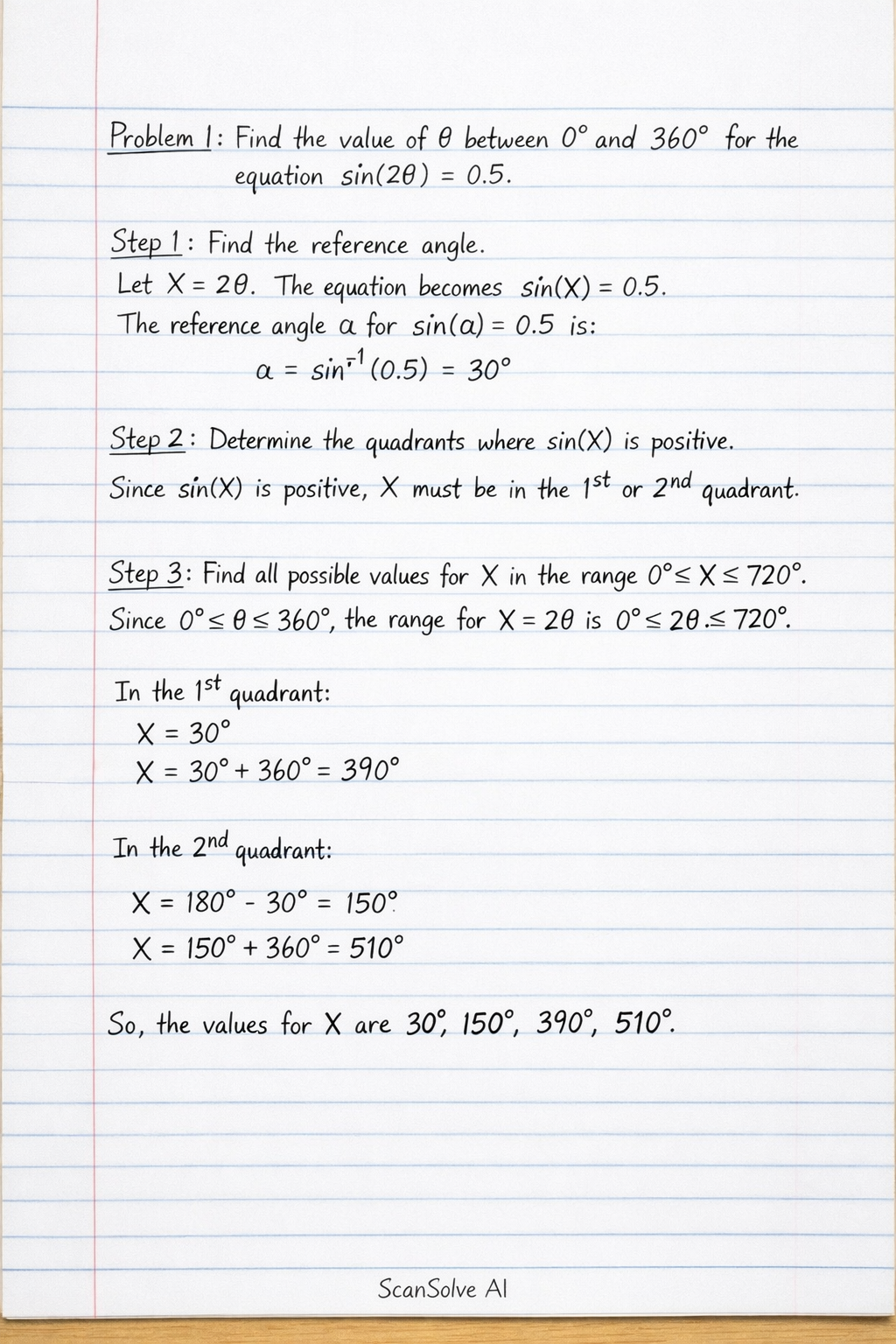
: Find the value of θ between 0∘ and 360∘ for the equation sin(2θ)=0.5.
Step 1: Find the reference angle.
Let X=2θ. The equation becomes sin(X)=0.5.
The reference angle α for sin(α)=0.5 is:
α=sin−1(0.5)=30∘
Step 2: Determine the quadrants where sin(X) is positive.
Since sin(X) is positive, X must be in the 1st or 2nd quadrant.
Step 3: Find all possible values for X in the range 0∘≤X≤720∘.
Since 0∘≤θ≤360∘, the range for X=2θ is 0∘≤2θ≤720∘.
In the 1st quadrant:
X=30∘X=30∘+360∘=390∘
In the 2nd quadrant:
X=180∘−30∘=150∘X=150∘+360∘=510∘
So, the values for X are 30∘,150∘,390∘,510∘.
Step 4: Solve for θ.
Substitute X=2θ and divide by 2:
2θ=30∘⟹θ=230∘=15∘2θ=150∘⟹θ=2150∘=75∘2θ=390∘⟹θ=2390∘=195∘2θ=510∘⟹θ=2510∘=255∘
All these values are within the range 0∘≤θ≤360∘.
The values of θ are 15∘,75∘,195∘,255∘.
: Find the value of θ to the nearest degree for cos(3θ+20∘)=23 where 0∘≤θ≤360∘.
Step 1: Find the reference angle.
Let Y=3θ+20∘. The equation becomes cos(Y)=23.
The reference angle α for cos(α)=23 is:
α=cos−1(23)=30∘
Step 2: Determine the quadrants where cos(Y) is positive.
Since cos(Y) is positive, Y must be in the 1st or 4th quadrant.
Step 3: Determine the range for Y.
Given 0∘≤θ≤360∘:
Multiply by 3: 0∘≤3θ≤1080∘
Add 20∘: 0∘+20∘≤3θ+20∘≤1080∘+20∘
So, 20∘≤Y≤1100∘.
Step 4: Find all possible values for Y in the range 20∘≤Y≤1100∘.
In the 1st quadrant:
Y=30∘Y=30∘+360∘=390∘Y=30∘+720∘=750∘
In the 4th quadrant:
Y=360∘−30∘=330∘Y=330∘+360∘=690∘Y=330∘+720∘=1050∘
The next values (30∘+1080∘=1110∘ and 330∘+1080∘=1410∘) are outside the range Y≤1100∘.
So, the values for Y are 30∘,330∘,390∘,690∘,750∘,1050∘.
Step 5: Solve for θ and round to the nearest degree.
Substitute Y=3θ+20∘:
3θ+20∘=30∘⟹3θ=10∘⟹θ=310∘≈3.33∘≈3∘3θ+20∘=330∘⟹3θ=310∘⟹θ=3310∘≈103.33∘≈103∘3θ+20∘=390∘⟹3θ=370∘⟹θ=3370∘≈123.33∘≈123∘3θ+20∘=690∘⟹3θ=670∘⟹θ=3670∘≈223.33∘≈223∘3θ+20∘=750∘⟹3θ=730∘⟹θ=3730∘≈243.33∘≈243∘
Was this helpful?
Need help with your own homework?
Get instant step-by-step solutions to any question. Free to start.
This mathematics problem involves applying core mathematical principles and formulas. Below you will find a complete step-by-step solution with detailed explanations for each step, helping you understand not just the answer but the method behind it.
ScanSolve AI Answer
Here are the solutions to the trigonometric equations. Problem 1: Find the value of between 0^ and 360^ for the equation (2) = 0.5. Step 1: Find the reference angle. Let X = 2. The equation becomes (X) = 0.5. The reference angle for () = 0.5 is: = ^-1(0.5) = 30^ Step 2: Determine the quadrants where (X) is positive. Since (X) is positive, X must be in the 1st or 2nd quadrant. Step 3: Find all possible values for X in the range 0^ X 720^. Since 0^ 360^, the range for X = 2 is 0^ 2 720^. In the 1st quadrant: X = 30^ X = 30^ + 360^ = 390^ In the 2nd quadrant: X = 180^ - 30^ = 150^ X = 150^ + 360^ = 510^ So, the values for X are 30^, 150^, 390^, 510^. Step 4: Solve for . Substitute X = 2 and divide by 2: 2 = 30^ = (30^)/(2) = 15^ 2 = 150^ = (150^)/(2) = 75^ 2 = 390^ = (390^)/(2) = 195^ 2 = 510^ = (510^)/(2) = 255^ All these values are within the range 0^ 360^. The values of are 15^, 75^, 195^, 255^. Problem 2: Find the value of to the nearest degree for (3 + 20^) = sqrt(3)2 where 0^ 360^. Step 1: Find the reference angle. Let Y = 3 + 20^. The equation becomes (Y) = sqrt(3)2. The reference angle for () = sqrt(3)2 is: = ^-1(sqrt(3)2) = 30^ Step 2: Determine the quadrants where (Y) is positive. Since (Y) is positive, Y must be in the 1st or 4th quadrant. Step 3: Determine the range for Y. Given 0^ 360^: Multiply by 3: 0^ 3 1080^ Add 20^: 0^ + 20^ 3 + 20^ 1080^ + 20^ So, 20^ Y 1100^. Step 4: Find all possible values for Y in the range 20^ Y 1100^. In the 1st quadrant: Y = 30^ Y = 30^ + 360^ = 390^ Y = 30^ + 720^ = 750^ In the 4th quadrant: Y = 360^ - 30^ = 330^ Y = 330^ + 360^ = 690^ Y = 330^ + 720^ = 1050^ The next values (30^ + 1080^ = 1110^ and 330^ + 1080^ = 1410^) are outside the range Y 1100^. So, the values for Y are 30^, 330^, 390^, 690^, 750^, 1050^. Step 5: Solve for and round to the nearest degree. Substitute Y = 3 + 20^: 3 + 20^ = 30^ 3 = 10^ = (10^)/(3) ≈ 3.33^ ≈ 3^ 3 + 20^ = 330^ 3 = 310^ = (310^)/(3) ≈ 103.33^ ≈ 103^ 3 + 20^ = 390^ 3 = 370^ = (370^)/(3) ≈ 123.33^ ≈ 123^ 3 + 20^ = 690^ 3 = 670^ = (670^)/(3) ≈ 223.33^ ≈ 223^ 3 + 20^ = 750^ 3 = 730^ = (730^)/(3) ≈ 243.33^ ≈ 243^ 3 + 20^ = 1050^ 3 = 1030^ = 1030^