
We read your photo as:
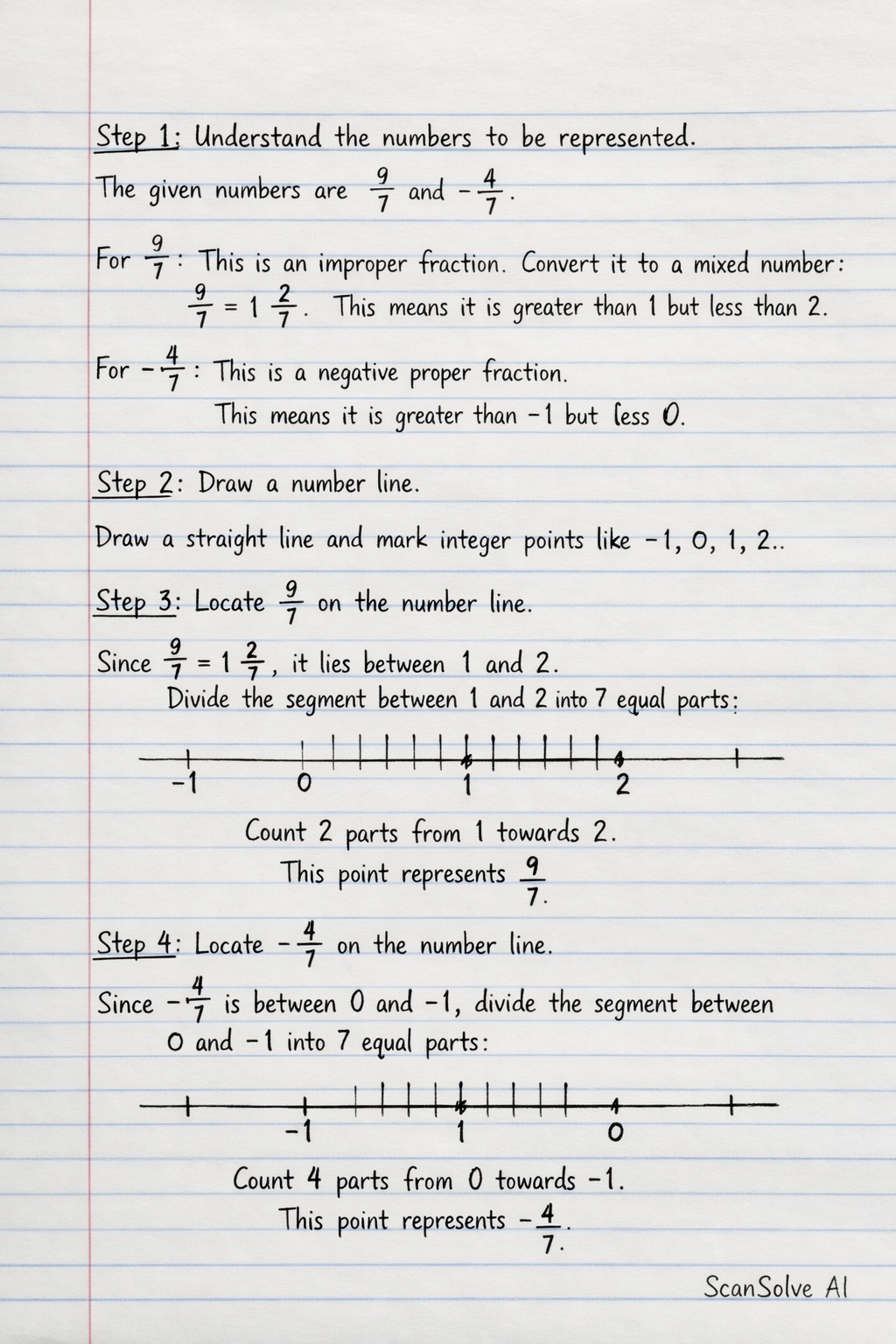
Represent the fractions 9/7 and -4/7 on a number line.
ScanSolve AI Answer
Step-by-step solution
4 stepsUnderstand the numbers to be represented.
The given numbers are and .
To represent these on a number line, it's helpful to understand their values relative to integers.
For : This is an improper fraction. Convert it to a mixed number: . This means it is greater than 1 but less than 2.
For : This is a negative proper fraction. This means it is greater than -1 but less than 0.Draw a number line.
Draw a straight line and mark integer points like -1, 0, 1, 2.
Locate on the number line.
Since , it lies between 1 and 2. Divide the segment between 1 and 2 into 7 equal parts. Count 2 parts from 1 towards 2. This point represents .
Locate on the number line.
Since is between 0 and -1, divide the segment between 0 and -1 into 7 equal parts. Count 4 parts from 0 towards -1. This point represents .
Here is the representation on a number line:
\text{
    \begin{tikzpicture}
    \draw[<->] (-2.5,0) -- (2.5,0);
    \foreach \x in {-2,-1,0,1,2}
        \draw (\x,0.1) -- (\x,-0.1) node[below] {$\x$};

    % Mark 9/7
    \draw[fill=black] (1+2/7,0) circle (1.5pt) node[above] {$\frac{9}{7}$};

    % Mark -4/7
    \draw[fill=black] (-4/7,0) circle (1.5pt) node[above] {$-\frac{4}{7}$};
    \end{tikzpicture}
}
The numbers and are distinct and are represented at different positions on the number line.
Still stuck on this one?
Ask a follow-up, and the answer starts from this question.
More Mathematics Questions
Handwritten Step-by-Step Solution
Get this as a handwritten image on WhatsApp — like a tutor wrote it for you.
Try on WhatsApp